admin
admin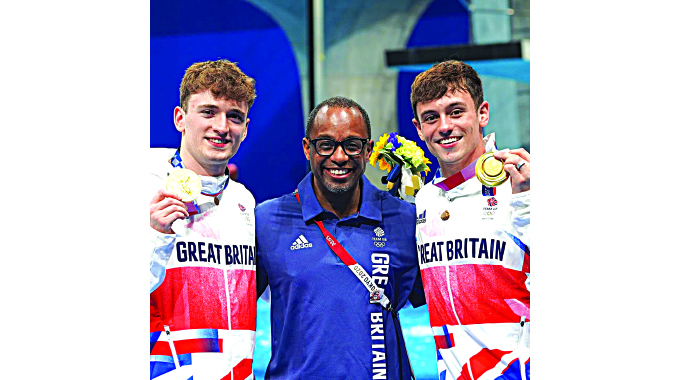
ZimbabweAN-born Gareth Ziyambi, made the headlines at last month’s Olympic Games in Tokyo where he worked behind the scenes as a specialist Sport and Performance Physiotherapist for the British Diving team. The 47-year-old, who is now based in England, returned home recently to take a break and reflect on the exploits which led to Olympic gold medal success with athletes Matty Lee and Tom Daley. Ziyambi speaks to our Senior Sports Reporter, Eddie Chikamhi, about the journey he has travelled so far.
Q. Who is Gareth Ziyambi?
A: I was born in Bulawayo, the son of the late nationalist and former Minister Tarisai Ziyambi, and the now retired Supreme Court Judge Vernanda Ziyambi. Although born in Bulawayo, I grew up in Harare.
Q. Which schools did you attend? Were you into sports at school?
A: I went to St Michael’s School, followed by Hartmann House, and then St George’s College in Harare. I was a keen sportsman then and played a number of sports but excelled in athletics, 400 and 800m and also hockey, where I represented Zimbabwe at Under-18 level. I also represented the school, in cross-country, cricket, and to a lesser extent swimming.
Q. How did it all start for you in the field of physiotherapy?
A: I actually planned to study Medicine and, because I came from a family of lawyers, I thought also about doing law. At the time though, there was only one medical school and the entry requirements were very high so I was offered alternative degree programmes of which physiotherapy was one. It was something I had never heard of at that time but I was able to seek advice from renowned physiotherapists, Pastor Langton Gatsi, and then at a later stage Mrs. Dorcas Madzivire, who was instrumental in getting me into the degree programme. After qualifying, I did my internship at the Sally Mugabe Central Hospital in 1998 and then I moved into private practice in Harare before setting up my own private practice in Bulawayo, for three years, in 2001.
Q. Can you explain how you made the breakthrough into elite sport?
A: I started working with the national hockey teams in 1998. My big break came when I was offered the opportunity to work with the Davis Cup Tennis team in 2000. It was my first chance to work with world-level athletes and I learned hugely from Byron and Wayne Black and Kevin Ullyett. Kevin was also kind enough to donate a portable physiotherapy table for me to use, which we struggled to get locally, at the time.
Q. How did you end up with the British diving team? Who else have you worked with besides the diving team?
A: I joined the English Institute of Sport in 2006 and was based in Sheffield. This is an organisation that employs sports medicine and sport science staff to work with the national teams in the UK. The idea is to concentrate the best in those fields and have them share and collaborate in their work with the sports. One of the sports I worked with initially was diving. But, my role also encompassed sports that had athletes based at my centre like Boxing, Athletics, Table Tennis, Badminton, Volleyball and Handball. I left after four years to work with British Diving, initially as a consultant, and then as the head physiotherapist for five years. For the last four years, I split my time between A2Z, and the elite divers based in London.
Q. What was the Tokyo 2020 experience like for you?
A: Tokyo was my fifth Olympic Games, having attended Athens 2004 & Beijing 2008, with Team Zimbabwe, and the rest with Team GB. It was simply incredible to be a part of these world-beating performances, especially knowing what went on behind the scenes.
Q. What is the physiotherapist’s contribution in the quest for gold medals at a stage like the Olympics?
A: The physiotherapist’s contribution to the quest for gold medals is an ever-evolving phenomenon. Primarily because we have to try and predict what a gold medal performance will be and this, for example in diving, has changed over the years as the dives have increased in complexity and divers are more able to perform these dives consistently. Over the years I have changed my priority from preparing to compete, to preparing to train. For the physiotherapist, once the gold medal performance is defined, the next thing is to define in physical terms what contributes to this performance. the physiotherapist, at a competition, will continue to liaise with the rest of the performance support team of nutritionists, psychologists, strength coaches, to make sure the athlete is in peak physical condition, at the time of competition.
Q. What is the biggest challenge that you have come across in the field and how did you handle it?
A: My biggest challenge early on in my career in the late 90’s was access to information that would help develop my practice and keep me abreast of trends in the world at large. Nowadays, this is much less of a challenge. The advent of the internet and, in particular social media platforms, microblogging sites, and information websites are awash with knowledge.
Q. Is there any chance for you to work again with Zimbabwean athletes in the future?
A: I would love to reprise my work with Zimbabwean athletes as I did previously, but with a greater knowledge and understanding of the world of elite sport. I firmly believe that Zimbabwe is capable of having Olympic success which is fully and truly created, nurtured, and developed in Zimbabwe


 Online Reporter