

 Online Reporter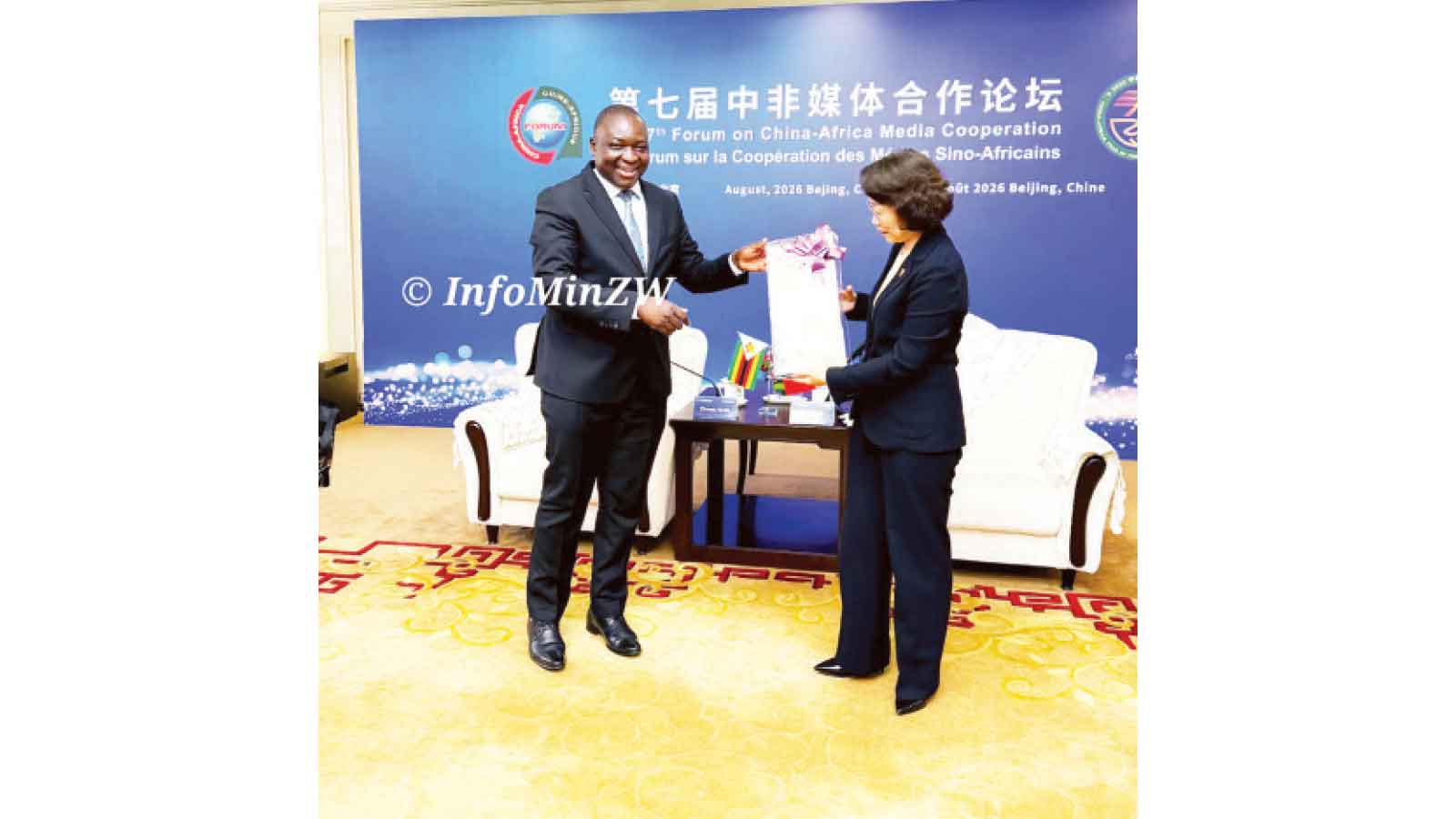
Freeman Razemba
Senior Reporter
Zimbabwe is seeking to harness artificial intelligence, advanced data analytics and 5G broadcasting infrastructure to modernise its media sector and accelerate the country’s digital transformation agenda, Information, Publicity and Broadcasting Services Minister Dr Zhemu Soda has said.
Minister Soda said the country was positioning itself to embrace emerging technologies that will enhance media plurality, content localisation and digital innovation in line with National Development Strategy 2 (NDS2) and Vision 2030.
He is leading the Zimbabwean delegation attending the 7th Forum on China-Africa Media Cooperation in China, a subsidiary mechanism for exchanges and dialogue in the media sector under the Forum on China-Africa Cooperation (FOCAC) framework.
The forum, which has been held biennially in Beijing since 2012, has successfully convened six previous sessions and played a key role in advancing exchanges and mutual learning between Chinese and African civilisations, while promoting the building of an all-weather China-Africa community with a shared future for the new era.
Addressing the forum yesterday, Minister Soda said Zimbabwe’s media modernisation agenda is firmly anchored in the Constitution, which guarantees citizens’ rights to information and freedom of expression.
“Alongside leadership from Zimbabwe’s public broadcasting pillars, we are here to transform these constitutional principles into lived realities by fostering true media plurality and diversity,” he said.
“This vision aligns perfectly with China’s newly approved 15th Five-Year Plan (2026-2030), which champions advanced digital infrastructure. We seek to align our sector with the technical frontiers outlined in this blueprint, focusing on Artificial Intelligence for automated content localisation, advanced data analytics and 5G broadcasting infrastructure.
“By building a shared digital future, we directly accelerate Zimbabwe’s National Development Strategy 2 (NDS2: 2026-2030), launched by President Mnangagwa,” he said.
Minister Soda said NDS2 drives innovation and the digital economy to fulfil the Vision 2030 goal of transforming Zimbabwe into a prosperous, upper-middle-income society.
“In harmony with this momentum, we celebrate the milestones of our broader commercial cooperation,” he said.
The minister said Zimbabwe had moved swiftly to implement all administrative protocols following China’s landmark Zero-Tariff Policy, which came into effect on May 1, 2026.
The delegation includes Ministry of Information Chief Director Mr Jonathan Gandari, Zimpapers chief executive Mr William Chikoto and ZBC chief executive Mr Sugar Chagonda.



In this country we have this uncomfortable tendency to talk about things we hardly understand. The growing hype about applying and using Artificial Intelligence is a case in point. Who in this country is clearly clued up with AI applications and which AI tools are being used and where? Most people think AI only encompasses ChatGPT and perhaps Gemini. There is a lot more to consume in AI and people must understand what it is all about first.