

 admin
admin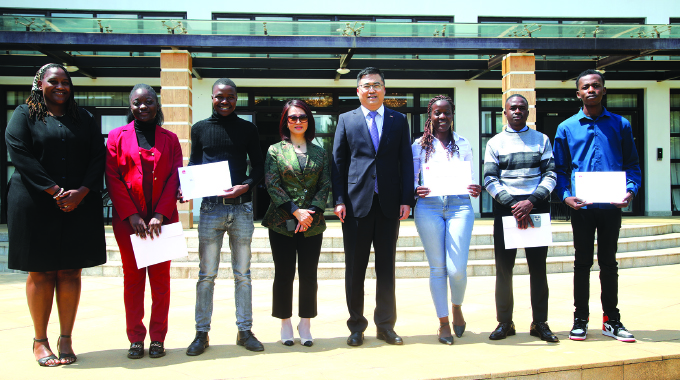
Elliot Ziwira, Senior Writer
As mutual relations between Zimbabwe and China continue to be reinforced, 11 Zimbabwean students were awarded Chinese governmental scholarships to pursue higher education in the Asian economic powerhouse, fostering educational cooperation between the two nations.
Seven of the beneficiaries were officially awarded their scholarships by the Chinese Ambassador to Zimbabwe, Zhou Ding’s wife, Madam Lyu Renhong, and charge d’affaires, Mr Cheng Yan, at an event hosted by the Chinese Embassy in Harare yesterday.
Speaking at the occasion dubbed Open House Event for Educators, attended by Government officials and educators from the country’s tertiary institutions, Mr Yan, emphasised the importance of education in promoting social progress and sustainable development.
Since 2021, China has offered around 100 scholarships to Zimbabwean students, cultivating academic exchange and cultural understanding.
Mr Yan praised the Confucius Institute at the University of Zimbabwe, which has graduated over 3 000 students and benefitted at least 16 000 others across its teaching sites in the past 17 years, hence, promoting Chinese language and culture.
He also acknowledged the contributions of local teachers and volunteers to language education and cross-cultural communication.
The event coincides with President Mnangagwa’s State visit to China, which is expected to strengthen bilateral relations and educational cooperation.
Mr Yan underscored the importance of nurturing talents and fostering educational exchange for the shared future of both nations.
The Chinese Embassy has also invited 260 local friends to attend short-term training programmes in China to promote mutual understanding and cooperation. The occasion testifies to the embassy’s commitment to educational collaboration, cultural exchange, and people-to-people diplomacy.
Deputy director of Higher Education Programmes in the Ministry of Higher and Tertiary Education, Innovation, Science and Technology Development, Ms Adriano Maria Angela, shared her experiences from a two-week seminar organised by the Ministry of Commerce of the People’s Republic of China.
The seminar, which drew university teachers from the Belt and Road Initiative partner countries, was held in Changchun City, China, from August 10-23, 2024.
Ms Angela highlighted the valuable cultural exchanges, impressive educational reforms, and valuable insights gained from the seminar.
“As a team, we were particularly struck by how China’s educational reforms are intricately aligned with societal needs, emphasising practical capabilities and real-world problem solving,” she said. “In addition, integrating cutting-edge technologies, such as artificial intelligence and virtual reality, into the curriculum inspired us profoundly.”
Ms Angela stressed how partnerships between academia and industry, as is the case in China, would impact outcomes for the greater good.
“The active involvement of the industrial sector in curriculum development and the enhancement of educational infrastructure is truly phenomenal,” she added.
Dr Laston Mukaro, co-director of the Confucius Institute at the University of Zimbabwe, underlined the importance of mutual learning through exchanges between China and Africa, particularly Zimbabwe.
He praised the Chinese government’s commitment to human capital development and expressed gratitude for the support received from the Chinese Embassy.
Dr Mukaro also acknowledged local teachers teaching Chinese across Zimbabwe and the Chinese government scholarship recipients, urging them to become torchbearers for Zimbabwe’s industrialisation and development.
Amanda Wayne Madzokere, a Chinese Language and Culture lecturer at the Confucius Institute, University of Zimbabwe, expressed her excitement to have been awarded a scholarship to pursue a Doctor of Philosophy (PhD) degree in Comparative Education at Zhejiang Normal University in China.
She is eager to explore how languages can contribute to the economy and bridge the knowledge gap between Zimbabwe and China.
Madzokere, who represented the recipients at the occasion, believes that language is a vital component of a country’s economy, and seeks to investigate how languages can be leveraged for economic development.
Having studied in China for four years before, she plans to pursue comparative education policies and principles and apply them to improve Zimbabwe’s education system.
Madzokere’s research focus is on the economies of languages. Her interest is understanding how languages can contribute to a country’s economic growth. She gives the example of traditional medicines in Zimbabwe, which are not well-known globally owing to a language barrier.
She hopes that her research will help to identify ways in which languages can be used to promote economic development in Zimbabwe.
Leo Mudenda, a 23-year-old recipient of the Shandong provincial scholarship, is grateful for the opportunity to study Computer Science and Engineering at Qingdao University. Coming from a financially disadvantaged background, Mudenda sees the scholarship as a life-changing opportunity that will enable him to achieve his academic and career goals.
He plans to pursue a master’s degree after completing his undergraduate studies and hopes to use his acquired knowledge and skills to positively impact his community and country.
Twenty-six-year-old John Muchingami, a recipient of the four-year Yunnan Chinese governmental scholarship, is delighted to have been awarded a scholarship to study for a Master’s in Cartology and Geography Information Systems at Yunnan Normal University.
Muchingami sees this opportunity as a chance to gain exposure to technological innovations and integrate Chinese solutions with Zimbabwean challenges. He aims to apply his knowledge and skills to bring about positive change in Zimbabwe’s technological landscape. Muchingami, who studied Geoinformatics and Surveying Engineering at the University of Zimbabwe for the past five years, hopes to be embedded in Chinese culture and bring back new ideas and perspectives to Zimbabwe.
The beneficiaries are eager to acquire knowledge, skills, and cultural understanding in China, with the ultimate goal of contributing to Zimbabwe’s development and positively impacting their communities.
They see the scholarships as life-changing opportunities that will enable them to achieve their goals and make a difference in their country.


 Online Reporter
 Bongani Ndlovu