

 admin
admin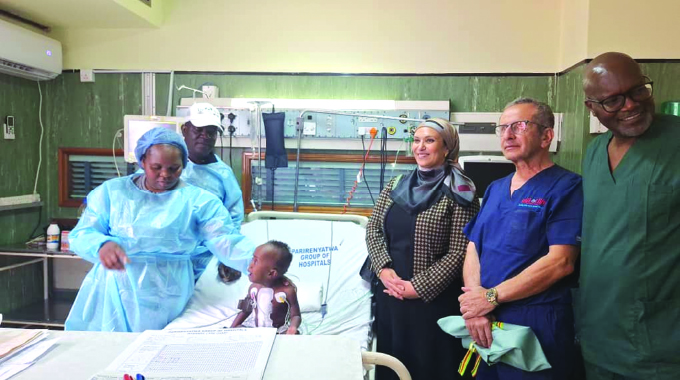
Rumbidzayi Zinyuke, Senior Health Reporter
BUILDING on the success of the just-ended joint camp with Egyptian specialists to use open heart surgery to correct congenital defects, Zimbabwe is well-positioned to launch a sustainable paediatric open heart surgery programme.
The camp, which started on Monday, saw 10 children aged from two years old with congenital heart defects receive life changing surgeries from local and Egyptian specialist doctors.
It was supported by the Government of Zimbabwe in partnership with the Rotary Clubs of Egypt and Zimbabwe, Gift of Life International, the National Oil Company of Zimbabwe, Simbisa Brands and the Avenues Clinic among others.
Parents whose children underwent surgery expressed immense gratitude to the surgeons for giving their children a new lease of life.
Said Mr Taphros Madondo from Mutare, whose two-year-old daughter has been battling a congenital heart condition since birth: “We didn’t know where we would get money for our daughter to go out of the country to get open heart surgery. She was now having difficulties in breathing and she was not growing well. At two years old Charmaine still cannot walk, so we are happy that she got this surgery and we are hopeful that she will start to catch up with other children of her age,” he said.
Another parent, Mrs Maud Rwanga from Ruwa, said her nine-year-old daughter had been living with heart disease since she was two.
“We started off getting assistance at Chitungwiza hospital and last year, we were transferred to Parirenyatwa hospital where she has been under observation. Most of her life she has been in and out of hospital so I am thankful to everyone who made this possible. She can now have a normal life,” she said.
Congenital heart defects are heart abnormalities present at birth which can affect the walls of the heart, the valves or blood vessels.
These can range from simple conditions that don’t cause symptoms to complex problems that cause severe, life-threatening symptoms if left untreated.
At least 4 500 children are born with a congenital heart disease each year in Zimbabwe and are in need of open heart surgery. However, many succumb to the natural disease progression as the disease is often left untreated due to the high cost of having the surgery outside the country.
The joint surgical team, led by Dr Hisham Shawky from Egypt and Dr Simukai Machawira from Zimbabwe, worked seamlessly together to ensure the success of the operations.
Dr Shawky said the main purpose of the camp was to train local experts to be able to perform the surgeries independently in the future.
“Our interaction with the Zimbabwean doctors was very positive. They are helping us in each step and we are helping them, so it is a win-win situation for them and for us. We are planning to start a sustainable programme, which will come in a few years. Actually, we are already starting to plan the next visit somewhere in April or July. It depends on how we can get things ready and funds available. We are here to make the people here get stronger. It will take a while. We are planning a three-year programme of annual or biannual visits to get the team here established,” he said.
Dr Machawira said all 10 patients who underwent surgery were recovering well without any mechanical ventilation and were expected to be discharged by next week.
He emphasised the importance of surgery for children born with heart defects.
“One out of every 100 children born alive will have a congenital heart condition, which is amenable to surgical therapy. Cumulatively, because there have been very few surgeries done, it becomes quite a large number. This is the start of congenital heart surgery. We did perform a congenital heart surgery but it was on a bigger child. But this is the first time we have now started on the smaller children. And we are going to continue operating on these children from now on. We have managed to refresh and see what we need. We obviously have to replenish our stocks and so on, but we will be continuing with open heart surgery on younger children from now on,” he said.
Dr Machawira said the main limitation in performing sustainable congenital heart surgeries had been the shortage of intensive care unit staff.
The hospital would ideally need an independent cardiothoracic intensive care unit while 150 open heart surgeries would need to be performed annually to keep a single surgeon competent.
“We are looking at doing at least three cases per week to make 150. So it’s obviously going to be a process. It is not going to be an event but this is what we are working towards and we are working with our administration here at Parirenyatwa, the Ministry of Health and we will continue to develop our relationship with the Egyptian team that has come. We will send a lot of staff for training,” added Dr Machawira.
Egyptian Ambassador to Zimbabwe Sakwa Mowafi said the cooperation between the doctors from the two countries was evidence of the strong relations that existed. This was evidence that Africa could find solutions to its own problems.
“The relations between Zimbabwe and Egypt are actually very strong since before independence when Egypt supported Zimbabwe in its liberation struggle. We continue to support Zimbabwe and I believe always in African solutions for African problems. And this is not only my personal point of view, this is the Government of Egypt’s point of view. Egyptian medicine is already here in Zimbabwe, and it’s actually in all the Government hospitals, and we are continuing to send more shipments here for the patients here in Zimbabwe,” she said.
She commended the team of surgeons for conducting the successful camp adding that Egypt was committed to continued support for Zimbabwe in the health sector.



 Online Reporter