daniel chigunwe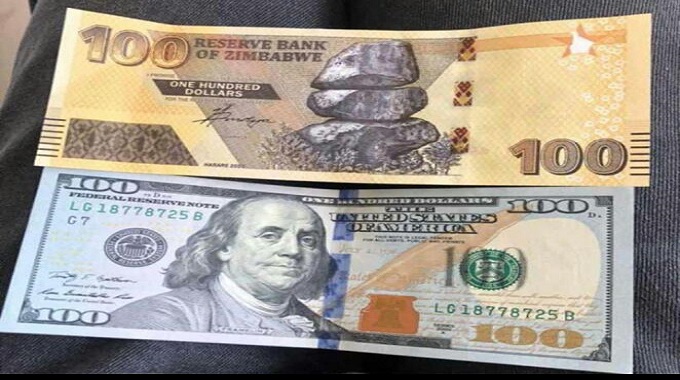
Oliver Kazunga
ZIMBABWE will not achieve this year’s economic growth target and inflation projection on account of the continued weakening of the domestic currency against the United States dollar, economic commentators have said.
At present, 80 percent of the domestic transactions are in foreign currency and on the back of resurgent currency volatility that is piling pressure on the exchange rate.
Due to the weakening of the Zimbabwe dollar, prices of goods and services in the market have also been rising sharply resulting in the resurgence of a hyperinflationary environment.
Official data from the Zimbabwe National Statistics Agency (ZimStat), the country’s month-on-month inflation rate spiked to 15,7 percent last month gaining 13,3 percentage points on the April 2023 rate of 2,4 percent.
On an annualised basis, inflation rose to 86,5 percent from 75,6 percent previously.
In 2022, Zimbabwe closed the year with the annual rate of inflation at 243,80 percent against a projection of 250 percent while month-on-month inflation rate ended the year at 2,4 percent compared to a target of 3 percent.
The disinflationary trend continued in 2023 with month-on-month inflation declining from a peak of 30,7 percent in June 2022 to 2,4 percent in December last year.
In January this year, month-on-month inflation rate was 1,1 percent while year-on-year it declined further to 229,8 percent.
But the disinflationary trajectory has discontinued in recent months with economic commentators indicating that the projected economic growth of 3,8 percent and a double digit rate of inflation are improbable.
“There is absolutely no chance of any of the Government’s targets being achieved. In so far as the Zimbabwe dollar is concerned, the Zimbabwe dollar has effectively collapsed and its collapse is continuing.
“I don’t think any new measures the Government has done in recent weeks it’s really going to change the trajectory.
“I think we are going to end the year with high inflation and the problem has to do with the local currency and that is not a problem that’s not going to go away because we need our local currency in order to fix our domestic economy. If we dollarise, it’s going to have a drastic impact on our economy,” said economist Eddie Cross.
The prevailing exchange rate instability has prompted the Government to adopt a raft of interventions geared at stabilizing the economy by consolidating the fiscal and monetary policies.
Among the measures adopted to restore stability is the suspension of duty on the importation of basic goods, 100 percent retention on domestic sales in foreign currency and the fine-tuning of the Reserve Bank of Zimbabwe’s Foreign Exchange Auction System.
To reverse the dollarisation trend that has characterised the economy, Cross said: “I think there is only one solution and that’s to adopt what I call a conventional system for exchange rate management and the conventional system will be market-based and it will involve us using the local currency as the sole means of exchange.
“It would mean liquidating all incoming foreign exchange on the market and provided we do that, this will bring stability and a strong dollar (local currency).”
He said if the country is to take that route this would not be peculiar to Zimbabwe as other countries in the region such as Zambia, Mozambique and Somalia have done that with success.
“We have to learn from our fellow Africans to do the right thing. I don’t know why the Government has not taken that route because to me the solutions are so obvious and I find it very difficult to understand why they are doing things the way they are doing.
“I think too many people are profiteering from this chaos, we have got elements within our society who are making a lot of money from this situation and those people are afraid of the market,” said Cross.
Speaking by telephone from Bulawayo economist Wendy Mpofu said the projections by the Government may not be achievable exacerbated by the fact that the country would be going for elections in two months’ time.
This, therefore, she said means that as has been the tradition there would be economic stagnation for the next two months until the elections are held in August.
President Mnangagwa has proclaimed that this year’s general elections would be held on August 23.
“Those economic projections and inflation target may not be achievable because of the prevailing financial market distortions and the situation is being exacerbated by the election mode the country has entered into where everything has come to a standstill.
“It may only be possible after elections when all other fundamentals or issues are addressed by the new Government after that period.
“But as of now because of the environment being fragile as you are aware, the exchange rate is not yet stable and that has a negative impact on any intention to reduce inflation. This is because our inflation is highly correlated with the exchange rate as of now.
“Whatever happens on the exchange rate has got a correlation on the inflation so, until we succeed on exchange rate stability that’s when we will begin to see any positive
change on economic growth projections,” said Mpofu.
“Our economic projections for this year could be a challenge because of the environment but after elections the projections could change for the better because normally after elections there can be activities that could boost economic growth.”
A financial market analyst George Nhepera said although the recent monetary measures announced by authorities are positive, their impact is yet to be seen because these have been proclaimed in an environment where there is a lot of lack of confidence by the market.
“There must be engagement between the policy makers and economic players so that there is a common understanding between these two players.
“There are things that we ought to do which have nothing to do with elections, our success as a country must not be hinged on elections.
‘‘If there is any policy that is good, let it be introduced now,” he said.


 Online Reporter