Online Reporter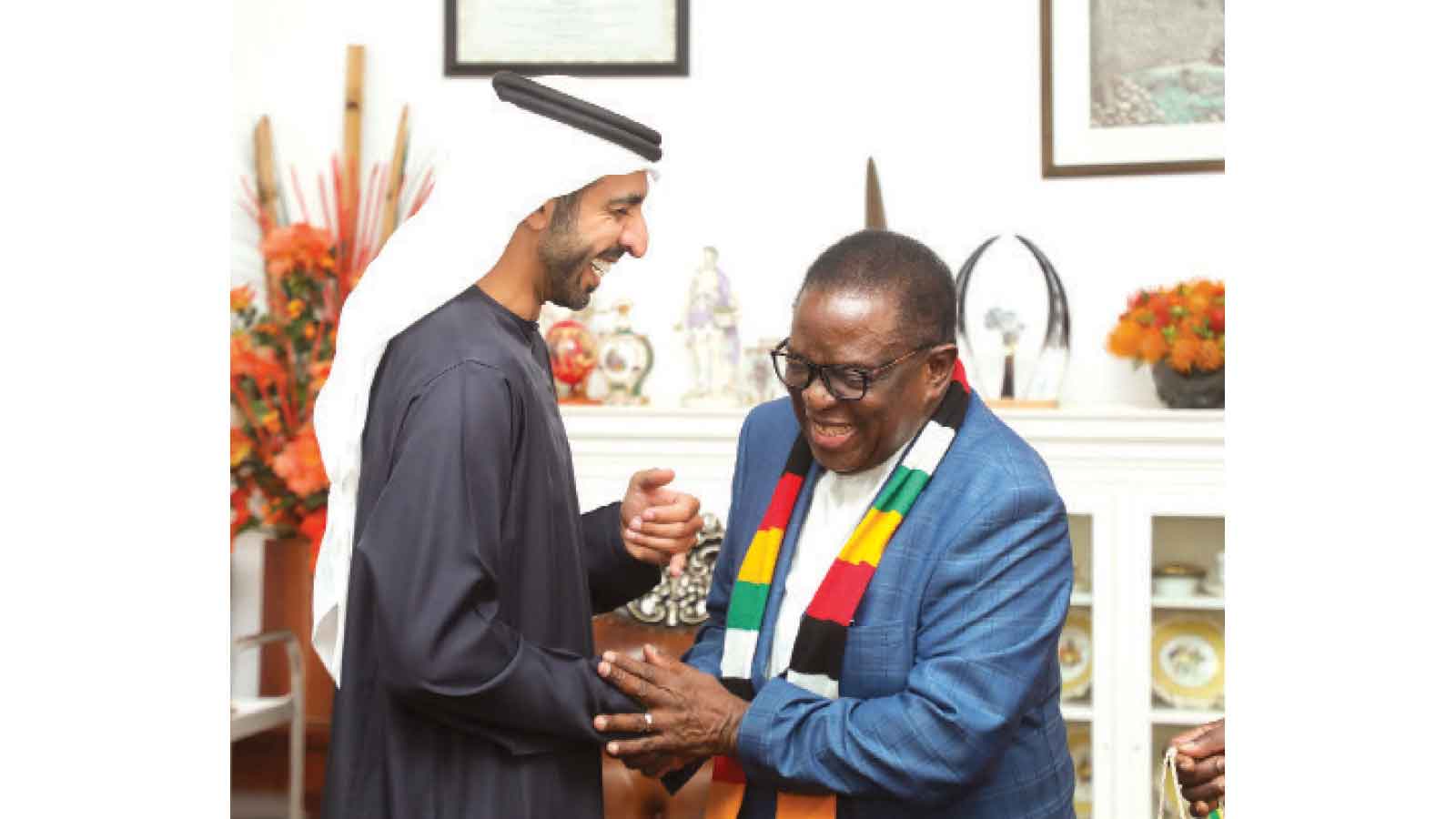
Rumbidzayi Zinyuke-Senior Reporter
ZIMBABWE and the United Arab Emirates (UAE), whose bilateral trade has since ballooned to US$7 billion, are working on further deepening ties, with the two countries set to conclude negotiations on a landmark Comprehensive Economic Partnership Agreement (CEPA) in the coming weeks.
The agreement, which is effectively a free trade pact, is expected to create a stronger framework for expanding trade, investment and market access between Harare and Abu Dhabi.
UAE Minister of State in the Ministry of Foreign Affairs Sheikh Shakhboot bin Nahyan Al Nahyan yesterday paid a courtesy call on President Mnangagwa at State House in Harare, where the two discussed the deepening economic and diplomatic relations.
Bilateral trade between the two countries has grown by 74 percent over the past two years.
Speaking after the meeting, Foreign Affairs and International Trade Minister Professor Amon Murwira said the remarkable growth in economic ties demonstrated the strong relations between the two countries and provided fresh impetus for concluding the CEPA.
“Zimbabwe and UAE have excellent relations. Our trade figures have grown astronomically for the past two years by 74 percent. Our economic linkages between Zimbabwe and UAE are excellent,” Prof Murwira said.
He said yesterday’s meeting also provided an opportunity to brief President Mnangagwa on the state of bilateral relations and progress made in negotiations for the trade agreement.
“We are looking forward to the completion of our Comprehensive Economic Partnership Agreement, which is a free trade agreement between Zimbabwe and the UAE,” he said.
Zimbabwe has already submitted its comments on the draft agreement, clearing the way for further negotiations between the two sides.
“Everything is on course because, as of Thursday evening, Zimbabwe was able to provide its comments to the CEPA, and now it’s time for further negotiations. We are looking forward to finishing the partnership agreement in the shortest future, which might be next week, which might be this month, but practically, very soon,” said Prof Murwira.
Harare and Abu Dhabi intend to broaden relations into sectors such as tourism, infrastructure and other productive areas.
Victoria Falls has already emerged as one of the prime destinations for UAE investment, particularly in tourism and hospitality, as Zimbabwe seeks to leverage the resort town’s global tourism appeal.
The push to deepen economic relations with the UAE is also in line with the Second Republic’s broader economic diplomacy strategy, anchored in President Mnangagwa’s “Zimbabwe is open for business” drive.
The growth in trade with the UAE, Prof Murwira added, was part of wider gains in Zimbabwe’s economic engagement with international partners.
He said trade with the European Union had increased by more than 30 percent, while economic and investment relations with China had also expanded.
“The trade with other countries is growing also at the same time. His Excellency, the President, Dr Emmerson Mnangagwa, has coined the doctrine in Zimbabwe over the years that Zimbabwe is open for business, and this is causing things that are positive,” he said.
For Harare, deepening ties with the Gulf state presents an opportunity to attract capital into productive sectors while widening the country’s export markets and reducing dependence on minerals.
The proposed CEPA is expected to provide an important platform for consolidating the gains already recorded in bilateral trade by improving market access, facilitating investment and creating new opportunities for businesses in both countries.
Data from the Zimbabwe National Statistics Agency indicate that the UAE accounted for half of the country’s export earnings — US$1,4 billion — during the first three months of the year.
The UAE has also become Zimbabwe’s leading export destination, with minerals and horticultural products being the key export products.