admin
admin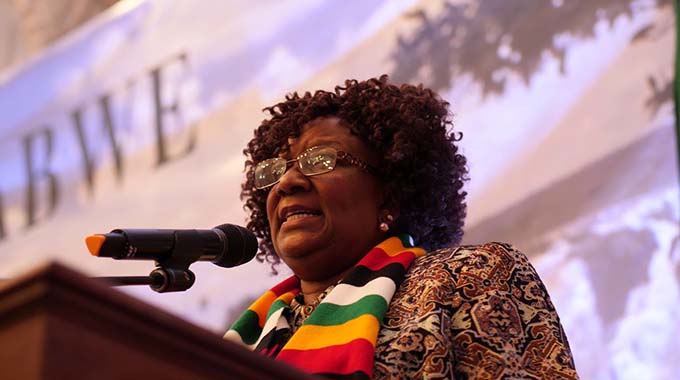
Bruce Ndlovu, Sunday News Reporter
ZIMBABWE is in a race against time to sell US$300 million worth of ivory, with Minister of Environment, Tourism and Hospitality Industry Prisca Mupfumira indicating that the country’s stockpile would be lost as it continues to decompose.
Zimbabwe, alongside a few other southern African countries, is restricted from trading in ivory by the Convention on International Trade in Endangered Species of Wild Fauna and Flora (Cites), a global wildlife watchdog whose aim is to ensure that international trade in specimens of wild animals and plants does not threaten their survival.
Zimbabwe has the second largest elephant population in the world and together with Namibia and Botswana, accounts for 61 percent of elephants on the African continent.
Fielding questions after presenting her ministerial statement this week in Parliament, Minister Mupfumira revealed that Zimbabwe was in danger of losing out of a potential revenue stream as the ivory stockpile could decompose while the country waited for Cites’s go ahead.
“So we are saying we will keep our ivory until we are in a situation where we are allowed to sell the ivory which we have and we are saying $300 million and we will lose some value because we are talking about something which is biological, which can decompose and we will lose the value. We are saying at the moment our present value is $300 million which we badly need as a country,” Minister Mupfumira said.
Minister Mupfumira revealed that Cites had offered the country compensation for burning its ivory stockpile, a deal similar to one that had been offered to Kenya in the past. In 2016 Kenya set ablaze over 100 tonnes of ivory, in attempt to discourage poaching and shock the world into protecting the giant animals.
“The issue of the huge stockpile – that is what I am saying, we are doing our best. We came to a position where they were even offering to say we will take the ivory and burn and give you some money. Following on what happened in Kenya where they burnt the ivory, we understand they never got the money,” Minister Mupfumira said.
She said there had been a lack of continental solidarity around the issue, with many African countries failing to rally around those that wanted to dispose of the excess ivory under their care.
“Unfortunately, some of our African countries who have no capacity in looking after their wildlife – some of them, I do not know for whatever reason, do not seem to understand. You come up with a common position, and overnight they just change. So the African Union as AU does not have one position. That is our challenge. As Sadc and as KAZA, (Kavango Zambezi Transfrontier Conservation Area) we are clear because we are the host to 75 percent of the population. So, we need support from all over even when we talk to our own media here which is why we made the effort to say we must come and explain to our own legislators so that if they are attacked or if they have to talk and comment at least they talk from an informed position,” she said.



 Temba Dube