Online Reporter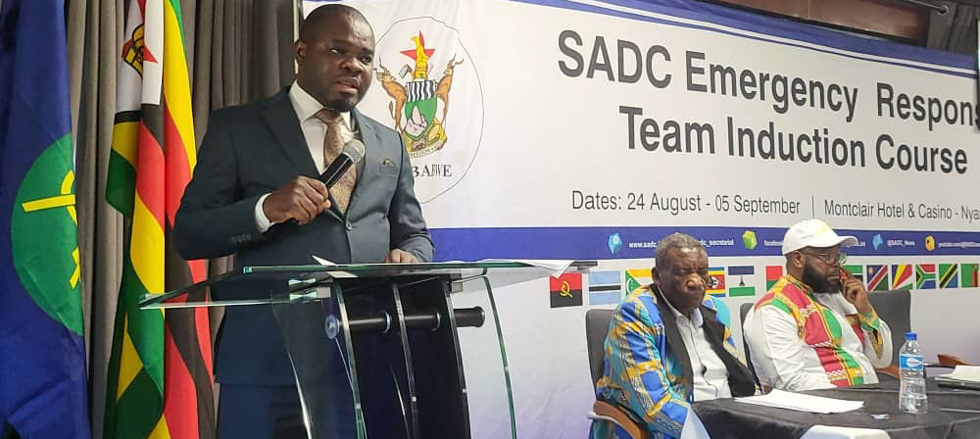
Samuel Kadungure
News Editor
ZIMBABWE is strengthening its disaster response capabilities in the face of rising natural and human-induced threats – with notable successes having been noted following Cyclone Idai, Covid-19 and the devastating El-Nino-induced drought last year.
Increasing frequency and severity of disasters have underscored the need for enhanced preparedness and response, with Cyclone Idai, which ravaged Manicaland in 2019, serving as a wake-up call for robust risk reduction strategies.
This was revealed by the Civil Protection Unit chief director, Mr Nathan Nkomo, on the sidelines of the SADC Emergency Response Team (ERT) training, officially opened by Local Government and Public Works Minister, Honourable Daniel Garwe in Nyanga on Wednesday.
SADC launched a standby ERT to provide timely assistance to member states facing natural and human-induced disasters.
Minister Garwe was represented by his deputy, Engineer Benjamin Kabikira.
The training, attended by participants from 13 countries, was aimed at equipping the region with critical skills for disaster response.
Mr Nkomo said Government, through the CPU, is focusing on critical areas – reviewing and strengthening the Civil Protection Act, enhancing early warning systems, leveraging technology and digitalisation, training of responders, and establishing the National Emergency Operation Centre – to enable the nation to respond more effectively to disasters.
He said Zimbabwe gleaned valuable lessons from Cyclone Idai, and highlighted the importance of interoperability in strengthening the response
system and the SADC Humanitarian Operation Centre (HOC).
He also highlighted the importance of combining trained personnel with search and rescue teams, and establishing emergency response teams at grassroots, since village structures are now integral to the civil protection system.
“We learnt valuable lessons from Cyclone Idai, and our participants here, drawn from across the country, can be quickly contacted and provided with resources by the SADC HOC for local disaster responses. There is also emphasis on interoperability between national emergency operation centres and the SADC HOC and African union (AU). We have identified four critical success factors in disaster response and coordination.
First, we strengthened our disaster law by reviewing the Civil Protection Act of 1989, incorporating emerging issues like radiation, seismology – which can also be a human-induced disaster due to mining – to make our law more comprehensive.
“We will leverage our people’s diverse skills, including drone pilots and accountants, to ensure accountability in disaster risk management. We will deploy technologies like drones, to assess damage and collect information during disasters. Once trained, the personnel will join our search and rescue teams. The training is comprehensive, and these trainees will become trainers of trainers. Instead of relying on SADC, they will lead the process, enabling us to establish emergency response teams at grassroots, integrating village structures into the civil protection system,” he said, adding that hydro-metrological hazards account for 60 percent of the early warning systems in the country.
“Our disaster committee, comprising 19 ministries, serves as early warning units. We are strengthening our early warning system, documenting it properly, and ensuring active responses. We are also exploring relocation and evacuation strategies. Simulation exercises will be conducted nationwide, and resources permitting, devolved to villages, where village heads are the first and last responders. We are implementing anticipatory action, prepositioning resources in areas prone to disasters. Our state-of-the-art National Emergency Operation Centre in Harare will be digitally linked to all districts and wards, enabling real-time disaster response. We aim to digitalise operations and complete the integrated disaster risk management system before the International Disaster Risk Reduction commemorations. Earth tremors in Manicaland must be factored into local emergency response plans. We also conducted a geo-physical survey in Nyanga, Chimanimani, Chipinge, and Mutare rural – epicentres of Cyclone Idai – to determine suitable areas for human habitation. Using our in-house capacity, we identified only two of five potential sites as safe for relocation in Runyararo. Geophysical surveys are now a prerequisite for relocation. We are pleased with the progress, as people from Koppa and Ngangu are settled in Runyararo, and we have maps to guide future geo-physical surveys,” said Mr Nkomo.
In another interview, acting SADC Head of Disaster Risk Reduction Unit, Ms Nana Dlamini, said SADC conducts seasonal forecasting exercises through the SADC Climate Service Centre, and the 2025 forecasting will take place in Zambia from September 8 to 11, followed by the Platform for Regional Disaster Preparedness and Response Planning, with the SADC ERT playing a key role in disaster preparedness and response.
“Preparing the plan helps us identify the region’s vulnerabilities to weather, climate, and other hazards. We pinpoint countries at highest risk, forming ‘hotspots,’ and assess each country’s capacity to respond to disasters. With the first cohort trained and ready to deploy, and the second cohort undergoing this training, we will have a more diversified skill set to tackle various disasters.
“As the rain season begins in September, we will be well-positioned to respond, armed with search capacity and contingency plans outlining at-risk countries, necessary resources, and financial support needed. Fortunately, the Council of Ministers allocated annual ring-fenced resources in August 2022, enabling us to deploy search capacity and provide financial support to affected member states. We began this support during Tropical Cyclone Idai in 2019 and continued it for subsequent cyclones and floods.
“The SADC ERT training enhances our disaster preparedness and response toolbox, positioning us to provide technical assistance to member states more effectively. Our capacity and experience are growing, making the region better prepared for disasters than it was two or three years ago,” she said, adding that in 2022, the council allocated US$900 000 annually to support disaster-affected member states, and US$300 000 for the SADC ERT’s operationalisation, capacity strengthening, and deployment.
“This is an awesome start, considering where we were as a region in 2019. We have made significant progress, with enabling instruments, frameworks, and capacity, as well as financial and in-kind support, including the trained emergency response team,” she said.
Minister Garwe said the ongoing training follows a recent project launch workshop by the SADC Humanitarian and Emergency Operations Centre (SHOC) and the UN World Food Programme (WFP) in Mozambique.
“This two-year project funded by the European union to the tune of US$3 million aims to enhance Regional Disaster Preparedness and Response capabilities in our member states. The project launch brought together key stakeholders, including project beneficiaries from five SADC countries, namely Zimbabwe, Zambia, Malawi, Mozambique and Madagascar, humanitarian partners and technical experts.
“As we thrive towards well-coordinated Regional Preparedness and Response mechanisms, let us also explore the potential of geospatial innovations to support Disaster Risk Reduction and Management. There are indeed key capacity gaps that require concerted strengthening of cross-border collaboration, harmonising search and rescue standards and investing in prepositioned supplies and more importantly, trained personnel,” said Minister Garwe.
Minister of State for Manicaland Provincial Affairs and Devolution, Advocate Misheck Mugadza praised President Mnangagwa’s swift declarations of national disasters, citing examples such as the El Niño-induced drought and the Covid-19 pandemic, as a demonstration of his commitment to mobilising resources to protect and ensure the well-being of citizens.
“Manicaland, in particular, bears the indelible marks of the devastating Cyclone Idai of 2019. It was a moment that tested our resolve, but also showcased the extraordinary spirit of our people and the invaluable support from our regional and international partners. We worked tirelessly to provide immediate humanitarian assistance, rehabilitate critical infrastructure like schools, roads, and water systems, and restore livelihoods, particularly in the hardest-hit districts of Chimanimani and Chipinge,” he said, adding that the efforts were, not just about rebuilding what was lost, but about “building back better” – integrating resilience and climate-proofing into reconstruction to withstand future shocks. Lessons learnt from Cyclone Idai continue to inform and strengthen our disaster preparedness and response frameworks and forge stronger networks among our emergency responders,” he said.