Online Reporter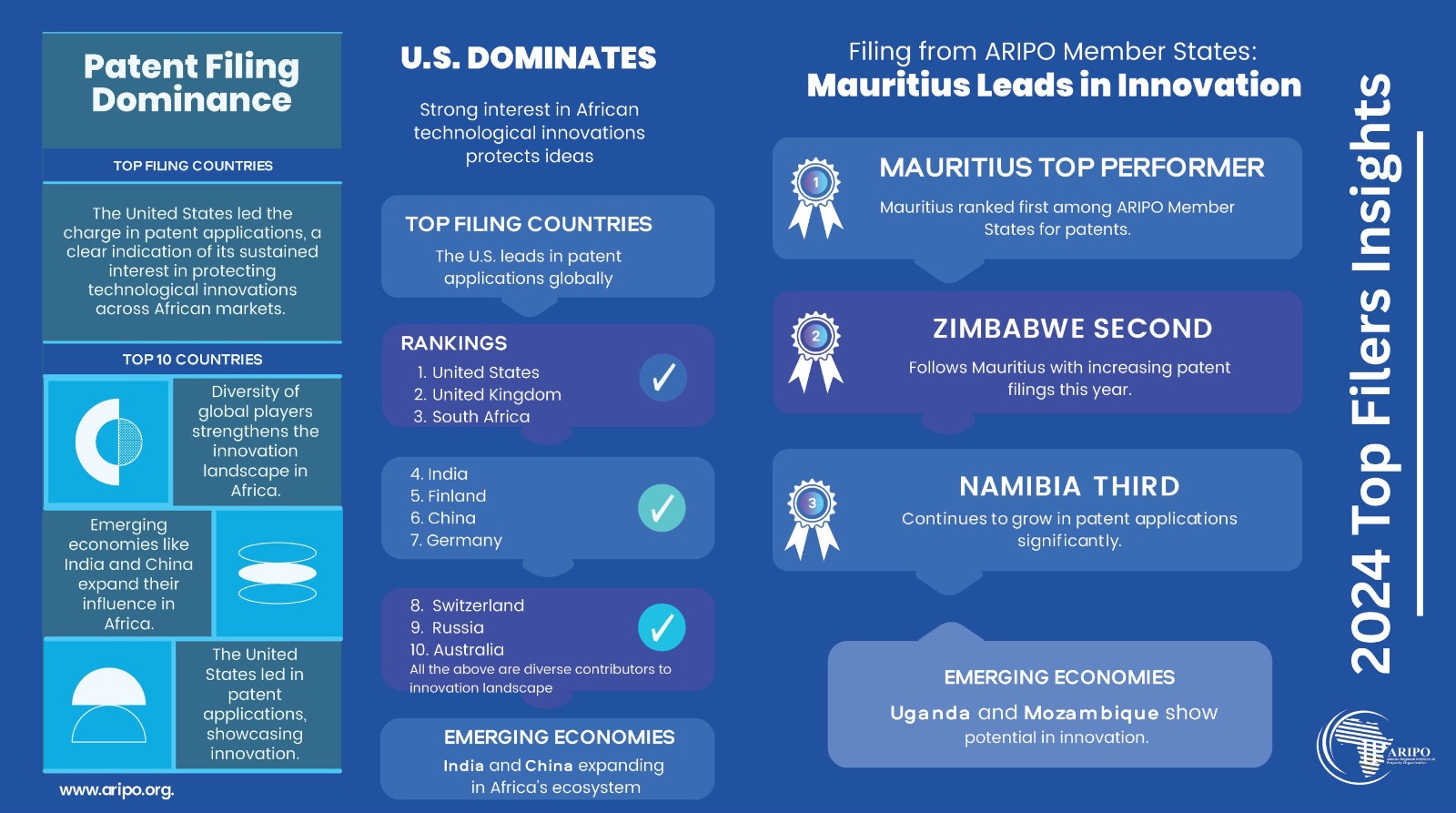
Judith Phiri,Zimpapers Business Hub
ZIMBABWE emerged as the second top filer of patent applications for 2024 among the African Regional Intellectual Property Organisation (ARIPO) member states, demonstrating early but promising engagement in patent-based innovation.
Mauritius was the top performer and Namibia took third place. This was revealed in the 2024 Intellectual Property (IP) Filing Trends: Key Insights from ARIPO’s Top Applicants.
A patent application is a formal request to a patent office for the grant of a patent for a new invention. It’s a detailed document that includes a description of the invention, its features, and how it works, along with claims defining the scope of protection sought.
ARIPO, as a vital hub for IP protection in Africa, said in 2024, the organisation recorded a diverse range of sector engagement, international participation and regional entrepreneurial activity in IP filings.
“Among ARIPO’s 22 member states, Mauritius emerged as the top filer of patent applications in 2024. Zimbabwe followed closely, while Namibia took the third spot. Uganda and Mozambique each contributed, demonstrating early but promising engagement in patent-based innovation.”
The organisation said global pharmaceutical giants and tech innovators led the way as pharmaceutical companies were the most active patent filers, with Eli Lilly and Company (USA) leading, primarily in pharmaceuticals, organic fine chemistry and biotechnology.
ARIPO said this suggests ongoing efforts to protect drug innovations in the African market, likely driven by public health initiatives and the emergence of new markets in the region.
On strong regional representation, it added: “Regional economies were well represented in 2024’s trademark filings, with Zimbabwe leading, followed by South Africa and China.
This strong performance by African states underscores the growing local awareness of intellectual property rights as a crucial foundation for business growth and economic development.”
The organisation said among ARIPO member states, Zimbabwe continued to lead in trademark filings, far surpassing those of other countries, while Zambia and Mauritius ranked second and third, respectively.
On grassroots innovation with a focus on local needs, ARIPO said while utility model filings were fewer, they provide insight into grassroots innovation, especially in public health, mechanical engineering, and computing.
“Key highlights include John Hemming Trading Ltd (UK) applications for pharmaceutical solutions. Great Zimbabwe University (GZU) and its collaborators, development of mechanical engineering machines tailored to local contexts, said the organisation. Brian Turyabagye and colleagues (Uganda), creation of medical instruments that align with frugal innovation and rural healthcare delivery.
“Innovators from Kenya and Zimbabwe were particularly active, indicating a rich environment for practical, needs-based solutions among ARIPO member states. This category emphasizes ARIPO’s role in promoting accessible innovation pathways for individuals, research institutions, and small and medium-sized enterprises (SMEs),” said the organisation.
It said on utility models, often regarded as “petty patents”, which are crucial for incremental innovation, Zimbabwe topped the list, followed by Kenya.
ARIPO said although the numbers remain modest, this area represents considerable growth potential, especially among SMEs and grassroots inventors.
The organisation said Zimbabwe, Zambia and Tanzania shared the top spot in 2024 with designs increasingly being recognised as valuable IP assets for product aesthetics and user appeal.
“Kenya and Mauritius also performed well, followed by Mozambique and Uganda, indicating the growing interest in creative industries across the continent.”
Headquartered in Harare, Zimbabwe, ARIPO aims to centralise and harmonize IP registration and protection across its member states.