Online Reporter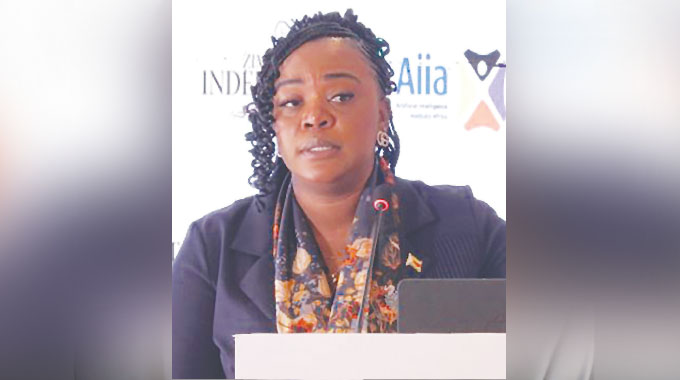
Rutendo Nyeve, Victoria Falls Reporter
THE Government has finalised the crafting of a National Artificial Intelligence (AI) Strategy, which will be unveiled in October, marking a significant milestone in the country’s digital transformation journey.
Minister of Information Communication Technology (ICT), Postal and Courier Services, Dr Tatenda Mavetera, said this in an address at the official opening of the Artificial Intelligence for Africa Summit held in Victoria Falls on Monday.
Held under the theme: “AI-Powered Transformation: Unlocking New Frontiers for Sustainable Social-Economic Growth,” the summit brought together Government officials, industry leaders, academics, and innovators from across the region to discuss how AI can be harnessed to drive inclusive growth, economic sovereignty and resilient development.
Minister Mavetera said the summit was not just another meeting but a transformative platform to ensure Africa’s unified presence in the global AI landscape. She went on to outline tangible efforts being made by Zimbabwe to build the pillars of AI.
“The country has established a High-Performance Computing Centre with a 559 Peta-Flops capacity, recently expanded under Phase 2, inaugurated by President Mnangagwa.
“To support data storage, Zimbabwe is upgrading its National Data Centre to a Tier 4 level, while the National Enterprise Architecture Model is being finalised to streamline data collection, sorting, and retrieval,” said Dr Mavetera.
Skills development is a cornerstone of Zimbabwe’s AI strategy and the Government has already launched the 1.5 million Coders Programme to train citizens nationwide in AI and digital skills.
Additionally, Dr Mavetera said an AI training programme targeting senior Government officials is underway to ensure policymakers understand the technology’s implications.
The Digital Skills Ambassadors Programme will soon train young people from all provinces, ensuring no one is left behind.
“Infrastructure development is also a priority, with plans to deploy more 5G base stations, expand fibre coverage, and enhance satellite capacity, including Low Earth Orbit (LEO) technology.
“These efforts align with Zimbabwe’s vision of becoming an upper-middle-income society by 2030, leveraging AI to empower farmers, healthcare workers, and educators,” said Dr Mavetera.
She further highlighted the importance of cultural and social self-determination in AI development, noting that foreign-built AI systems may not understand local languages like Shona, Ndebele, or Tonga, or the complexities of Zimbabwe’s societal fabric.
“AI is a mirror that reflects the values of its creators,” she said, emphasising the need for home-grown solutions.
Dr Mavetera also addressed concerns about job displacement, urging a shift in the narrative.
“AI should not mean job losses; it should mean job transformation,” she said.
The minister called for reskilling initiatives to prepare workers for emerging roles in AI development, data science and digital agriculture.
She painted a vivid picture of AI’s potential, comparing it to the mighty Zambezi River.
“Artificial Intelligence is like the mighty Zambezi River. It begins as a small stream of ideas, but with the right conditions, it grows into an unstoppable current, cutting through barriers and reshaping the land forever,” said Dr Mavetera.
She stressed that Africa’s moment had arrived, and that Zimbabwe was determined to leverage AI to leapfrog development.
“Africa’s strength lies in unity. We must speak with one voice in Artificial Intelligence, declaring our commitment to participate, innovate, and own our future,” said Dr Mavetera.
She underscored the need for a continental strategy rooted in three foundational pillars — economic sovereignty and competitiveness, cultural and social self-determination, and inclusive and resilient development.
“History shows that those who do not actively shape their technological future will be shaped by it. In the age of AI, passivity leads to digital dependency and a form of neo-colonialism, where our economic and societal values are dictated by distant algorithms, ignoring our unique contexts,” said Dr Mavetera.
Zimbabwe, she affirmed, rejects this future and is committed to building an AI ecosystem that reflects African values and priorities.
On the economic front, Minister Mavetera said AI is rewriting the global economy, transforming industries from agriculture to finance.
“To remain competitive, we must become fluent in this new digital language,” she said.
Culturally, she stressed that AI must reflect Africa’s diversity, including indigenous languages such as Shona, Ndebele and Tonga.
“An AI built on foreign data will not understand the richness of our communities or the complexities of our societal fabric,” said Dr Mavetera.
For inclusive development, the Minister outlined AI’s potential to empower small-scale farmers with predictive analytics, aid healthcare workers in remote areas, and personalise education for students.
With the National AI Strategy set for unveiling in October, Zimbabwe is set to lead in harnessing AI for sustainable and inclusive development.