Chronicle Editor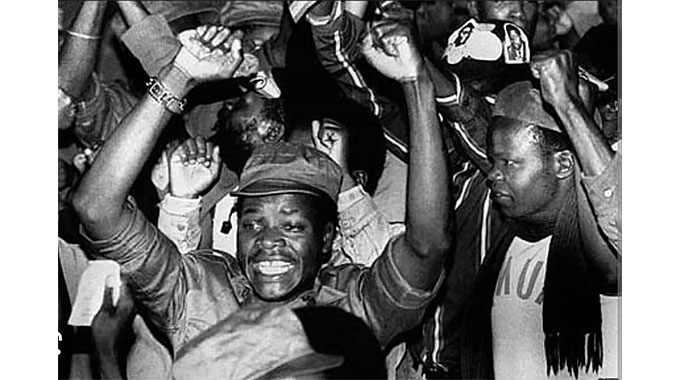
Yoliswa Dube-Moyo, Features Editor
Whether it was in the middle of an isitshikitsha dance, toyi toyi of sorts, jumping up and down uncoordinated or mere awe at what was about to unfold, the raucous cheer from those that flocked Rufaro Stadium in Harare on 18 April 1980 was enough to bring prickling goosebumps on one’s bare arms.
What they had worked hard for in the trenches during the protracted struggle to liberate Zimbabwe was finally becoming a reality right before their eyes.
The joy could not be contained, the sense of victory could not be suppressed, the euphoria was magical — it was a mixture of everything all around.
A long, hard journey of blood, sweat and tears had culminated in an independent Zimbabwe where the black majority could truly be in charge of their destiny.
Rhodesian Prime Minister Ian Smith had previously declared that blacks would never rule the country, not in a thousand years, but he was wrong. The Zimbabwean flag was hoisted as the Union Jack was lowered, in shorter than a thousand years.
This was made possible through a long-drawn-out liberation struggle where many lost their lives and limbs to free their country from white minority rule.
The liberation struggle was not for the fainthearted — many boys and girls abandoned their studies at secondary schools and the University of Rhodesia to join the war.
They were constantly pushed to the edge, with no choice but to hold on.
Some comrades watched their fellow cadres die and did not have the chance to give them decent burials. Instead, they had to quickly move on and continue with the cause.
They were constantly under attack, always having to look above their shoulders.
The cadres went for long periods without adequate food, shelter and clothing. The training was so rigorous that many women’s bodies responded by stopping menstruation.
Protection from wildlife and the elements was a matter of divine fortification.
They had to be on the lookout for landmines, poisoned water sources and poisoned clothes while protecting civilians from the enemy and engaging their adversaries.
This is why they screamed uncontrollably and tears rolled down their cheeks at Rufaro Stadium; they had conquered it all.
The sons and daughters of the soil chose to say “no” to white minority control over their country and their wealth. They said “no” to living a life without dignity, no vote, restricted jobs, small housing, poor schools, limited opportunities and low salaries.
Blacks were barred from “white jobs”, areas, shops, clinics, pubs, buses, clear beer, and generally regarded as inferior to dogs such that police asked where one got a wrist watch or white shirt from.
They bought through shop windows and were barred from pavements.
Blacks needed a pass to live in town in male only or female only hostels. Only very few blacks were allowed to go beyond Grade 7 and even less Form 2 under the bottleneck education system, meaning fewer blacks could proceed beyond the next level until university.
Racial segregation permeated the colonial project at every level, whether it was in sports, hotel facilities, or the use of public conveniences and amenities.
But after all the fighting, the talking and the back and forth, the Lancaster House Agreement finally brought uhuru to the black majority in Zimbabwe.
Oh, what a journey it has been for the people of Zimbabwe over the last 43 years!
A raft of measures were put in place to ensure the growth of the country and restoration of its wealth into the hands of its rightful owners.
Development of quality, affordable and resilient infrastructure is enabling industries to access markets, boosting trade as well as positioning the country to produce locally made products for the world.
This enabling environment that has been created by the Second Republic has resulted in increased investor confidence in the country as shown by the huge appetite by foreign companies to invest in Zimbabwe — thereby enhancing prospects of becoming an upper middle-income economy by 2030.
Various policies that are being championed by President Mnangagwa — such as the “Zimbabwe is Open for Business” agenda and “Friend to all and enemy to none” foreign policy thrust — have seen several multi-nationals flocking to the country, helping in the modernisation and industrialisation of Zimbabwe.
Women empowerment has been a strong talking point over the years with women having been the worst affected by the colonial segregation system.
After independence, Government came up with deliberate policies and affirmative programmes to empower women both economically and politically.
The National Gender Policy adopted in 2013 as a development of its predecessor adopted in 2004 dedicates to create a fair society where all citizens enjoy equality of opportunities and participation in all sectors.
The country is also party to international protocols such as the Universal Declaration of Human Rights, the Convention on Civil and Political Rights (CCPR), the Convention on the Elimination of all Forms of Discrimination Against Women (CEDAW) and the Beijing Declaration and Platform for Action (BDPA).
On a regional level, the country is signatory to the Sadc Gender and Development Declaration which also seeks to achieve gender equality and empower all women and girls.
The Government has initiated a number of women empowerment programmes superintended by the Ministry of Women’s Affairs, Community, Small and Medium Enterprises Development with support from the national fiscus.
The concept of devolution has been lauded as the best development strategy that ensures equitable distribution of the national cake.
Zimbabwe’s Constitution adopted in May 2013 states that governmental powers and responsibilities must be devolved between the national government, provincial and metropolitan councils and local authorities which are expected to ensure good governance by being effective, transparent, accountable and responsive to the needs of local people.
Devolution of power as a new governance model in Zimbabwe replaces deconcentration on the premise that devolution is a more democratic, citizen centred, participatory, more transparent, accountable and locally relevant development focused governance system.
Devolution seeks to make the system of governance community-based and people-centred by enhancing community participation in making decisions on local development issues that affect them and in the exercise of governmental powers, while upholding the preservation of national unity.
Decentralisation is a key feature and strategy for non-discriminatory and just governance as well as inclusive and transformative socio-economic development, a major gain of independence.
The concept seeks to empower provinces to drive local and national economic growth and development using their own factor endowments.
The transformative growth of the country’s agricultural sector has been immeasurably impactful on the livelihoods of many Zimbabweans.
This is apparent in the ongoing mechanisation and modernisation of the agriculture sector as efforts are made to ensure food security and reduce the import bill.
Already, the agriculture sector has hit the initial 2025 target of US$8,2 billion a year as the industry grew by 36,2 percent to US$8,19 billion in 2021, and a further 10 percent last year — owing to the huge financial investments made by the Second Republic.
These achievements have not gone unnoticed as Zimbabwe repositions itself as a major agriculture player on the global stage.
This is all part of the National Development Strategy 1, which places emphasis on the modernisation of the agriculture sector.
Black men toiled in the mines with no real returns for their labour. They were low level employees and did not hold management roles.
It was not until the country attained its independence from white minority rule in 1980 that blacks started to have access to mining concessions and rose to manage mines and conglomerate mining operations.
Now, Zimbabwe’s extractive industry is well on course to attaining the US$12 billion mining milestone.
Renewed investment interest in the mining sector has seen the establishment and expansion of critical mining operations across the country with the gold sector expected to deliver the 100-tonne target.
The mining sector is critical in generating foreign currency, contributing about 70 percent of the country’s forex earnings, largely driven by gold, platinum, and diamond.
Leading mining companies such as Blanket Mine, Pretoria Portland Cement (PPC) and Duration Gold are already seized with the implementation of different expansion
projects that involve millions of United States dollars.
These are being complemented by artisanal small-scale mining breakthroughs in different resource districts, which have seen the sub-sector contributing more to formal gold deliveries.
The country continues to make significant strides in developing its economy and empowering its people, safeguarding its hard-won independence.
We continue to win and revel together, after all, ilizwe lakhiwa ngabaninilo. — @Yolisswa



 Online Reporter