Chronicle Editor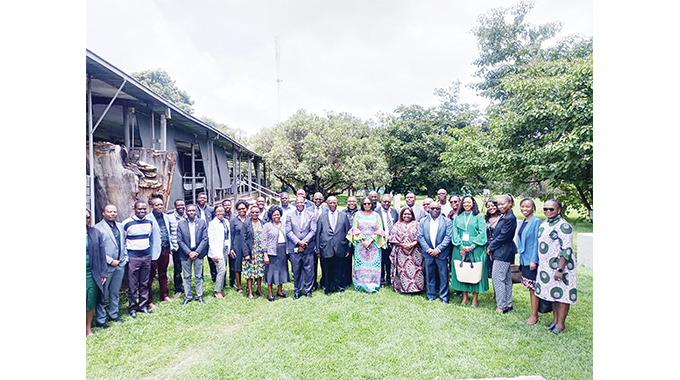
Sifelani Tsiko, Agric, Environment & Innovations Editor
Zimbabwe is open to new and emerging technologies that can transform the country into a knowledge driven and industrialising upper middle income economy by 2030 and the attainment of the African Union’s vision and Agenda 2063.
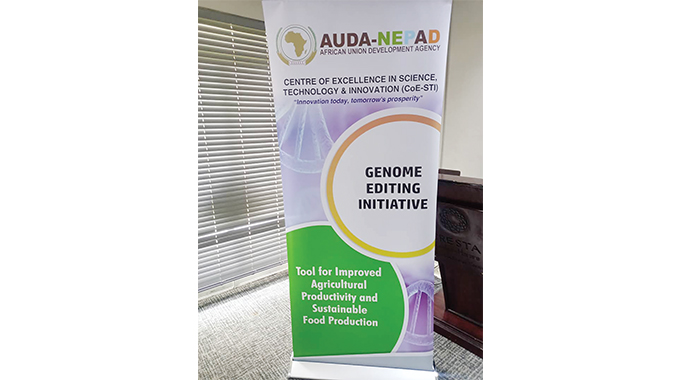
Mr Willard Manungo, deputy chief secretary for Policy Analysis, Coordination, Devolution and Development Planning in the Office of the President and Cabinet said this at a genome editing workshop organised by the African Union Development Agency (AUDA-NEPAD) and the National Biotechnology Authority to help the country to increase and scale up the use of biotechnology, in particular genome editing.
“President Mnangagwa’s vision of transforming Zimbabwe into a knowledge driven and industrialising upper middle income economy by 2030 aligns with the AU’s Vision and Agenda 2063,” he said.
“This cooperation demonstrates that Zimbabwe is indeed open for business contrary to the unsubstantiated negative perceptions that had resulted in some development partners withdrawing support. We’re indeed enthused to be considered in NEPADs current development initiatives and be part of the continental agenda.”
Mr Manungo said Zimbabwe is proud to be one of the pioneers of genome editing which dovetails with the country’s current development trajectory as espoused in its vision 2030.
“The vision embeds Information and Communication Technology (ICT) across all national development strategies as an enabling tool for development. It prioritises promoting innovation, entrepreneurship, equitable development and prosperity for all, under a market economy that leverages on Zimbabwe’s natural resources and abundant human skills,” he said.
Zimbabwe is among other selected countries such as Burkina Faso, Ghana, Ethiopia, Nigeria, Mozambique, Kenya and Malawi that were chosen to pilot the application of genome editing research towards product development.
Gene editing technology allows scientists to edit any gene they target, enabling them to find and change or replace genetic defects.
Gene-editing science and technology is in its early stage in Zimbabwe and most African countries and the potential of this technology is still to be harnessed.
Under the Second Republic, biotechnology is no longer seen as an option but as a necessity that should be deployed alongside other conventional methods to improve genetic gains for enhanced crop productivity and agriculture value chain transformation.
Zimbabwe is now home to one of the most established innovation ecosystems in Africa with technology and innovation hubs, agro-industrial parks and incubators, giving space to developers, designers, researchers and entrepreneurs to work on new technological solutions.
One of the most outstanding achievements in innovation includes the commercialisation of the indigenous Marula or Mapfura fruit value chain in Mwenezi’s Rutenga Growth point.
The indigenous fruit has bi-products such as wine, cosmetic oil, edible oils, stock feed and juices.
The country has also embraced emerging technologies such as block-chain, data science, artificial intelligence (AI), cloud computing, Internet of things (IoT), gene editing, biotechnology and other sciences to spur industrialisation.
Zimbabwe now has the National Data Centre and the High Computing Performance Centre at the University of Zimbabwe and an array of science and innovation hubs that have the capacity to produce hydrogen for energy and lithium ion batteries that are key in the transformation and industrialisation of the country.
“The Government has prioritised human capital development and innovation with emphasis on Science, Technology, Engineering and Mathematics (STEM) subjects. This supports home-grown innovations in all areas of the economy, including agri-business among the youth,” Mr Manungo said.
Higher and tertiary education institutions have adopted Education 5.0 centred on equipping graduates with skills that empower them to become innovative towards societal development through transformative science and technology knowledge application that delivers goods and services.
The government hopes that innovation will bridge the gap between knowledge produced in lecture rooms, laboratories and industrial production.
“Allow me to emphasise that the Government of Zimbabwe embraces and is fully committed to genome editing. This technology is preferable due to its competitive advantage of accessibility, affordability, easy and shortened time frame for application, potential to ensure higher productivity, value-addition and food security,” Mr Manungo said.
“As experts in your various capacities, you have been tasked and entrusted with a responsibility to spearhead the successful implementation of this pertinent national project. It is your duty to scale up efforts so that the fruits of these engagements are impactful and life transforming, contributing to the realisation of vision 2030.”
The National Biotechnology Authority says it will develop and issue guidelines for genome editing in crops to allow for safety evaluation of genetically engineered plants.
He said genome editing is one of the new technologies that falls under the biotechnology umbrella with a potential to improve crop productivity, resistance to pests and adverse environmental conditions.
“In line with Zimbabwe’s current drive under Education 5.0, it’s time for Zimbabwe to consider the use of latest technologies, such as genome editing, to revive our industries and our economy,” he said.
“We must use resources at our disposal to align with the industrial revolution. It is imperative for us as a nation to have home-grown solutions to boost our economy.”
Ms Florence Nazare, acting director of AUDA-NEPAD for knowledge management said African countries must harness modern biotechnology applications to drive industrialisation and inclusive growth that improves livelihoods on the continent.
“The essence of this workshop is to help African countries to realise socio-economic transformation and attain Agenda 2063 goals,” she said.
“With science, technology and innovation as the driver, the AUDA-NEPAD is supporting and putting more effort to promote the wider utilisation of modern biotechnology.
“Gene editing is one of the tools of biotechnology to optimise agriculture and food systems in Africa.”
She said African countries must fully embrace new technologies to improve all facets of agriculture, medical and other critical sectors.
“It’s quite important for us to improve Africa’s capabilities in science, research and development to strengthen utilisation and improve safety of new technologies,” Ms Nazare said.
“We have to address security issues for the continent. We have to be the producers of biotechnology and not just be consumers. Our scientists have to be knowledgeable and globally competitive. This can be done through training.”
The workshop attracted academics, plant breeders and researchers from various institutions across the country.
Zimbabwe has set up a Genomics Centre at the University of Zimbabwe Innovation Hub that has a state-of-the-art sequencing unit.
The NBA regulates the use and application of modern biotechnologies to minimise the impact of these on human and animal health as well as the environment.
The Zimbabwean economy is well positioned to benefit from rapidly accelerating technological change and has established industrial and innovation hubs to harness new technological innovations to find solutions to the country’s problems.



 Online Reporter