Business reporter
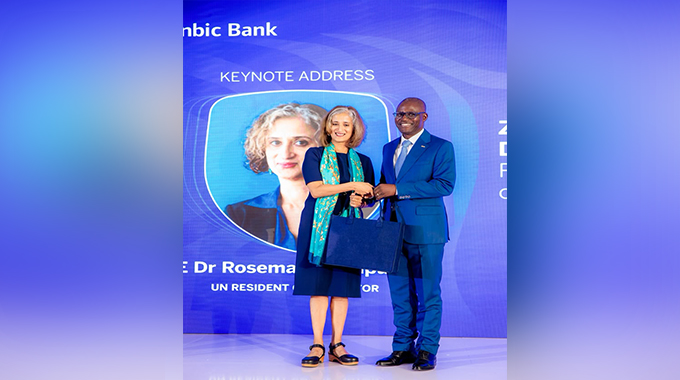
STANBIC Bank Zimbabwe hosted the Second Edition of the Sustainability Conference in Harare on Friday affirming its commitment to playing a pivotal role in pushing for economic growth through sustainability.
Driven by the bank’s purpose: “Zimbabwe is our home, we drive her growth”, the Standard Bank Group subsidiary has vowed to look beyond short-term transactions and to consider the enduring impact of the decisions it makes, the capital it deploys, the businesses it supports and the communities it serves.
Hence the Sustainability Conference was held at a local hotel under the theme: “Driving Zimbabwe’s Sustainable Growth,” underpinned by the recognition that economic growth needs to be pursued on the back of key pillars such as inclusivity, sustainability and responsibility.
Key sustainability stakeholders, bankers, corporate executives attended the event with the United Nations (UN) Resident Coordinator, Dr Rosemary Kalapurakal, as guest of honour.
In his opening remarks, Stanbic Bank Chief Executive, Mr Solomon Nyanhongo said the drive for sustainable growth must strengthen the economy today without compromising the opportunities, resources and wellbeing of future generations.
“Your presence reflects a shared understanding that sustainability cannot be delivered by one institution, one sector or one set of experts. It requires the deliberate interweaving of people, ideas, partnerships, innovation and responsible action,” said Mr Nyanhongo.
He said when these threads come together, they create a Zimbabwe that is better equipped to withstand shocks, unlock opportunity and generate lasting value.
Sustainability at Stanbic Bank, said Mr Nyanhongo, is not a separate programme that sits on the margins of the business, but is increasingly woven into governance, strategy, risk management, credit assessment, product development and daily operations, shaping how this balances economic growth, social progress, environmental stewardship and sound governance.
As a result Mr Nyanhongo said Stanbic Bank has strengthened its sustainability capability by creating a key post of ‘Head of Sustainability’ recognising that commitments of this nature require dedicated leadership and accountability,
“The Head of Sustainability is responsible for helping us drive and coordinate our sustainability agenda, ensuring that it is increasingly embedded in how we think, how we make decisions and how we do business. Her role is an important statement of intent for us,” he said.
Mr Nyanhongo also said Stanbic Bank believes that sustainability cannot simply be something talked about at conferences or reported on once a year. It must have ownership, focus and accountability within the organisation.
He reiterated the bank’s commitment to aligning with this sustainability drive, strengthening its own practices and advancing the journey towards certification under the Sustainability Standards Certification Initiative.
“Our approach is anchored on three High Impact Goals: infrastructure and economic development, financial inclusion, and entrepreneurship and job creation, which guide how we support sustainable infrastructure and energy systems, expand access to financial services, enable enterprise growth and contribute to employment creation,” said Mr Nyanhongo.
He said this includes directing capital towards sectors and solutions that strengthen Zimbabwe’s long-term productive capacity, including renewable energy, healthcare, agriculture, enterprise development and critical infrastructure, while expanding digital and inclusive banking solutions, strengthening financial capability, and working with clients and partners to unlock opportunities that broaden participation in the formal economy.
In her remarks, Dr Kalapurakal commended Stanbic Bank for convening the conference and “bringing together the people who can connect national ambition with capital, expertise and execution.”
She said the conference was being held at a moment when Zimbabwe’s development ambitions are clear, as are significant opportunities related to the themes of this conference – linking water security, land, agriculture, energy, climate resilience and economic opportunity.
“So, the question that we need to discuss is the following: how do we turn Zimbabwe’s development priorities into investable propositions, financed projects, and ultimately, lasting improvements in people’s lives?” asked Dr Kalapurakal.
She said while clearly there is not enough financing for all the needs, the challenge goes beyond, to creating enough credible, well-prepared and scalable opportunities through which capital can reach the real economy.
To that end, the focus moves from only “where is the money” to “What must we put in place for capital to move, responsibly and at scale?”
Dr Kalapurakal said Zimbabwe was endowed with real assets on which to build such as: human capability, agricultural, biodiversity and mineral endowments, renewable-energy potential, a strategic regional location, and businesses that have demonstrated resilience under difficult conditions.
“For investors, the opportunities are clearly visible in climate-smart agriculture and agro-processing, solar and storage, water, responsible mineral value addition, digital services, logistics and enterprises ready to grow,” said Dr Kalapurakal.
She said it is commendable that a lot of work has been done in record time to improve the environment in which those assets can attract investment.
Dr Kalapurakal noted that among ZIDA’s investment facilitation reforms include the move to digital licensing, greater transparency through eRegulations, the One Stop Investment Services Centre, and a dramatic reduction in licensing turnaround from 21 days to five.
“These are practical reforms because, for an investor, time, cost, transparency and predictability matter. So, the direction of travel is encouraging. The hard work now is to turn both opportunity and reform into a stronger pipeline of investable transactions,” said Dr Kalapurakal.