Online Reporter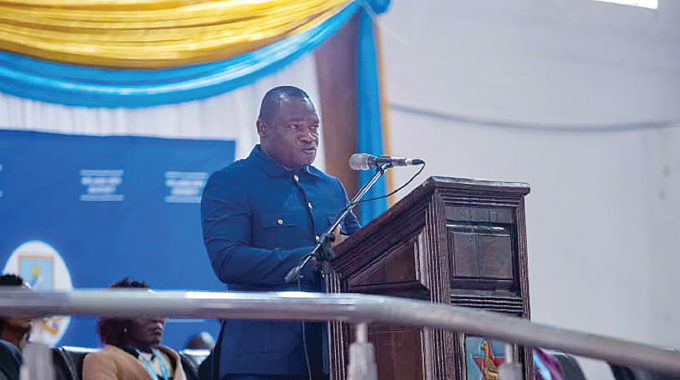
Patrick Chitumba, Zimpapers Writer
ZIMBABWE continues to lose billions in potential value and innovation due to the long-standing disconnect between academia and industry, business executive Dr Tinashe Manzungu has warned.
He said that for the country to achieve meaningful economic transformation, universities and industries must form strong partnerships that translate research into tangible solutions.
Dr Manzungu, a multilingual business mogul with extensive professional and entrepreneurial experience, was speaking at the Midlands State University (MSU) Research, Innovation and Industrial Expo held this week at the university’s main campus in Gweru. The Expo ran under the theme “Linking Academia and Industry to Forge a Path of Sustainable Growth.”
Officially opening the event, Dr Manzungu said the theme directly speaks to the heart of national development, as it challenges Zimbabwe to rethink the relationship between knowledge and production, between theory and practice, and ultimately between education and the economy.
“What we see displayed here today is not merely a collection of projects — it is tangible proof of this university’s vibrant potential. It is a portfolio of solutions waiting to be scaled. Traditionally, academia and industry have operated in silos. Universities focused on generating knowledge, much of it theoretical, while industry concentrated on profit, markets and operations. The result has been research gathering dust on library shelves while industries import solutions that could be developed locally,” he said.
Dr Manzungu said this divide has stifled innovation, wasted intellectual capital, and widened the skills gap between graduates and industry needs.
“Much academic research remains confined to libraries and journals with limited real-world application. Without industry uptake, even ground-breaking ideas fail to translate into new products, services or technologies,” he said.
Dr Manzungu warned that industries relying on imported technologies face higher production costs, reduced competitiveness, and slower adaptation to global trends, particularly in agriculture, manufacturing and ICT.
“If we are serious about economic transformation, job creation and industrialisation, we must bridge this gap and forge a dynamic, mutually beneficial partnership between academia and industry,” he said.
Dr Manzungu said that countries, which have strengthened academia–industry linkages have built thriving innovation ecosystems and high-tech economies, while the absence of such linkages has left many African nations lagging behind.
“A healthy innovation system requires a flow of ideas, talent, and resources between universities, industry and the Government. The divide has created a fragmented innovation landscape with little co-ordination, few synergies and minimal national impact,” he said.
Dr Manzungu urged universities to position themselves as strategic partners in solving national problems and producing graduates who are job creators rather than job seekers.
“To our faculty and researchers, I encourage you to look beyond the campus and identify pressing challenges where your expertise can make a tangible difference. To our students, you are the vital link in this chain — your energy, your fresh ideas, and your digital-native skills are the most valuable currency in this new ecosystem,” he said.
Dr Manzungu said research in higher education must directly address real issues in agriculture, energy, health, mining and manufacturing, in line with Vision 2030 and the Education 5.0 philosophy introduced by the Second Republic.
“Education 5.0 moves beyond teaching and research to include innovation, industrialisation and community service. This philosophy compels universities to produce not just graduates, but problem-solvers, entrepreneurs and creators of wealth,” he said.