malvernmugadzikwa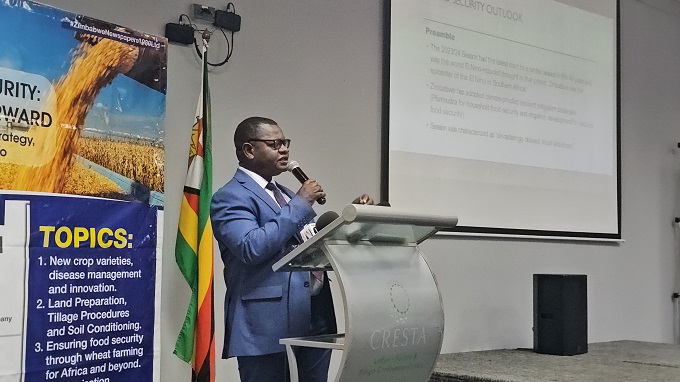
Business Writer
Zimbabwe is well on its way to achieving its 2024 winter wheat targets, with most of the key factors needed for a successful season in place, the Business Weekly can report.
The Ministry of Lands, Agriculture, Fisheries, Water and Rural Development has set a planting target of 120,000 hectares for this season.
Several key enablers are crucial for a successful winter wheat season, including the availability of power, water, seed, fertilizer, fuel, equipment, and capital.
Speaking at a conference themed “Wheat Based Food Security: Zimbabwe’s Best Foot Forward,” hosted by Zimpapers through B-Metro and The Knowledge Centre, Permanent Secretary Professor Obert Jiri of the Ministry of Lands, Agriculture, Fisheries, Water and Rural Development stated that the targeted yield of 600,000 tonnes is achievable if the nation collaborates on winter wheat production.
He explained that the ministry is working closely with stakeholders who play a critical role in enabling wheat production and productivity.
Professor Jiri assured that the power utility, Zimbabwe Electricity Transmission and Distribution Company (ZETDC), is providing 300 megawatts of electricity, which is more than sufficient to meet the needs of wheat production.
“The power utility is making every effort to ensure we receive our allocated power supply,” said Professor Jiri.
The Zimbabwe National Water Authority (ZINWA), responsible for the country’s water resources, has also committed to ensuring adequate water for irrigation.
“The Chief Executive Officer of ZINWA has clearly communicated the availability of water in this country. The short message is that there is enough water for any farmer who wants to grow wheat,” said Professor Jiri.
Regarding seed availability, Professor Jiri explained that the targeted planting area of 120,000 hectares requires 15,000 tonnes of seed. However, there is currently a shortfall of 2,336 metric tonnes, which would only cover a planting area of 101,312 hectares.
Another key enabler is fuel access. Professor Jiri said farmers will have access to fuel, which can be partially paid for in local currency (ZiG) at Petrotrade stations through the Agriculture and Marketing Authority.
“We are also working diligently to ensure that farmers can access fuel. We are grateful for the ZiG initiative, which now allows farmers to access fuel in local currency for tillage and other farming operations,” said Professor Jiri.
Over the years, farmers have faced delays in receiving payment for their deliveries to the Grain Marketing Board (GMB). Professor Jiri assured that the Government, through the GMB, is making strides to clear outstanding arrears owed to farmers.
“The government has made significant progress in just two weeks, reducing the US$34 million owed to farmers to less than US$15 million, which will be paid this week,” added Professor Jiri.
Finally, pre-emergency weed control chemicals have been made available to ensure a smooth start to wheat production.
Professor Jiri concluded by stating, “We have also implemented measures to ensure that no grain will be lost to quelea birds.”



 Online Reporter