Nqobile Bhebhe, Zimpapers Business Hub
ZIMBABWE stands out as the clear front-runner among African lithium producers by 2030 as global demand for lithium accelerates, driven by electric vehicles and battery storage as the world transitions to clean energy, a new report shows.
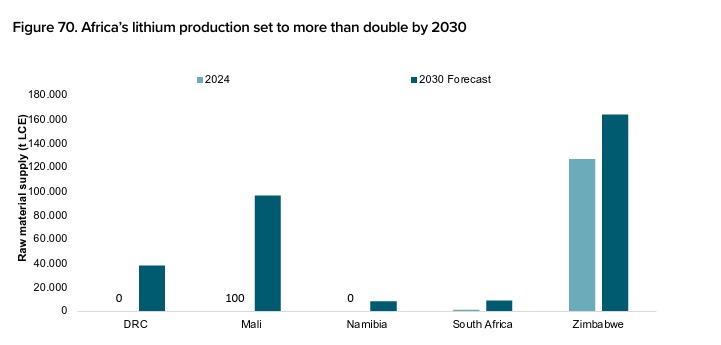
According to the African Energy Chamber’s State of African Energy 2026 report, data shows that while Africa’s overall lithium production is expected to more than double by 2030, Zimbabwe already leads the pack and is projected to widen that lead further.
The report notes that in 2024, Zimbabwe featured prominently in the global lithium production landscape, with two of the top 10 lithium-producing projects located in the country.
These projects collectively accounted for 7.42 percent of global lithium output, highlighting Zimbabwe’s growing strategic importance in the lithium supply chain, it said.
In 2024, Zimbabwe accounted for the largest share of lithium supply on the continent, producing well over 100 000 tonnes of lithium carbonate equivalent (LCE).
By 2030, its output is forecast to rise substantially, reaching around 160 000 tonnes LCE, far ahead of any other African country.
By comparison, Mali, the second-largest producer in the forecast, is expected to reach close to 95 000 tonnes LCE by 2030.
The Democratic Republic of Congo (DRC), Namibia and South Africa remain relatively minor contributors, each producing a fraction of Zimbabwe’s projected output.
This gap highlights Zimbabwe’s dominant role in shaping Africa’s lithium supply over the coming decade.
Continued investment, expanding processing capacity and strong interest from international battery and electric vehicle supply chains have positioned the country as a strategic supplier in the global lithium market.
The report notes that lithium in Africa is mainly mined from hard rock deposits.
It is extracted from a mineral called spodumene and turned into concentrate before being shipped for further processing.
“Africa produced 124 230 metric tonnes of lithium carbonate equivalent (LCE) in 2024. The output is expected to grow by over 150 percent by 2030, led by Zimbabwe, Mali and new projects in the DRC, Ghana and Namibia.
“The continent holds 26.7 million metric tonnes of identified lithium resources, accounting for 5 percent of the global total,” reads part of the report.
It added that Africa has transitioned from exporting raw lithium ore to shipping concentrate; however, battery-grade chemical refining remains limited, currently viable only in Morocco.
“Governments are increasingly promoting local value addition, with countries such as Zimbabwe, Ghana, the DRC, Namibia and Tanzania banning lithium ore exports and imposing higher export taxes on less-processed forms (lithium ore) to encourage domestic processing.
“Zimbabwe is leading beneficiation efforts, having banned lithium ore exports and introduced a two percent royalty on lithium sales, while advancing a US$450 million refinery at the Mapinga Industrial Park.”
According to the report, Africa’s lithium mines are cost-competitive, with production costs ranging from US$250 to US$650 per metric tonne of spodumene concentrate, well below the global benchmark price of approximately US$800 per metric tonne on a Free on Board (FOB) Australia basis.
Several projects have been developed quickly and at relatively low capital costs, particularly in Zimbabwe and Mali.