Online Reporter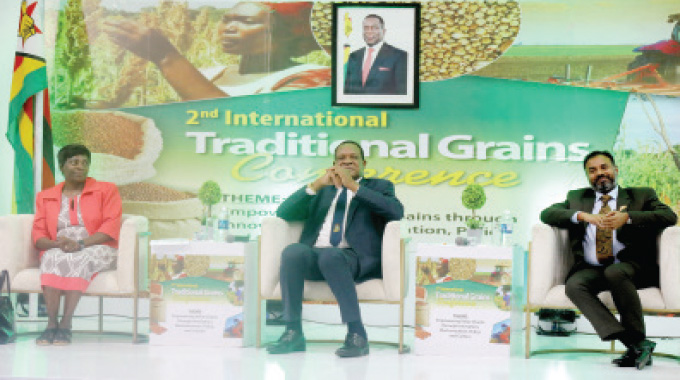
Judith Phiri, Zimpapers Business Hub
LANDS, Agriculture, Fisheries, Water and Rural Development Minister, Dr Anxious Masuka, has rallied Zimbabwean farmers to ramp up production of traditional grains and move away from labelling them “small grains,” saying the term undermines their critical importance to national food security, nutrition and climate resilience.
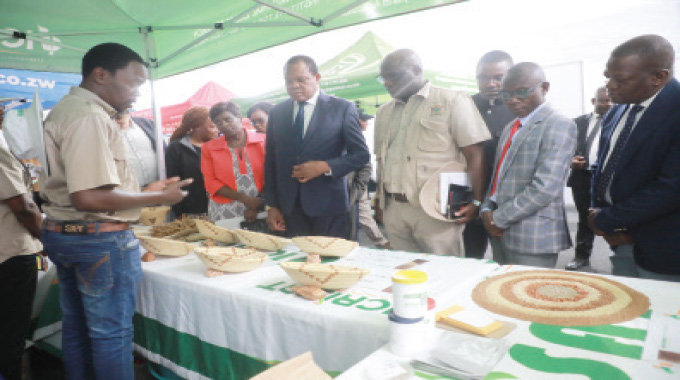
Speaking in Bulawayo while officially opening the 2nd International Traditional Grains Conference hosted by Zimpapers’ Sunday News in partnership with International Crops Research Institute for the Semi-Arid Tropics (Icrisat) on Friday, Dr Masuka said traditional grains are neither orphaned nor neglected crops, but strategic commodities essential to Zimbabwe’s agricultural transformation.
“The recent emphasis to call traditional grains, small grains exhibit small brains. Traditional grains are ecologically suited to our country and have better nutrition and health characteristics compared to maize, for example,” he said.
He highlighted that Government is aggressively promoting both production and consumption of traditional grains.
“In 2020 only eight percent of cereals were traditional grains, in 2025 it is 28 percent,” he noted.
Dr Masuka revealed that during the 2024/25 season, Zimbabwe produced 634 650 metric tonnes (MT) of traditional grains with sorghum recording 436 784MT (432 percent increase), pearl millet: 188 261MT (703 percent increase), and finger millet 9 605MT (136 percent increase).
Under the Agriculture, Food Systems and Rural Transformation Strategy 2 (AFSRTS 2) (2026–2030), he said traditional grain volumes are expected to grow to 796 000 MT, while maize will rise to 3 million MT.
“We believe this is a good balance, as consumption of maize is predicted to be 1,593,278MT,” he said.
However, he acknowledged several barriers still hinder wider adoption, including low yields from open pollinated varieties, pest and disease burden, labour-intensive production, post-harvest challenges and consumption patterns shaped by preference for maize, rice and Irish potatoes.
“There is also the bird menace for pearl millet and sorghum during harvest,” he added.
Dr Masuka said increased production must be supported by modern agronomy, data-driven farming and improved genetics. He paid tribute to scientists contributing to this progress.
“Our own Dr Mushonga received the ‘Commendation Medal’ . . . and the ZPBA Honorary Life Award . . . for the outstanding work in developing and releasing improved traditional grain varieties,” he said.
The minister also stressed the need to change public perception — especially among youth — towards traditional foods.
“Chefs, restaurants, fast food outlets must collaborate and begin to have traditional grains alongside exotic dishes,” he said, applauding the efforts of First Lady Dr Auxillia Mnangagwa, whom he described as “our culinary and gastronomic Ambassador.”
Dr Masuka revealed that 1 384 700 beneficiaries in Agro-regions IV and V will receive traditional grain seed under the Presidential Inputs Programme this season.
He affirmed his commitment to attending next year’s edition to review progress in scaling up traditional grain adoption.
AFSRTS 2 was launched by President Mnangagwa in October in Mutare, succeeding the first strategy, which expanded the agriculture sector from a US$5,6 billion industry in 2020 to US$10,3 billion in 2025.
The 2nd International Traditional Grains Conference — running under the theme “Empowering Value Chains Through Innovation, Mechanisation, Policy and Culture” — was hosted by Zimpapers in partnership with Icrisat and the Ministry of Lands, Agriculture, Fisheries, Water and Rural Development.
It was attended by the Indian Ambassador to Zimbabwe, Amb Bramha Kumar and the Minister of State for Bulawayo Provincial Affairs and Devolution, Judith Ncube (represented) as well as stakeholders in the crop agriculture sector.
Traditional grains remain central to food security, nutrition and climate resilience, but unlocking their full potential requires innovation across production, processing, markets and consumption.