Online Reporter
Chronicle Writer
ZIMBABWE has gazzetted close to 50 agricultural commodities eligible for export trading riding on the establishment of the Zimbabwe Mercantile Exchange (ZMX)’s Warehouse Receipt System a few years ago.
Officiating at the Association of Commodities Exchanges Annual Conference which ended in Victoria Falls yesterday, Minister of Lands, Agriculture, Fisheries, Water and Rural Development, Dr Anxious Masuka, said the country was angling for huge spoils under the African Continental Free Trade Area (AfCFTA), which introduced a structured liberalised commodity-marketing framework, a departure from the centralised-government-controlled marketing system of the past.
Dr Masuka said the AfCFTA presents a unique continent-wide opportunity to deepen trade, enhance collaboration, and accelerate transformation of our economies.
He said the Agriculture, Food Systems and Rural Transformation Strategy (AFSRTS) launched in August 2020 by President Mnangagwa was meant to ensure national food security and sovereignty, contribute to nutrition security, improve livelihoods, contribute to economic development and contribute to peace and security through affirmation and re-affirmation of boundaries, which has set the tone for liberalising trade.
“In this context, the Warehouse Receipt System Act (Chapter 18:25) was launched in 2020 with the Zimbabwe Commodity Exchange (ZMX), in which Government has a shareholding, but operating independently under the Companies and Other Entities Act (Chapter 24:3), being operationalised in 2022 to provide an additional marketing platform for farmers to act as a platform to mobilise resources to finance agriculture and to act as a price discovery platform,” said Dr Masuka.
“To date, I have gazetted 48 commodities for trade eligibility on the Warehouse Receipt System that anchors the ZMX’s operations.
“These commodities range from maize, cotton to livestock, wheat, soya beans, red and white sorghum, sugar beans, white rice, and rice bran,” he added. Minister Masuka said ZMX has established a network of 33 warehouses providing 642,000 metric tonnes of storage space in seven of the country’s 10 provinces.
Dr Masuka said ZMX is increasingly becoming an active trading platform, as farmers and traders become more aware of its utility as an exchange mechanism that guarantees more timeous payments. He said ZMX is also exploring a robust forward and future contracts platform, which dovetails with intra-continental trade, by providing a structured and transparent market mechanism that enhances price discovery, mitigates risks, and ensures supply chain predictability.
The establishment of the AfCFTA Association of Commodity Exchanges (A-ACX) is a testament to Africa’s collective desire and commitment to achieve economic integration through efficient and transparent commodity markets.
By facilitating secure and reliable forward and futures contracts, the ZMX can empower farmers with guaranteed off-take agreements, reducing post-harvest losses and improved financial planning, said Dr Masuka. He said Zimbabwe is building capacity to export key commodities. The country boasts of surplus yield in a number of products in the past few years. Zimbabwe now has an annual surplus of wheat of about 250 000 metric tonnes, 290 million kilograms of tobacco, as well as surplus sugar and many horticultural products.
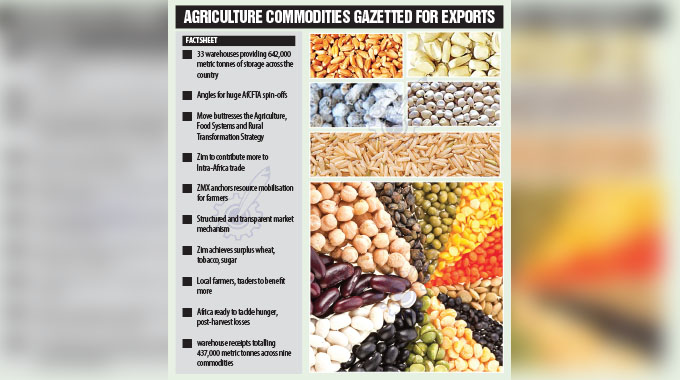
He said warehouse receipts totalling 437,000 metric tonnes across nine commodities (maize, wheat, soya beans, red and white sorghum, ginned cotton seed, sugar beans, white rice, and rice bran) have been cumulatively issued by ZMX, which is now operating weekly auctions.
“As Africa still imports US$80 million to US$100 billion worth of food annually, Zimbabwe is actively exploring the export opportunities brought about by the AfCFTA and A-CX,” said Dr Masuka.
“With enhanced value-addition and beneficiation, coupled with the creation of competitive production and pricing models, establishment of risk mitigation through appropriate insurance models, the increasing use of innovative payment platforms and use of more efficient logistics and transportation networks, Zimbabwe can indeed contribute to stable, affordable, and friendly intra-Africa trade.” Dr Masuka said the conference, which ended yesterday, under the theme: “Scaling Intra-African Trade: Leveraging Commodity Exchanges for Economic Resilience and Growth,” has created a platform for driving the continent towards ‘Agenda 2063: The Africa We Want’ targets.
Speaking on the same platform, Matabeleland North Provincial Affairs and Devolution Minister Richard Moyo called for strengthening of commodity exchanges and enhancing intra-African trade for sustainable economic growth.
“Let’s embrace the spirit of unity and collaboration to build stronger trade networks and market systems that will benefit the entire African continent,” he said.
ZMX chief executive, Mr Collen Tapfumaneyi, said there is a need to address the paradox of abundance and scarcity where the continent has immense wealth of natural resources and human capital yet millions grapple with poverty and hunger.
He said the AfCFTA is a key driver in implementation of Sustainable Development Goals (SDGs) by creating a single market for goods and services.
“ZMX is excited to have embarked on the journey to achieve this, and through its membership in the AfCFTA, it aims to improve access to markets, and ensure access to markets,” said Mr Tapfumaneyi.
“At continental level, Africa is also leading its own initiatives to tackle the pressing issues of hunger, post-harvest losses, enhance intra-continental trade, promoting value addition, investment in storage and logistics, and market linkages that ensure farmers and producers get fair returns for their goods.
“By unlocking trade barriers and fostering industrialisation, AfCFTA is not only a tool for economic growth but a vital instrument in the fight against hunger and poverty.”
ZMX is a founding member of the AfCFTA Association of Commodities Exchanges and together it is keen to build a more interconnected and resilient African economy.