


 Chronicle Editor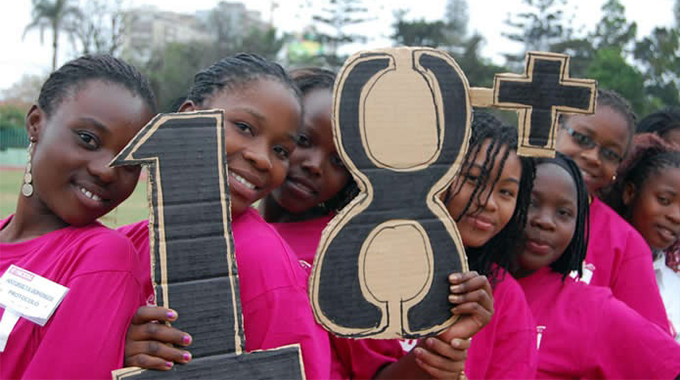
Yoliswa Moyo, Features Editor
WHAT is most striking about the Criminal Laws Amendment (Protection of Children and Young Persons) Bill, 2024, which raises the age of consent from 16 to 18 is that even if they have consented, it is still illegal to have sex with a person under the age of 18.
It had become quotidian that a 12-year-old girl could be “in love” with a 19-year-old man, and consent to sexual intercourse and some sections of society found it in fine fettle.
How could a child, because that’s what a 12-year-old is, consent to sexual intercourse? For years, we have watched young girls being married off at a tender age, sexual offenders walking scot-free while others received light sentences for bedding minors.
In many African homes, once a girl fell pregnant, she was sent off to become the man’s wife, even when she was just a child herself. Some Apostolic sects had normalised marrying off young girls as young as nine, to men old enough to be their grandfathers yet no real action was taken against the instigators neither did legal instruments fully protect the rights of the child.
In some cases, issues of sexual abuse were swept under the carpet with parents and guardians accepting various forms of tokens from perpetrators to keep it hush.
The issue of the legal age of consent to sex and the legal age of marriage in Zimbabwe had been a minefield dating as far back as 2014 when child’s rights activists, politicians, lawyers and women’s groups debated on the failure of the law to protect children, particularly girls.

In 2013, when a magistrate sentenced a man who had sex with a 14-year-old girl to an effective 12 months in jail, a judge rebuked her on appeal, saying it was “an extremely harsh sentence that she imposed without any plausible justification as it would have the effect of further prejudicing the accused person.”
On appeal, Justice Andrew Mutema blasted the magistrate for being “too harsh”. The judge, citing earlier cases to buttress his point, added: “Her appearance is important because the moral blameworthiness of the man will be less if he wrongly believes, from her appearance, that she is older than she actually is.
Similarly, the girl’s character — whether she be virgin or promiscuous, a flirt or demure — must have a like bearing on whether the accused was knowingly preying on the innocent or merely risking lying with an under-age but worldly-wise girl.”
In April 2013, Plumtree magistrate Mr Livard Philemon sentenced a 19-year-old man who impregnated his employer’s Grade 7 daughter (13) to 315 hours of community service. While observing that Conscience Nleya, of Bulilima, had “destroyed the girl’s future”, Philemon still handed out the light sentence.
During the same year in May, Future Ncube, a 19-year-old Kezi herdsman who impregnated his 12-year-old “lover” was sentenced to perform 210 hours of community service by Gwanda regional magistrate Mr Joseph Mabeza.
The magistrate said while passing sentence: “Both of you exhibited immaturity and you were oblivious of the dangers of engaging in sexual intercourse.”
Many other cases followed over the years and light sentences continued to be dished out. Child sex predators were getting away with community service sentences and magistrates and judges were reluctant to pass exemplary punishment.
The previous law presented a challenge as the age of consent for sexual intercourse was 16 but 18 for marriage, which meant that girls were exposed and vulnerable as men could “use” them and sleep with them knowing that should things go wrong and they fell pregnant, they would walk away easily citing that the law doesn’t allow them to marry “minors”.
The age of consent at 16 was indirectly discriminatory towards girls based on gender, as only girls suffer the consequences of pregnancy and related social, economic and health implications.
Child rights activists argued that the age of consent at 16 was discriminatory towards girls as it disproportionately compromised their health, education, human dignity and best interests’ rights. Section 70 of the Criminal Code set the age of sexual consent at 16, which they argued failed to grant the same protection to minors aged 16 and 17 that it granted to children Under-16.
The General Laws Amendment Act, 2016 aggravated this age discrimination by creating a provision that subjected those aged 16 and 17 to criminal prosecution for engaging in sexual activity with children under the age of 16, while children under the age of 16 were virtually free from criminal prosecution for engaging in the same activity.
The differences in law exposed those aged 16 and 17 to sexual exploitation while raising the age of consent to 18 would at least deter men, especially older men, from engaging in relationships with girls under the age of 18.
At the height of the Covid-19 pandemic when lockdowns were imposed to control the spread of the virus, 5 000 girls were reported to have fallen pregnant and dropped out of school. The statistics were overwhelming and legal instruments for prosecution were inadequate.
President Mnangagwa recently signed into law, the Criminal Laws Amendment (Protection of Children and Young Persons) Bill, 2024, raising the age of consent from 16 to 18 and protecting young people from sexual predators and early marriages.
This was announced in a proclamation under General Notice 1441A of 2024 in an Extraordinary Government Gazette published two weeks ago by the Chief Secretary to the President and Cabinet, Dr Martin Rushwaya.
The amendment was passed by both Houses of Parliament in July. The new law comes following a Constitutional Court ruling in May 2022 which found that the Criminal Law Code did not adequately protect children between the ages of 16 and 18 from sexual exploitation.
Under the new law, the age of sexual consent has been raised to 18, consistent with the Constitution, which sets the minimum marriage age at 18 and defines all young people as those below the age of 18.
In the original law, young people were defined as those below the age of 16, meaning those aged between 16 and 18 were not protected.

Following the ruling, President Mnangagwa invoked his powers in January this year under the Presidential Powers (Temporary Measures) Act to gazette Statutory Instrument 2 of 2024, in compliance with the Constitutional Court ruling that had declared unconstitutional, the section of the law that set the age of sexual consent at 16.
The temporary measures were only valid for six months as required by law, meaning a substantive law had to be promulgated. This resulted in Parliament passing the new law.
In a statement, Unicef said raising the age of consent for sexual relations to 18 years would contribute to a reduction of sexual abuse of children and adolescents, which continues to be a concern in Zimbabwe.
“Available data suggests that in Zimbabwe, over a third of girls experience sexual violence before the age of 18 years. For most of these girls, the perpetrators are intimate partners. Sexual violence on children has a significant impact on girls and boys who experience it. The effect is both physical as well as psychological,” reads the statement in part.
“As Zimbabwe implements the new legislation, Unicef calls on the Government to continue to invest in the prevention of sexual abuse of children and support to victims.
Based on the lessons from existing initiatives by the Government and partners, prevention and support programmes must be continued and scaled up. Everybody in Zimbabwe must understand that sexual abuse of children is not acceptable, and they need to act accordingly and speak up.”
Unicef also called on all stakeholders to continue guaranteeing access to friendly services to promote health, well-being, and protection for adolescents and young people.
“Children deserve to grow up in a safe environment. It is our shared responsibility to break the silence, to help prevent sexual abuse of children, and by extension all forms of violence against children, and to ensure children that are victims of violence, abuse and exploitation get the attention, assistance and support they need,” reads the statement.
Ms Ekenia Chifamba, director of the girls’ rights group, Shamwari Yemwanasikana, said she hopes the change will deter pedophiles.
“We were disgruntled in instances where we would see perpetrators’ penalties that were not favourable — some of them being given community service – while the girl would have to deal with key issues that mattered, which included their health,” she said.
Some girls would go for backyard abortions while others struggled with their mental health. A significant number of girls have to drop out of school after becoming pregnant, despite the Education Amendment Act adopted in 2020 which prohibits exclusion based on non-payment of fees and pregnancy as well as discrimination based on pregnancy regarding admission, suspension, exclusion and expulsion.
Constitutional law expert, Professor Lovemore Madhuku, described the Criminal Laws Amendment (Protection of Children and Young Persons) Bill, 2024 law as progressive.
“This is a law that is progressive and conforms with international best practices and standards. It also aligns the law with the Constitution in line with the ruling of the Constitutional Court,” he said.
Prof Madhuku said the new law also provides harsher penalties of up to 10 years in prison for people that abuse children, which was previously not the case.
He added that by stating that people below 18 cannot consent to sex, it means that people who have sex with those below 18 cannot use it as a defence, even in cases where they would have consented.
Prof Madhuku commended provisions that punish people who infect children and young persons with sexually transmitted infections, including HIV.
According to a study by Amnesty International, adolescents in Zimbabwe did not know how to protect themselves from unintended pregnancies and sexually transmitted infections, including HIV.
Entrenched taboos around adolescent sexuality, barriers to health services and a failure to provide comprehensive sexual education in schools keep adolescents dangerously cut off from information that is vital to protect their well-being and futures.
The study also highlighted that girls who became pregnant also faced human rights violations. Some were pressured to drop out of school or forced into an early marriage. Others were ostracised by their communities and shunned by their families.
Meanwhile, Zimbabwe’s demographic health data indicates that nearly 40 percent of girls and 24 percent of boys are sexually active before they reach the age of 18.
Some may be freely choosing to engage in sexual activity, while many others are victims of child marriage, sexual violence or exploitation.
Whatever the case may be, the new law is expected to protect children from sexual abuse and early marriages. – @Yolisswa Ends



 Bongani Ndlovu
 Online Reporter