Online Reporter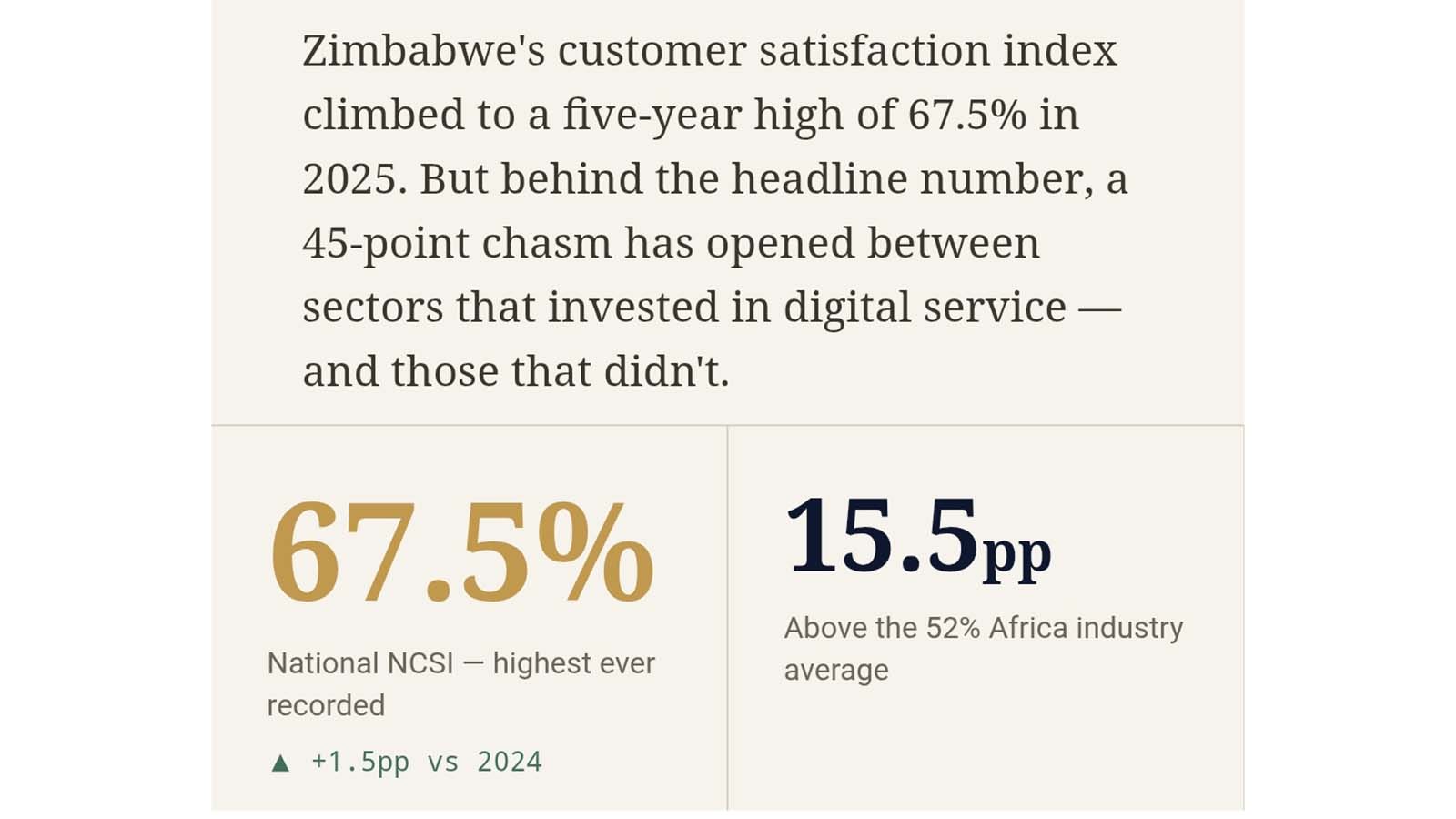
Tawanda Musarurwa
ZIMBABWE’S customer satisfaction score climbed to 67,5 percent in 2025, its highest mark in at least five years, according to the National Customer Satisfaction Index report launched last week by the Chartered Institute of Customer Management and the Customer Experience Association of Zimbabwe (CXAZ).
The report was launched at the 10th annual Customer Experience Conference held in the capital last week, which saw local and regional customer experience experts converge to chart a new path for the industry.
On the surface, it is an unambiguous good-news story: a 1,5 percentage point gain on 2024, a 7,3-point climb since the pandemic trough of 2020, and a score that sits more than 15 points above the 52 percent African industry average cited in the report.
But, buried in the index’s sector-by-sector breakdown is a more uncomfortable narrative — one of a two-speed economy, where customer experience has become almost a proxy for who has invested in digital infrastructure and who has not.
The report, compiled from 15 000 respondents across all ten provinces between September 2025 and January 2026, found a 45-percentage-point spread between the best- and worst-performing sectors — the widest gap in the index’s history.
Hotels and lodges topped the table at 89 percent, followed by tour operators at 84 percent and funeral assurance providers at 85 percent.
At the bottom, local authorities scored just 44 percent, with regulatory and public service agencies at 50 percent and hospitals and clinics at 52 percent.
The pattern is strikingly consistent: every sector scoring above 75 percent is privately run and has made verifiable investments in digital platforms, contact-centre capacity and frontline training.
Nearly every sector below 55 percent is lightly regulated.
Local authorities’ net promoter score actually fell 28 points year-on-year even as its raw satisfaction score ticked up a single point — a sign, the report’s authors argue, that small service improvements are no longer enough to rebuild trust once it has eroded.
Banking offers the clearest digital-dividend story in the data. The sector’s score rose from 62 percent in 2022 to 75 percent in 2025, with customers rating digital adoption at 9.5 out of 10 — yet perceived value lags at 64, suggesting Zimbabweans believe banks have modernised faster than they have lowered fees.
Healthcare tells a starker version of the same divide: private hospitals scored 71 percent against just 41 percent for public facilities, a 30-point gap the report calls a patient-safety issue given emergency responsiveness ratings of just 4.8 out of 10.
Mobile financial services emerged as the index’s most improved sector over five years, gaining 21 percentage points to reach 79 percent, with the highest perceived-value score in the entire report at 83.
International remittance services, newly added to the index this year, debuted at 64 percent despite Zimbabweans sending an estimated US$1,8 billion annually through formal channels at fees of 5 to 12 percent — three to four times the World Bank’s 3 percent target, a cost the report says falls hardest on the country’s most economically vulnerable households.
Real estate, also new to the index, entered at a modest 59 percent after mystery shopping found that 59 percent of agents gave materially inaccurate property information — what the authors describe as Zimbabwe’s most urgent consumer-protection gap.
Said CXAZ secretary-general Dr Rinos Mautsa: “This year’s NCSI tells us that customer experience has become a real measure of institutional readiness — not a soft metric, but a hard signal of who is investing in the future and who still has work to do.
“The 45-percentage-point spread between our strongest and weakest sectors is the widest we’ve recorded, and it should focus minds.”
The index’s message for 2026 is that closing the headline satisfaction gap matters less now than closing the loyalty gap.
“Sectors with strong advocacy scores are compounding their advantage through repeat business, while public agencies posting negative recommendation scores risk a widening credibility deficit no incremental survey gain can fix,” said customer experience expert Mr Richard Nyoni.