

 Online Reporter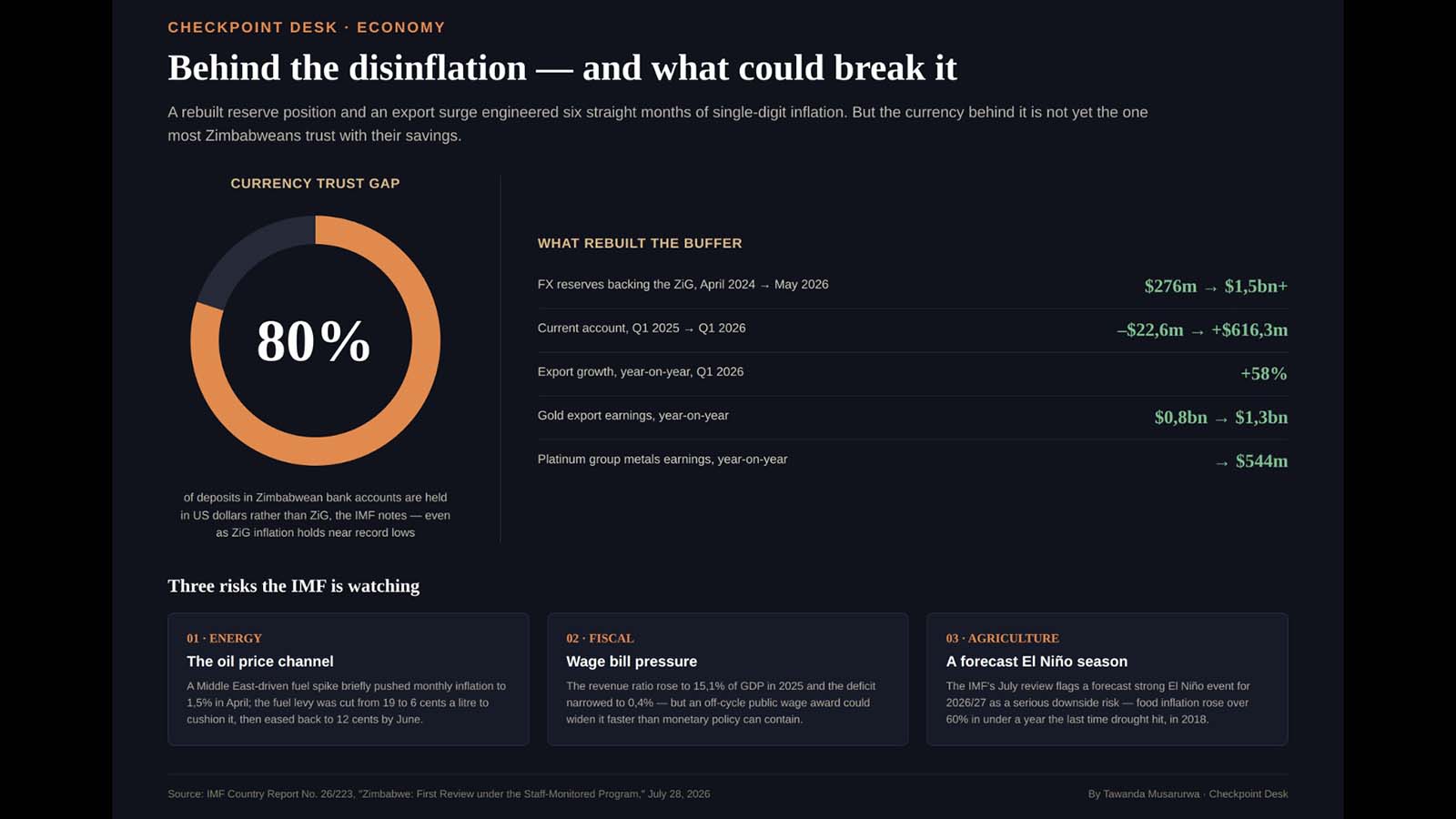
Tawanda Musarurwa
CHECKPOINT DESK
ON March 18, 2026, the Reserve Bank of Zimbabwe (RBZ) confirmed that annual local currency inflation had entered single digits for the first time in more than three decades, holding at 4,4 percent.
Nine days later, the International Monetary Fund (IMF) approved a 10-month Staff-Monitored Programme (SMP), adding outside verification.
On July 27, the Fund’s Executive Board cleared the programme’s first review, confirming every end-March target was met, including the floor on net international reserves and the ceiling on ZiG monetary base growth.
The check matters: Zimbabwe’s inflation history includes a year when official estimates stopped being meaningful, so an independently verified reading carries more weight than any figure produced in recent memory.
Finance, Economic Development and Investment Promotion Minister Professor Mthuli Ncube, speaking at the Insurance and Pensions Symposium in Victoria Falls earlier this year, said the milestone matters for institutional investors and ordinary citizens alike.
“Single-digit inflation will also allow us as an economy to develop a proper yield curve for our fixed income market, which is where your pension funds want to play,” he said.
“We need a proper yield curve so that we know what the yields for 90 days, 180 days, one year, two years, five years, and 10 years.”
A yield curve maps borrowing costs across time and needs stable prices to function. IMF studies put developing economies’ growth-supporting inflation threshold at 7 percent to 11 percent.
The Southern African Development Community’s convergence framework targets 3 percent to 7 percent annually; COMESA targets below 5 percent.
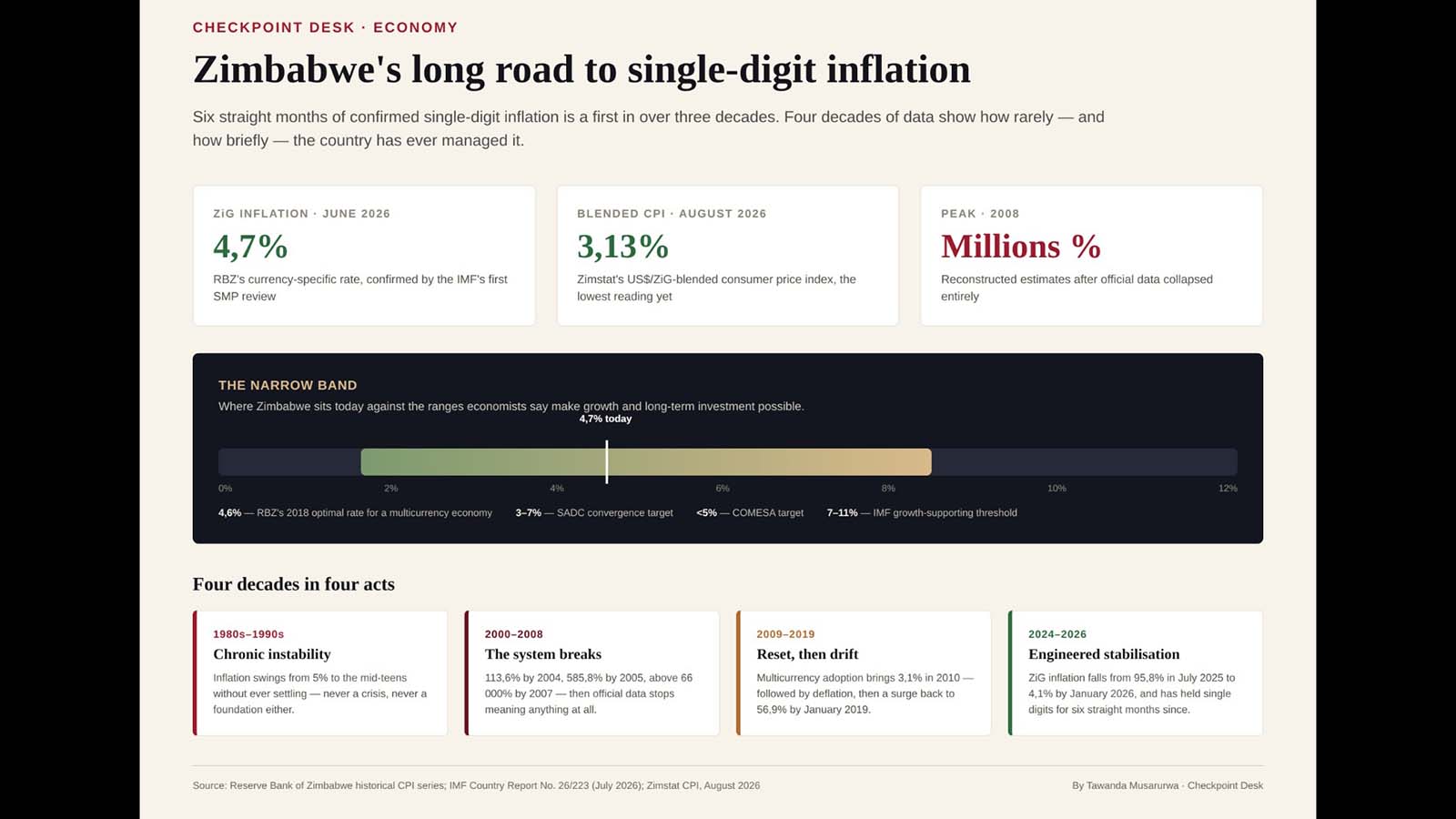
The RBZ’s 2018 research calculated the optimal rate for a multicurrency economy at 4,6 percent.
Since March, the rate has stayed inside that band: 4,8 percent in April, 4,4 percent in May, 4,7 percent in June – the most recent month confirmed through the IMF review.
ZimStat’s broader, currency-blended CPI, mixing US dollar and ZiG purchases, ran lower: 3,2 percent in July, 3,13 percent in August, the clearest sign the stabilisation has outlasted any single reading.
A rare band
RBZ statistics show how seldom Zimbabwe has held that range. Inflation stood at 15,2 percent in 1979, eased to about 5 percent in 1980, rose to roughly 13,9 percent in 1981 and 12,5 percent in 1982, then to about 31,9 percent in 1983, staying positive but volatile through the mid-1980s and 1990s.
The early 2000s marked a structural break: after 4,5 percent in 2000, inflation reversed violently, reaching 113,6 percent by 2004 and 585,8 percent by 2005; reconstructed estimates put it above 66 000 percent by 2007. In 2008 official data collapsed entirely, with alternative estimates running into the millions.
RBZ research found inflation above roughly 40 percent in the late 1990s triggered sustained contraction.
Mrs Memory Makuwe remembers payday in mid-2008: “You could get paid in the morning and by afternoon it was already not enough. We stopped planning; you just bought whatever you could, immediately.”
The multicurrency regime adopted in 2009 collapsed inflation to 3,1 percent in 2010, 3,5 percent in 2011 and 3,7 percent in 2012 – briefly within the growth-supporting band – before prices fell below zero: -0,2 percent in 2014, -2,4 percent in 2015, -1,6 percent in 2016.
Economist Mr Tinashe Mukuni said the deflation carried its own hazard: “You cannot price long-term risk in an economy where even short-term price direction is unreliable.” Inflation surged again, reaching 42,1 percent by December 2018 and 56,9 percent by January 2019.
The current stabilisation was built over nearly two years. The ZiG launched in April 2024, when reserves stood at just US$276 million, central bank data show.
By the start of this year reserves had grown to US$1,169 million; by end-May they had passed US$1,5 billion, the IMF’s July review shows – more than a fivefold increase in just over two years.
Annual ZiG inflation had peaked at 95,8 percent in July 2025, easing to 15,0 percent by December, then to 4,1 percent by January 2026 – single digits for the first time since launch – and has since drifted between 3,8 percent and 4,8 percent through June.
Exports rose 58 percent year-on-year in the first quarter of 2026, the IMF found, led by gold, platinum group metals and lithium.
Gold exports climbed to US$1,3 billion from US$0,8 billion; platinum group metal earnings more than doubled to US$544 million; lithium exports, boosted by new local value-addition rules, reached US$184 million after resuming in April at higher scale.
Imports rose 30 percent on higher fuel prices and machinery demand. The current account swung from a US$22,6 million deficit in the first quarter of 2025 to a US$616,3 million surplus in the first quarter of 2026, the IMF has recorded, building on a 2025 in which merchandise exports rose 34,4 percent to US$10,5 billion and the full-year surplus widened to about US$2,1 billion, or 3,6 percent of GDP, from US$501,2 million in 2024.
The parallel market premium – a gauge of distrust in the local currency – narrowed and stabilised through 2026, IMF staff said, as the RBZ kept intervening using surrender-requirement proceeds.
The central bank held its policy rate at 35 percent for much of the disinflation before cutting it to 30 percent in June, calling it a recalibration, not a loosening.
The IMF has urged caution, saying the cut should be reversed if Middle East energy-shock pressures build.
What low inflation feels like
Ms Grace Murambinda* (not her real name), who runs a stationery and printing shop in Harare’s Avondale suburb, said the slowdown is real but narrow.
“The rate of price changes has definitely slowed. I can plan stock now; I know roughly what things will cost next month,” she said.
“The problem is that everything is still expensive from where prices were. Stability at a high level is not the same as things being affordable.”
Zimbabwe’s struggle is not inevitable for a developing economy at its income level, regional data show.
South Africa has kept inflation within its 3-to-6 percent target band for most of the past decade under formal targeting adopted in 2000. Botswana has held low single digits since the early 2010s; Tanzania has stayed below 4 percent for much of the past three years; Mozambique has anchored inflation below 5 percent since 2021, after a 2016 debt crisis.
Zambia offers the closest parallel: inflation peaked above 24 percent in 2021 after a currency collapse and fiscal overrun, before IMF programme discipline and kwacha stabilisation brought it below 14 percent by early 2026 – a four-year process still short of the band where long-term investment becomes viable.
Zimbabwe compressed from a peak above 95 percent to single digits in about six months, extraordinary by regional and global standards.
What could break it
The RBZ and the IMF’s July assessment flag several risks. The most immediate remains oil: a Middle East-driven fuel spike pushed monthly inflation to 1,5 percent in April, prompting the Government to cut the strategic fuel levy from 19 to 6 cents a litre, then ease it to 12 cents in June. Zimbabwe has avoided fuel shortages, and second-round effects have so far been contained.
The second risk is fiscal. The revenue ratio rose from 14,3 percent of GDP in 2024 to 15,1 percent in 2025, and cash budgeting narrowed the deficit to 0,4 percent of GDP with a primary surplus of 0,2 percent.
The IMF’s projections assume the wage bill ratio stays “broadly flat” only if spending discipline holds; an off-cycle wage award could widen the deficit faster than monetary policy can contain.
The RBZ’s August 2025 Monetary Policy Statement set a hybrid approach – price stability as the primary objective, the exchange rate as an intermediate target, reserve money as the operational target – rather than full inflation targeting.
The central bank and Finance Ministry are developing a longer-run strategy toward a single-currency system and formal inflation targeting, though no transition date has been set.
The third risk is agricultural. The Fund’s July review flags a forecast strong El Niño event as a serious downside risk for 2026/27, following an El Niño-induced drought in 2024.
A renewed drought would hit food prices directly; food inflation rose more than 60 percent in under a year in 2018.
The currency itself carries risk: roughly four in five dollars in Zimbabwean bank accounts are held in US currency rather than ZiG, the IMF notes, and ZiG-denominated lending has stayed flat because real lending rates remain high.
A weaker commodity export picture or a wider parallel market premium would test an exchange-rate architecture reserve accumulation alone cannot resolve.
The full arc
The pattern across four decades is consistent: chronic instability through the 1980s and 1990s, catastrophic overshoot from 2000 to 2008, a brief settlement after 2009 followed by deflation and renewed surge, and now six consecutive months of single-digit inflation confirmed by the IMF, with ZimStat data suggesting the run has reached a seventh and eighth month.
The gap between growth and contraction is measured in a few percentage points, and it remains near zero even after an energy shock the IMF once feared could widen it.
The rest of the SMP, running through early 2027, will show whether Zimbabwe can hold that distance as fiscal, meteorological and geopolitical pressures compound.




 Bongani Ndlovu