

 admin
admin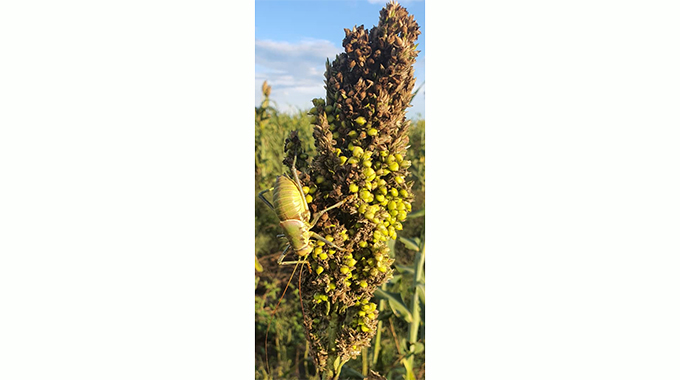
Sifelani Tsiko Agric, Environment & Innovations Editor
Farmers in the sorghum and millet growing regions in the Lowveld are facing a threat from the armoured bush cricket, a destructive but sporadic pest that consumes vast fields of small grain crops if left unchecked, a chief Government entomologist says.
Department of Migratory Pests and Biosecurity Control acting director Mr Shingirayi Nyamutukwa told The Herald on Wednesday that armoured bush crickets (ABC), considered a destructive pest and an even greater cause for concern than the fall armyworm, were devastating traditional grains Chiredzi, Checheche, Middle Sabi, Chisumbanje and with some few reports Mukumbura, Muzarabani and Mt Darwin.
“Armoured crickets are attacking traditional grains and we have also received reports of yellow aphids on sugarcane and maize in the Lowveld. As we speak right now, our teams are on the ground assisting with control activities,” he said.
“This is our major focus now. Armoured crickets feed directly on the grains and I have seen four variations of the pests.”
Plant disease experts say armoured bush crickets, (Orthoptera: Tettigoniidae, Hetrodinae) are destructive pests on smallholder farmer cereal crops in eastern and southern Africa.
They say major outbreaks usually occur when a relatively wet season follows several dry seasons in areas that receive an annual rainfall not exceeding 500 to 600 mm.
Armoured bush crickets, commonly known in Zimbabwe as mazekenene or mamunye, are destructive flightless species that typically grow to a body length of about 5cm and are known to attack or feed on crops such as pearl millet, sorghum and maize.
Plant experts also say they can also eat vegetables such as watermelons, cowpeas, pumpkins, ground nuts and beans.
“I have seen four variations of the armoured bush crickets. Some are edible but mostly those in the northern part of Zimbabwe in areas like Mukumbura, Muzarabani and Mt Darwin,” said Nyamutukwa.
“Our department Migratory Pests and Biosecurity Control is encouraging farmers to use Carbaryl baits or digging trenches around fields to control the crickets.”
Quelea and armoured bush cricket pest outbreaks threaten the food security and livelihoods of smallholder farming communities which grow small grain crops.
In some countries in southern Africa, armoured bush crickets have seen farmers losing between 70 – 100 percent of their crops.
Plant disease experts worry that the pest is destructive and can cause more damage than the fall armyworm (Spodoptera frugiperda) as it feeds indiscriminately on all crops.
Crop disease experts in Southern Africa are researching a digital solution that could help collect data to better understand the pest’s biology, ecology and development and help send alerts to extension officers in case of outbreaks.
At present, there is little information for extension officers and farmers in relation to armoured bush cricket outbreaks.
No digital supporting tool currently exists in tracking and forecasting the pest.
Nyamutukwa said the fall armyworm which was reported for the first time in Zimbabwe during the 2016 -2017 cropping season is no longer a threat for now.
“This one is no longer a threat. Usually as we approach March, the risk of outbreaks is reduced and our crops will not be vulnerable to attacks due to the advanced growth stage. The African armyworm populations do not survive our winter season and therefore become of less importance until we start another rainfall season,” he said.
The first report of the fall armyworm in Zimbabwe was in 2016 when the pest was detected in the Bubi district of Matabeleland North province.
In 2020 and 2021, Zimbabwe, Botswana, Namibia and Zambia experienced outbreaks of locusts that were controlled.
Heavy rains in the 2020 -2021 period created conducive conditions for swarms and moths to breed in these countries forcing plant protection agencies to take steps to control any outbreaks.
The fall armyworm pest was first reported in Africa in 2016. Native to the Americas, the fall army worm can feed on 80 different crop species, including maize — Africa’s major staple food consumed by more than 300 million on the continent.



 Online Reporter