Chronicle Editor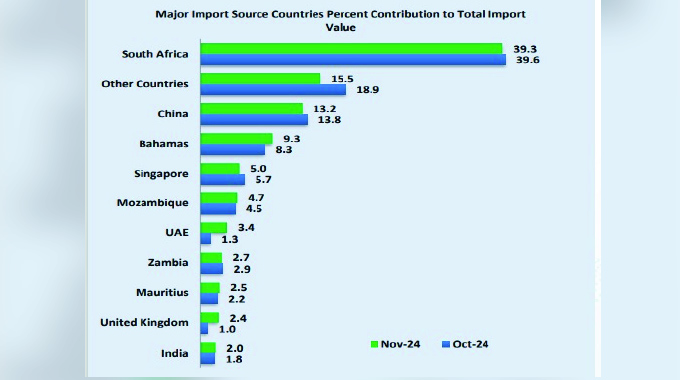
Sikhulekelani Moyo, [email protected]
ZIMBABWE’S trade deficit narrowed to US$46,9 million in November, representing a 60 percent decrease from US$137,8 million recorded in October, with the United Arab Emirates (UAE), South Africa, and China continuing to be the top export destinations, official figures show.
A trade deficit occurs when a country’s value of imports is greater than that of exports in a given period. When the value of exports exceeds the value of imports, it implies a trade surplus.
Latest data from the Zimbabwe National Statistics Agency (ZimStat) also reflects that the country recorded a 29,7 percent export increase to US$905,2 million from the October value of US$698,1 million.

“The November 2024 trade deficit for goods was US$46,9 million, translating to a 66 percent decrease from a deficit of US$137,8 million recorded in October 2024.
“Imports for November 2024 amounted to US$952,1 million, an increase of 13,9 percent from US$835,9 million recorded in October 2024,” said ZimStat acting director for macro-economics, Ms Mable Chimhore, during a recent external trade statistics presentation.
The narrowing trade deficit comes at a time when Zimbabwe is becoming more integrated into global supply routes, with new markets presenting export opportunities for local products and services.
According to ZimTrade, buyers across the world are now looking at Zimbabwe as a source market, with Zimbabwean products gaining mileage due to their high quality.
The growing appetite for Zimbabwean goods follows a robust campaign by President Mnangagwa to increase the visibility of local products in regional and international markets. With the current approach to economic diplomacy, several export promotion activities have been undertaken in recent years by ZimTrade.
ZimStat indicates that among the top 10 products exported in November were semi-manufactured gold (39,7 percent), tobacco (30,5 percent), and nickel mattes (11 percent). On the import side, mineral fuels constituted 22,1 percent, machinery and mechanical appliances (11,9 percent), cereals (9,1 percent), and vehicles (7,6 percent).
“Among the major source countries for imports in November 2024 were South Africa (39,3 percent), China (13,2 percent), Bahamas (9,3 percent), and Singapore (5 percent),” said Ms Chimhore.
“The four countries accounted for around 67 percent of the total import value of US$952,1 million.”
— @SikhulekelaniM1


 Online Reporter