Online Reporter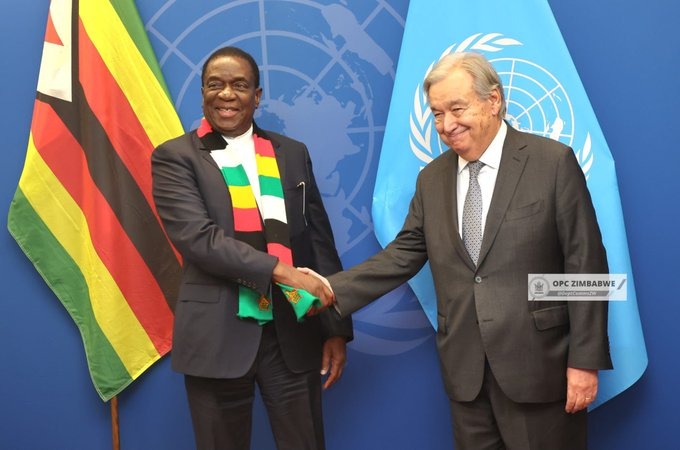
Gibson Mhaka [email protected]
FORMER Higher and Tertiary Education, Science and Technology Development Minister and political analyst, Professor Jonathan Moyo, has described President Mnangagwa’s participation at the 81st United Nations General Assembly (UNGA81) as a significant diplomatic milestone for Zimbabwe, saying the country is attending the global gathering with a new status as an incoming member of the United Nations Security Council (UNSC).
Zimbabwe was elected to the 15-member Security Council in June for the 2027–2028 term after garnering 182 votes from the General Assembly, securing the African seat.
It will take up its mandate on January 1 next year and is scheduled to assume the Council’s rotating presidency in June 2027.
Writing on his X handle, Prof Moyo said the significance of this year’s UNGA participation went beyond the annual diplomatic calendar, as Zimbabwe was now preparing to assume responsibilities at the centre of the UN’s international peace and security architecture.
“The captivating images and reports from the sidelines of #UNGA81 in New York leave little room for doubt: For the Zimbabwean delegation led by President Emmerson Mnangagwa, the 81st United Nations General Assembly is not yet another routine date on the diplomatic calendar,” he said.
“It is the first high-level week in which Zimbabwe is attending the annual UNGA meetings not merely as a campaigning state, but as an incoming member of the UN Security Council.”
His comments come as Zimbabwe steps up its diplomatic engagements in New York, with the country’s participation coinciding with the start of the UNGA81 high-level week.
The UN says the 81st General Assembly is being held under the theme “Restoring trust, managing transformation: A United Nations that delivers for all”, with world leaders focusing on peace, security, sustainable development and other global challenges.
Prof Moyo singled out President Mnangagwa’s meeting with UN Secretary-General António Guterres as one of the key engagements demonstrating the changed diplomatic circumstances under which Zimbabwe is participating at this year’s gathering.
“A notably high point of the sideline engagements ahead of the start of the official programme was President Mnangagwa’s meeting with the UN Secretary-General António Guterres,” he said.
“This on the back of Zimbabwe’s election in June 2026 by the General Assembly to a non-permanent seat in the Security Council for 2027–2028 with an overwhelming 182 votes.”
The meeting comes as Zimbabwe prepares to return to the Council for the first time since 1991–1992.
The UN’s official records list Zimbabwe’s previous terms on the Council, including 1991–1992, and its forthcoming 2027–2028 term.
Prof Moyo said the Guterres engagement should, therefore, be viewed against the backdrop of Zimbabwe’s forthcoming multilateral responsibilities.
“The country will take its place on 1 January 2027, returning to the Council for the first time since 1991–1992,” he said.
“The meeting, therefore, was more than perfunctory protocol. It placed Zimbabwe’s new multilateral mandate in the Security Council at the centre of its week in New York at #UNGA81.”
The President’s meeting with Guterres also comes at a critical juncture for the multilateral system, with the UN chief this week warning of deepening global divisions and calling for stronger international cooperation.
Addressing the opening of the General Debate, Guterres highlighted war and peace, inequality, climate change and artificial intelligence among the major tests facing the international system.
Beyond the diplomatic engagements, Prof Moyo said Zimbabwe’s UNGA programme was also being accompanied by efforts to attract international capital.
He pointed to a business dinner hosted by President Mnangagwa, which brought together 35 senior investors, with half of them reportedly considering Zimbabwe for the first time.
According to information released on the President’s official channels, Victoria Falls International Financial Centre chairman Marc Holtzman said reforms in mining, services, banking and monetary policy were generating interest among investors.
“The business opportunities are amazing. This is Africa’s century and within Africa it is Zimbabwe’s time,” said Mr Holtzman.
Prof Moyo said the remarks were significant because they came from an international financier rather than a Government spokesman.
“Coming from an international financier rather than a Government spokesman, the remark carried notable significance,” he said.
The business engagement forms part of Zimbabwe’s broader use of the UNGA platform to promote investment opportunities and expand commercial relations.
Prof Moyo also highlighted parallel diplomatic engagements involving Foreign Affairs and International Trade Minister Professor Amon Murwira.
He said Prof Murwira’s meeting with United States Assistant Secretary of State for African Affairs Frank Garcia was aimed at exploring ways of advancing and deepening relations between Zimbabwe and the United States.
He further cited the signing of joint communiqués establishing diplomatic relations with Malta and St Lucia as another development on the sidelines of the General Assembly.
According to Prof Moyo, the new diplomatic channels could create opportunities in areas including trade, investment, tourism, financial services, education and people-to-people exchanges.
“These were not ornamental signatures for the gallery. They were policy instruments set to widen Zimbabwe’s international orbit of partners at the very moment the country is joining the Security Council,” he said.
The developments, Prof Moyo argued, should be viewed as part of a broader diplomatic trajectory rather than as isolated engagements.
“The significance of these encounters is sharpened by their timing,” he said.
“They follow the recent enactment of the Constitution of Zimbabwe Amendment (No. 3) Act Number 6 of 2026, which presents a constitutional and institutional framework for policy continuity; and a more predictable business environment for long-term investment.”
He said the convergence of domestic policy changes, Zimbabwe’s forthcoming Security Council mandate and its diplomatic and commercial engagements in New York presented a broader picture of the country’s international engagement.
“Progressive constitutional change at home, a multilateral Security Council mandate abroad, and a bilateral burst of diplomatic and commercial outreach in New York have magnificently arrived together,” Prof Moyo said.
His assessment comes as Zimbabwe seeks to use its forthcoming Security Council membership to advance its foreign-policy priorities while representing broader African interests in the global body.
The Security Council has 15 members, five permanent and 10 non-permanent members elected for two-year terms. Zimbabwe will serve alongside the other members during 2027 and 2028, with its presidency scheduled for June 2027.
Prof Moyo said the significance of Zimbabwe’s presence at UNGA81 was, therefore, reflected not simply in the high-level meetings, but in the combination of diplomatic, political and economic engagements taking place around the gathering.
“All told, the images from the Guterres meeting, the investor turnout and the new diplomatic instruments are more than photo opportunities,” he said.
“They are the best evidence of Zimbabwe’s changed and changing geopolitical engagement: the country is no longer only asking to be heard.”
Prof Moyo said Zimbabwe’s entry into the Security Council would give it a formal platform in discussions on international peace and security.
“From January 2027 it will sit among the 15 Security Council members charged with overseeing international peace and security,” he said.
The country’s return to the Council comes at a time when the international body is confronting multiple conflicts and renewed calls for reform of the multilateral system.
For Zimbabwe, its forthcoming mandate will, therefore, place a premium on diplomacy, consensus-building and advancing issues affecting Africa and the wider Global South.
Prof Moyo said: “Zimbabwe’s moment has come.”