

 admin
admin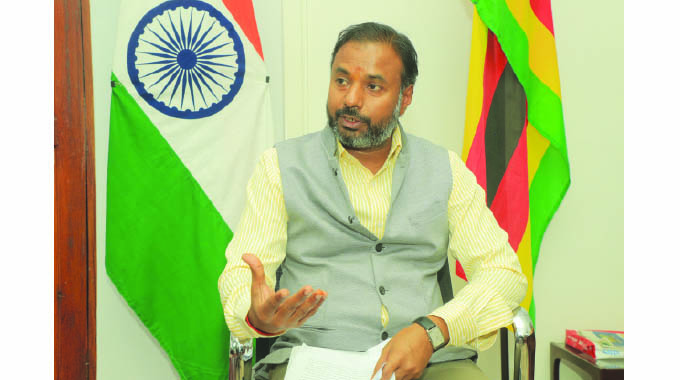
Trade interactions between modern states of India and Zimbabwe can be traced back to the 15th and 16th centuries when the former’s merchants exchanged goods with the Kingdom of Mutapa, from as far as Goa.
These historical trade links have not been erased, but have remained strong. Both states are now nurturing them for the benefit of their people. Zimpapers Politics Hub’s Gibson Nyikadzino (GN) spoke with the new Ambassador of India to Zimbabwe, Bramha Kumar (BK), on how he intends to promote and deepen bilateral cooperation between the two countries. Below are the excerpts:
GN: During your tenure, which areas do you think you would want deepen bilateral cooperation?
BK: My focus will be on the continuation of our strong, close and cordial relationship India and Zimbabwe are enjoying since the latter’s independence. We are enjoying close relations since the days of the Kingdom of Mutapa when it traded with Indian merchants from Goa during the 15th and 16th centuries. So, my prime focus will be to enhance bilateral trade between India and Zimbabwe.
GN: Which major goods are being traded and what needs to be improved?
BK: The bilateral trade as of now is between US$150 million to US$200 million, which does not reflect strong ties between the two countries.
Traded goods include iron and steel, tobacco, dyes, pigments and colouring matters, natural and cultural pearls, precious and semi-precious stones, coffee, tea and spices are some major goods of export from Zimbabwe to India.
On the other hand, major imports from India are in pharmaceutical products, boilers, machinery and mechanical appliances, plastics, vehicles and their parts, electric machinery and textiles, among others.
We need to enhance and diversify this trade basket. We have to add some more products where Zimbabwe needs to import from other parts of the world. If India can provide some cost-effective and quality goods, it will be my pleasure to promote that trade. I am happy to note that the Government of Zimbabwe has shown keen interest to engage India in enhancing trade and commerce.
GN: Any investment areas that Indian businesses are willing to exploit in Zimbabwe?
BK: Recently, on request of Zimbabwe, the Embassy has been able to arrange a visit of a business delegation, which was here on October 21. They explored various areas like solar power, agriculture technology, food processing, and artificial intelligence (AI). Some of them were encouraged by Zimbabwe’s atmosphere, and hopefully they will be engaging further discussion with Zimbabwe to bring more investment, and also to enhance their trade with Zimbabwe.
GN: Which areas do you think are the low-hanging fruits which should be diversified in terms of these investments?
BK: Our focus will be healthcare and pharmacy, first and foremost, and also investments in infrastructure and connectivity areas. So, when these big investments happen, they also provide a good opportunity to enhance trade and commerce. There are other areas as well, which we have in line, and new trading and investment will benefit from the existing investments and trading relations between the two countries. So far, our estimate is that Indian private sector investment is around US$600 million, employing some 5 000 people in Zimbabwe directly. The number of Indian companies operating in Zimbabwe is rising steadily.
GN: Some Zimbabweans have over the years seen India as a health tourist destination. In what ways can Zimbabwe and India collaborate on health?
BK: Before the liberalisation of the economy in the early 1990s, India was considered as a closed economy. It was a socialist kind of economy, but now it is open, where corporate sectors are promoted by the government, and they have been motivated to explore markets abroad. We estimate that around 400 Zimbabweans go to India to get cost-effective and quality healthcare services every year, and they come satisfied. It gives us a kind of hope that we need to enhance our cooperation in pharmaceuticals and healthcare sectors with Zimbabwe. We have been talking to the Ministry of Health and Child Care and the Ministry of Foreign Affairs and International Trade on acceptance of Indian pharmaceutical companies in Zimbabwe. More Indian quality drugs can come to Zimbabwe, and this can reduce the cost of treatment in Zimbabwe itself. We have offered some institutional mechanisms for capacity building; training of human resources through institution-to-institution links, which I am discussing with the Ministry of Health and Child Care.
GN: What have been your impressions of Zimbabwe and its people since your arrival?
BK: Zimbabwe is a very beautiful country. It is also resource-rich. Environmentally, it has serene beauty and is pollution-free. All good things which we can say about a country, I think Zimbabwe has everything. I must say that the people are peaceful and law-abiding. Zimbabwe is a good country. Your society is good. It is peaceful, safe and secure for foreigners.
I must appreciate and I wish that Zimbabwe will take care of this aspect and it will remain such a peaceful country. I was touched when I met His Excellency President Mnangagwa, Vice Presidents; Dr Constantino Chiwenga and Kembo Mohadi. They emphasised the fact that Zimbabwe is a friend to all and enemy to none. I think it captures the sentiments of Zimbabwe and its people.
GN: In which ways can bilateral cooperation between Zimbabwe and India be entrenched in the tourism sector?
BK: Zimbabwe needs to do more in India about promoting its tourism. I am Ambassador of India in Zimbabwe, but I can become Zimbabwean Ambassador to promote tourism to Indian travellers. The fact is that Indian travellers like going to Europe, US and neighbouring countries which happen to be their destinations. Zimbabwe fits into this scenario well. I think Zimbabwe has to capture it in a very institutional mechanism. I think all Zimbabweans know India well. But I do not think many Zimbabweans have been able to go to India. So, it will be my pleasure if we can also have some promotional events here. I encourage Zimbabweans to go to India. They can see those landscapes which are not available in Africa. Indians are looking forward to see vast landscape which Zimbabwe provides them easily and its natural beauty.


 Online Reporter