admin
admin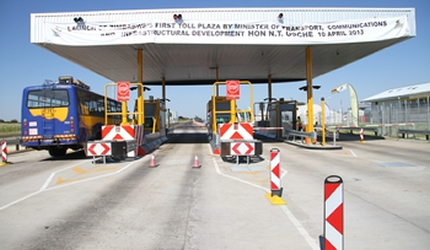
is a major step towards boosting revenue collection and enhancing inter-regional trade between Zimbabwe and other Sadc countries. The toll plaza, which is one of the eight to be built along the Plumtree- Mutare highway is said to have the capacity to rake in US$140 000 a month and roughly US$1,7 million a year. This will help assure the nation of good user friendly roads through some guaranteed funds for rehabilitation.
Inadequate funding from treasury over the years had hampered efforts by the government to rehabilitate all the country’s major road networks.
Zimbabwe, which has road network of 87 654km comprising of 8 194km of urban roads, 61 000km rural and 18 460km of state highways, needs about US$2 billion to rehabilitate the entire road network and bring it to international standards.
But the introduction of toll gates in the past few years as a strategic way of generating funds to maintain the country’s roads has brought a glimmer of hope to motorists and the haulage transport industry.
Road construction and engineering experts say funding of road development through toll plazas and Public Private Sector partnerships has provided the country with an effective solution for the rehabilitation of roads.
Transport, Communications and Infrastructure Development Minister Nicholas Goche said good roads promote national trade and efficient transit traffic flow between Zimbabwe and neighbouring countries.
Also see…
The Plumtree-Mutare Highway, which links Zimbabwe with Botswana, Namibia and South Africa to the west and Mozambique, Malawi and Tanzania on the eastern side is expected to be complete by March 2014.
The road which is being rehabilitated using a US$206 miilion-dollar facility secured from the African Development Bank will also help link Zimbabwe with the interior — Uganda, Tanzania and other countries in the Great Lakes region.
A 2009 World Bank report says if all African countries were to catch up with the best infrastructure, per capita growth rate could increase by 2.2 percent.
The report dubbed “Infrastructure in Africa” indicates that poor infrastructure services are a huge handicap to inter-Africa trade, reduce businesses productivity by 40 percent and holds back the attainment of the Millennium Development Goals (MDGs).
Good road infrastructure can bring numerous benefits that include employment, boosting tourism, reducing vehicle maintenance costs and other social and economic issues.
Improved roads also support and strengthen regional integration right from sub-regional trade blocs to continental trade groupings.
Group Five chairperson Mrs Philisiwe Mthetwa says her company is promoting the use of sustainable energy practices through the installation of toll gates that use green energy.
“All measures have been taken to ensure a substantially reduced carbon footprint.
“We can confidently say that what we have here is one of the most energy efficient designs for a toll plaza in the world,” she said.
“Furthermore, the road protocols have been largely aligned to the rest of the Sadc region, thereby providing consistency of interpretation for cross border travellers and encouraging safer driving habits.”
Last year, Sadc adopted the Regional Infrastructure Development Master Plan Vision 2027, a 15-year blueprint that will guide the implementation of cross-border infrastructure projects from 2013 to 2027.
The plan will serve as a key strategic framework to guide the implementation of efficient, seamless and cost-effective transboundary infrastructure networks in an integrated and co-ordinated manner in six sectors, namely energy, transport, tourism, ICT and postal, meteorology and water.
The master plan will be implemented in three five-year phases — short term (2012-2017), medium term (2017-2022) and long term (2022-2027).
With a good road infrastructure, Zimbabwe can enhance its business opportunities by tapping into the huge Sadc market of 234 million people which generates a GDP of US$760 billion per year.
Additionally, it can also enhance its access into the Common Market for Eastern and Southern Africa, a free trade area with 20 member states stretching from Zimbabwe to Libya.



 Online Reporter