


 Online Reporter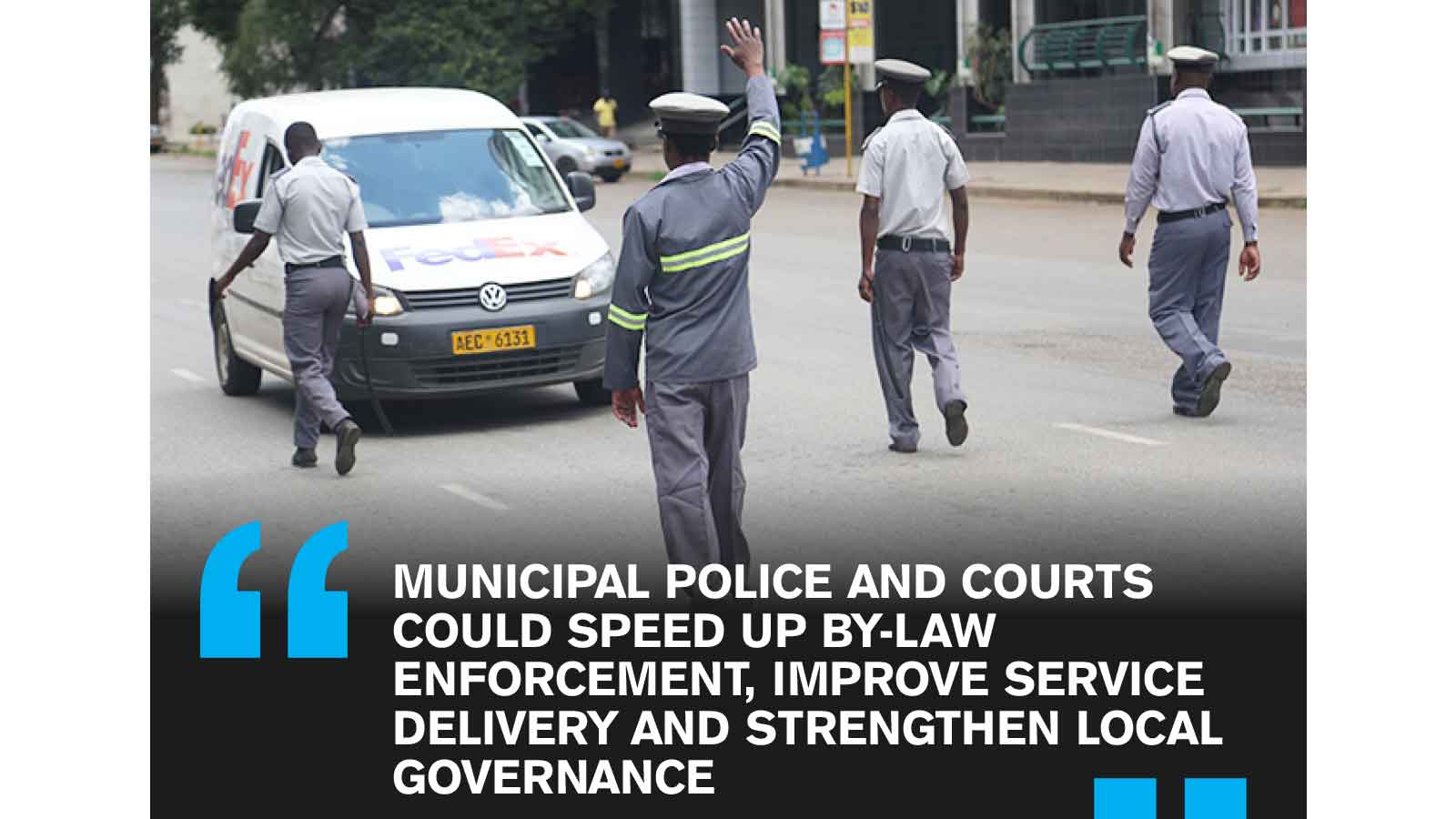
Wallace Ruzvidzo and Trust Freddy
LOCAL authorities have long complained that they bear the responsibility of maintaining order without possessing sufficient legal tools to enforce their own by-laws.
Municipal police can issue tickets and confiscate goods, but when offenders refuse to comply, councils often have little option but to call in the Zimbabwe Republic Police (ZRP), a process critics say delays enforcement and weakens deterrence.
That could soon change.
Cabinet last week approved the proposed Municipal Police and Courts Bill.
If enacted, the legislation would grant municipal police arresting powers and establish specialised municipal courts.
This could fundamentally reshape how Zimbabwe’s urban and rural local authorities enforce by-laws, deliver services and exercise the constitutional principles of devolution.
The Bill is intended to strengthen the legal framework for municipalities to establish dedicated and professional police services focused on community safety, by-law enforcement, traffic management and local crime prevention, while also creating specialised municipal courts to hear cases involving municipal by-laws, minor offences and traffic violations.
The envisaged legislation is anchored in the Urban Councils Act (Chapter 29:15) and the Rural District Councils Act (Chapter 29:13), which already empower local authorities to formulate and enforce regulations within their jurisdictions.
Rationale behind intervention
The country’s largest cities are grappling with increasingly complex urban management challenges driven by rapid informalisation, illegal land development, deteriorating infrastructure and declining compliance with municipal by-laws.
Harare’s recently adopted 2025-2045 Master Plan concludes that council by-law enforcement is under strain, and identifies weak enforcement of zoning regulations, informal trading, illegal developments and declining municipal capacity among the city’s biggest governance challenges.
For years, councils have struggled to enforce by-laws covering illegal vending, littering, illegal structures, traffic management, environmental protection and noise pollution.
It is believed that when by-laws are enforced consistently, councils are better able to protect public infrastructure, improve revenue collection and create safer, cleaner and more orderly communities.
While Sections 264 and 265 of the Constitution recognises the role of Local Government in service delivery and maintenance of order in their precincts, the absence of dedicated municipal enforcement structures has significantly undermined compliance with local authority by-laws.
Experts believe there is, therefore, need for coordinated structures from apprehension of bylaw offenders to investigation and prosecution.
The new law will have the effect of giving municipal by-law enforcement personnel clear statutory arresting powers.
In addition, specialised courts, which will operate in line with Section 165 of the Constitution, will help local authorities to end increased urban disorder, environmental degradation, illegal land use practices, revenue leakages and general non-compliance to local authority regulations.
Sources privy to the proposed legislation say the key objective is to provide a legal framework to establish “professional police services” that are able to guarantee by-law enforcement, traffic management, local crime prevention and general community safety.
So, in essence, the proposed legislation hinges on the creation of municipal courts, defining their jurisdiction, as well as providing the framework for appointment of municipal magistrates.
Perhaps critical to new proposal is the creation if a dedicated Municipal Police Services to provide specialised enforcement of by-laws in regulation of informal trading, environmental management, regulation of informal trading, traffic control, spatial planning and development control.
Policymakers opine that the service will enhance enforcement efficiency by granting clearly defined statutory powers, including powers of apprehension, investigation of by-law offences, issuance of compliance notices, as well as preparation of cases for prosecution before the courts.
Further, empowering the municipal police will free up the Zimbabwe Republic Police (ZRP) to focus on serious criminal offences and critically reduce operational costs associated with prolonged joint enforcement operations with the ZRP.
Among some of the broad range of proposals being made is the establishment of oversight structures to enhance accountability and adherence to professional standards.
There is also a proposal for municipal police to undergo structured professional training programmes to ensure that they possess a comprehensive understanding of local governance systems.
Harare City Council believes the proposed reforms could significantly improve the management of local authorities.
Acting Town Clerk Advocate Warren Chiwawa said the new powers would help the city deal decisively with illegal dumping, touting and vandalism.
“With the right safeguards, this will help us protect public infrastructure and ensure our by-laws are respected,” said Advocate Chiwawa.
“The new powers would be supported by training, clear operating procedures and a complaints system to ensure accountability.”
Learning from the region
The proposed new framework is not peculiar to Zimbabwe.
Across Southern Africa, municipal policing has become an important pillar of local governance.
In South Africa, metropolitan municipalities such as Johannesburg, Cape Town, Tshwane, Ekurhuleni and eThekwini operate municipal police services established under the South African Police Service Act.
These officers enforce municipal by-laws, traffic regulations and selected criminal offences, allowing the South African Police Service to concentrate more on serious crime while municipal police focus on local governance and public order.
Namibia has adopted a similar model.
City police departments in Windhoek and several other municipalities enforce municipal regulations, traffic laws and public safety measures while working alongside the Namibian Police Force.
Their responsibilities include tackling illegal trading, parking violations, environmental offences and nuisance control.
Zimbabwe’s proposed legislation also introduces municipal courts with jurisdiction over municipal by-laws, traffic violations and other minor offences, as well as providing for the appointment of municipal magistrates.
Such specialised courts are generally able to dispose of by-law cases more quickly, improving compliance, strengthening deterrence and enabling councils to recover unpaid fines more efficiently.
Power must be matched by accountability
The City of Harare Master Plan also identifies institutional weaknesses within municipal police itself.
It notes that while the city and the Zimbabwe Republic Police routinely collaborate on public safety operations, the effectiveness of municipal policing is constrained by staff shortages, inadequate operational resources and low public confidence.
It estimates that against the city’s own staffing standard of one municipal police officer for every 450 residents, Harare is operating at only 26 percent of its required establishment, with 1 287 officers in post.
But, while there is broad agreement that councils require stronger enforcement tools, the proposed reforms have also ignited debate over accountability.
The concerns are not new.
Last year, three Harare municipal police officers appeared in court on charges of criminal abuse of office, theft and malicious damage to property.
They were accused of clamping a ZRP police officer’s vehicle after it had run out of fuel, demanding money and later failing to account for US$530, a laptop and groceries allegedly missing from the impounded vehicle.
Public concerns resurfaced last week after videos circulated on social media appearing to show a Harare municipal police officer slapping a member of the public, raising fears that arresting powers could be abused if adequate safeguards are not put in place.
Combined Harare Residents Association director Mr Reuben Akili said accountability should be built into the legislation itself.
“The law must have strong accountability mechanisms because municipal officials have been implicated in serious human rights violations over the years,” he said.
Similarly, Harare Residents Trust director Mr Precious Shumba said improving professionalism should be a priority.
“The reputation of municipal police and traffic enforcement officers is tattered and needs re-imaging. They need training in handling people because many officers are unprofessional.”
Harare Ward 41 Councillor Kudzai Kadzombe also urged council to reform its municipal police before the new powers take effect.
“Once approved the municipal police must not use that power as a tool of brutality on residents.
“The council should retrain officers, introduce professional courses and enforce accountability before exercising the new powers,” she said.


