Online Reporter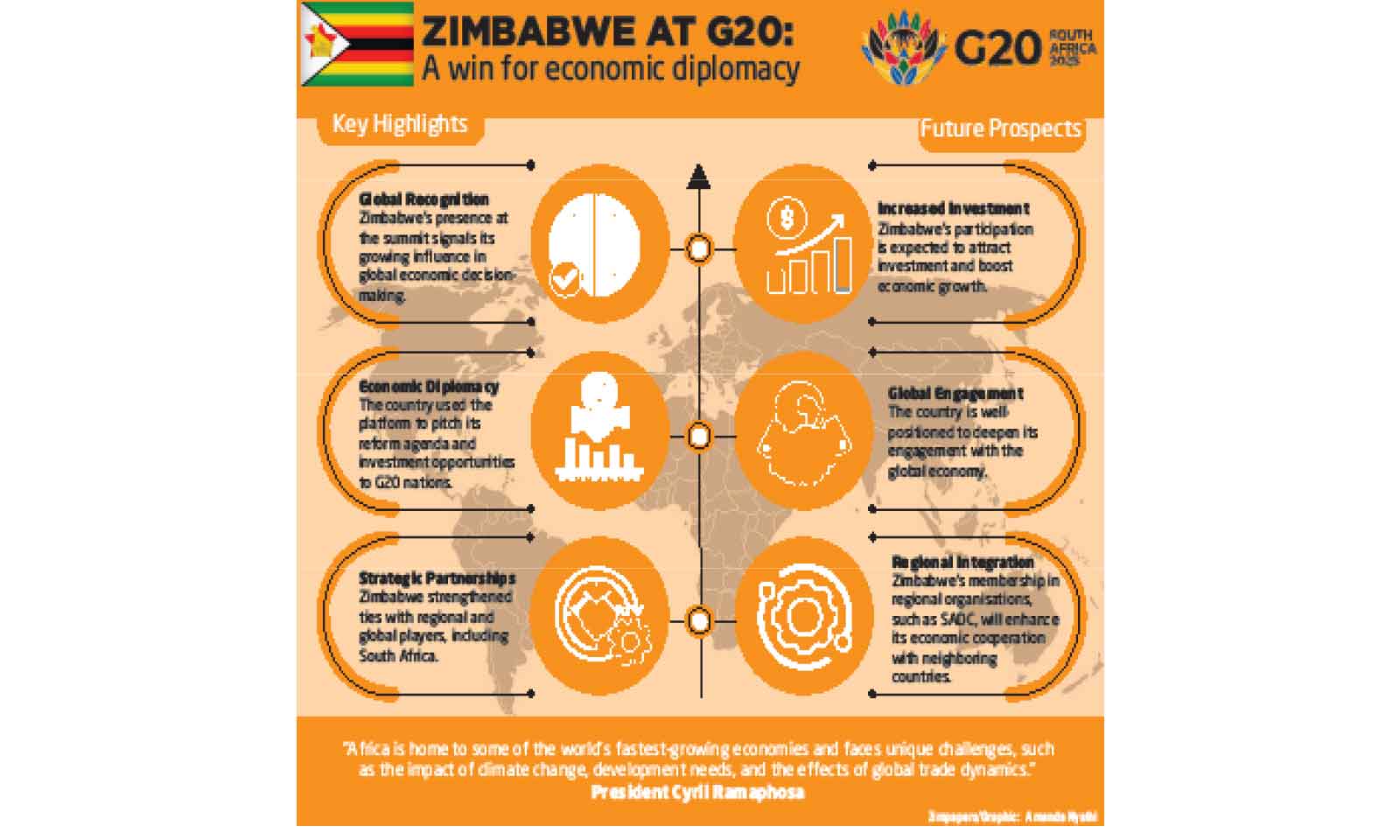
Ranga Mataire
Head – Politics, Opinions and Foreign
Zimbabwe’s presence at the 2025 G20 Leaders’ Summit in Johannesburg went beyond mere diplomatic courtesy. It was a strong signal that the country’s strategic economic diplomacy and re-engagement drive under the Second Republic is gaining global traction.
Vice President Constantino Chiwenga represented President Mnangagwa at the summit, hosted from 22–23 November. For the first time, Zimbabwe took its place among the world’s major economies at a moment when global attention is shifting toward developing nations.
Despite the absence of the United States, which was expected to assume leadership of the G20, President Cyril Ramaphosa said the summit’s declaration reflected a “renewed commitment to multilateral cooperation.”
Strengthening global economic engagement
Zimbabwe used the platform to pitch its reform agenda and investment opportunities to countries that together account for 85% of global GDP and 75% of global trade. As the street-lingo popularised by the late Soul Jah Love goes, “pamamonya ipapo”, standing firm among giants. Zimbabwe’s attendance embodied this spirit.
Zimbabwe, Angola and Namibia were the only non-G20 SADC countries invited, giving Harare rare access to discussions shaping global economic policy. Political analyst Dereck Goto said Zimbabwe’s presence “moved the country from the periphery of global politics to the centre of high-level decision-making forums.” For investors, it signalled a country deliberately repositioning itself and widening its international partnerships.
Enhancing economic diplomacy
The platform allowed the Zimbabwe delegation to showcase macroeconomic reforms, outline the country’s investment priorities and strengthen ties with global and regional players whose decisions shape international finance and trade. It also demonstrated that Zimbabwe’s diplomatic outreach is yielding recognition in spaces where global economic policy is set.
Prioritising Africa’s development
In his speech to the summit, VP Chiwenga shared how the meeting’s focus on solidarity, equality and sustainability aligned with Zimbabwe’s development goals. President Ramaphosa highlighted the need for international financial institutions and the private sector to scale up post-disaster recovery, especially in vulnerable nations. Zimbabwe stands to benefit from the growing emphasis on sustainable development, climate finance and a just energy transition.
Bilateral relations and economic cooperation
On the sidelines, Vice President Chiwenga met South Africa’s Deputy President Paul Mashatile to discuss trade, energy cooperation, regional security and labour migration—areas central to Zimbabwe’s economic strategy. These engagements reinforced Zimbabwe’s commitment to deepening ties with South Africa.
A new era of cooperation
President Mnangagwa’s invitation, despite Zimbabwe not being a G20 member, demonstrated the country’s commitment to re-entering the global economic landscape with a proactive foreign policy.
As President Ramaphosa noted, “Africa is home to some of the world’s fastest-growing economies and faces unique challenges, such as the impact of climate change, development needs, and the effects of global trade dynamics.” Zimbabwe’s presence affirmed its readiness to engage in global decision-making.
Looking ahead
Zimbabwe’s invitation holds significant promise. VP Chiwenga took the opportunity to showcase the country’s inclusive economic reforms, attract investment and reinforce the country’s strategic position in regional and global economic integration. With rich natural resources and a central location in Southern Africa, Zimbabwe is well placed for deeper global engagement.
As President Ramaphosa put it, “The Summit’s location underscores the need for African voices to be heard on critical global issues, like sustainable development, the digital economy, and the shift toward green energy.”
For the first time in G20 history, the summit leaned heavily toward issues affecting developing nations. Contentious matters were unanimously endorsed, and discussions focused on helping developing economies adapt to climate impacts, transition to clean energy and reduce excessive debt.
South Africa has held the Presidency since 1 December 2024, under the theme “Solidarity, Equality, Sustainability”. The summit culminated almost a year of meetings and negotiations intended to bridge the gap between the Global North and South.
South Africa’s Minister of International Relations and Cooperation, Ronald Lamola, explained the uniqueness of hosting the summit on African soil.
He said that when South Africa took over the chairmanship, the world was navigating a precarious geopolitical climate. “Our response was clear and courageous: the world needs more Solidarity, Equality and Sustainability.
These are not just words, they are the pillars of our Presidency, rooted deeply in the African philosophy of Ubuntu… ‘I am because we are.”
Reaching consensus in such a diverse group of countries required careful diplomacy. Guided by Ubuntu, South Africa treated the diversity of the G20 nations as a strength rather than a source of division.
Zimbabwe’s aspiration to become an upper-middle-income economy while being “a friend to all and an enemy to none” dovetailed with the summit’s theme. The G20’s push for inclusive and sustainable growth aligns with President Mnangagwa’s guiding principles.
Zimbabwe’s participation at the G20 summit was more than symbolic. It was a clear recognition that the country is re-entering global conversations with a more assertive economic diplomacy strategy.