Online Reporter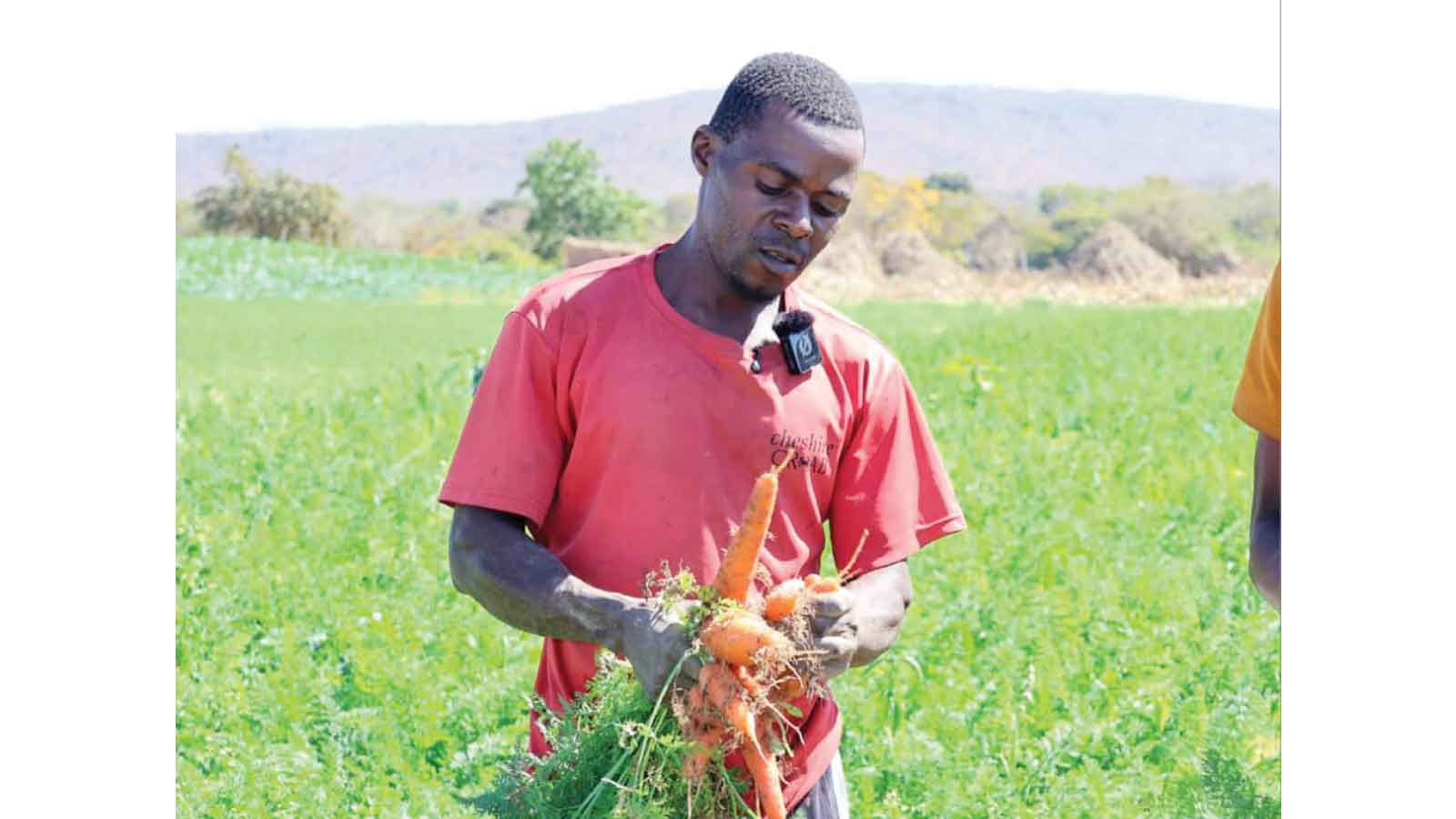
Theseus Mauruki Shambare
Features Writer
THE morning mist still hangs over Nyaitenga Irrigation Scheme in Mutoko, Mashonaland East province, when 29-year-old Katrosa Gondo stoops to pull another carrot from the rich, dark soil.
Bright orange roots emerge one after another before being stacked into bulging sacks awaiting collection.
Within hours, they will begin the journey to Mbare Musika in Harare, Zimbabwe’s largest fresh produce market.
Sprinklers hiss steadily across rows of carrots, leafy vegetables and maize.
It is an ordinary sound today.
Six years ago, it had fallen silent.
“There was a time we thought this irrigation scheme would never work again,” says Gondo, brushing soil from his hands during a recent tour of the scheme.
“We depended entirely on rainfall. Every farming season became a gamble.”
Around him, dozens of farmers now tend crops sustained not by seasonal rains but by a rehabilitated irrigation network that had once all but collapsed. Commissioned in 1994, the Nyaitenga Irrigation Scheme transformed a drought-prone community into a thriving horticultural hub. Reliable water enabled families to grow crops throughout the year, educate their children, build homes and create sustainable livelihoods.
Few understand that transformation better than 70-year-old Barnabas Kamusisi of Village 4.
“I have seven children and two grandchildren,” he says proudly.
“For years, since I was a young man, we relied on this irrigation scheme.”
The proceeds from farming shaped his family’s future.
“I even used proceeds from this scheme to pay lobola for my wife. My children went to school without me struggling to pay fees,” he adds.
Pointing towards his homestead, he smiles.
“Even if you come to my home, you will see that although I live in a rural area, my life compares well with that of people who live in towns.”
But after decades of service, the infrastructure began to fail. Underground pipes burst and leaked, water pressure dropped, breakdowns became frequent and repairs increasingly difficult.
By 2020, much of the irrigation scheme had become dysfunctional.
Fields that once produced vegetables throughout the year lay dry and fallow.
Some farmers abandoned production while others returned to rain-fed agriculture, exposing themselves once again to increasingly erratic weather patterns.
Ward 25 councillor Chenjerai Kandemiri recalls the difficult period.
“When the irrigation scheme stopped functioning, many people became idle. Some youths turned to drugs and substance abuse while families struggled to survive,” he says.
As Nyaitenga battled ageing infrastructure, Zimbabwe faced another challenge.
Meteorologists warned of a high probability of below-normal rainfall across Southern Africa during the 2026/2027 agricultural season.
President Mnangagwa urged farmers to prioritise early maturing and drought-tolerant crops while assuring the nation that the Government was implementing comprehensive measures to cushion agriculture from the anticipated El Niño.
Central to that strategy was irrigation.
Few places illustrate that strategy more clearly than Nyaitenga. Its revival did not begin with rainfall.
It began with a tax.
Every consignment of imported grain now attracts a levy under Statutory Instrument 87 of 2025. Collected by the Agricultural Marketing Authority (AMA) and deposited into the Agricultural Marketing Fund, the revenue is financing strategic investments aimed at increasing domestic agricultural production while reducing dependence on imports.
What many initially regarded as just another levy has quietly become one of the Government’s most ambitious climate adaptation financing mechanisms.
More than US$3,2 million and ZiG29 million have already been invested in rehabilitating 24 irrigation schemes covering 1 796 hectares across the country.
Among the completed projects are Nyaitenga in Mashonaland East, Chimhanda in Mashonaland Central, Nyamangara in Mashonaland West and Hlauke in Matabeleland North, while several others are nearing completion.
During a recent media tour, AMA marketing and public relations manager Ms Tina Nleya said the Grain Levy was created to provide a sustainable financing mechanism for agriculture.
“So far, we have managed to rehabilitate 24 irrigation schemes covering 1 796 hectares of land, and Nyaitenga is one of the irrigation schemes that is now 100 percent complete,” she says. Ms Nleya says the Agricultural Marketing Fund is also helping aggregate production and strengthen structured markets so farmers can increase production while accessing reliable buyers.
For Nyaitenga, the results are already visible.
Mashonaland East provincial irrigation development director Engineer Catherine Mureri-Jaji says rehabilitation took just one month after funding was released.
“For almost five years, our drip section was totally down, but after the intervention through AMA funding, it only took us a month to rehabilitate the scheme and now it is fully functional,” she says.
The project involved repairing the main pipeline, replacing damaged filters and drip lines, installing a new pump and extending the scheme by three hectares for young farmers.
For Katrosa Gondo, those additional hectares represent renewed opportunity.
“For years, we depended entirely on rainfall, and many young people had begun to lose interest in farming,” he says.
“With irrigation now restored, we can produce throughout the year, earn a reliable income and build our future through agriculture.”
Female farmers say reliable water has transformed livelihoods.
Samantha Sapuwa believes irrigation has given farmers confidence to invest because production no longer depends entirely on rainfall.
“We now have confidence to invest in farming because we know we can produce even when the rains fail. Irrigation is helping us improve food security, educate our children and generate income,” she says.
For Portia Chigora, the rehabilitation has strengthened women’s economic independence.
Water is now available throughout the year and that means we can diversify into high-value crops and supply formal markets. Women are becoming more economically independent because of this project,” she says.
The Food and Agriculture Organisation of the United Nations has consistently identified irrigation, climate-smart agriculture, resilient food systems and early warning systems as among the most effective investments for protecting agriculture against worsening climate variability.
Rather than waiting for drought to trigger emergency assistance, Zimbabwe is investing in infrastructure designed to keep farmers producing despite increasingly erratic rainfall.
Back in Nyaitenga, the benefits extend well beyond the irrigated fields.
Parents are once again planning school fees instead of worrying about the next meal. Transporters are carrying fresh produce to urban markets, while input suppliers are seeing renewed demand.
The revival of one irrigation scheme is stimulating an entire local economy.
Councillor Kandemiri says the difference is unmistakable.
“Today people are back in the fields, incomes are beginning to improve and the whole community is benefitting,” he says.
The rehabilitation also reflects a broader shift in agricultural policy.
Instead of responding to drought after crops have failed, Zimbabwe is investing in systems that reduce vulnerability before disaster strikes.
The Grain Levy transforms revenue generated from imported grain into infrastructure intended to reduce future imports by increasing domestic production.
For Barnabas Kamusisi, however, those policy debates remain secondary.
His measure of success is seeing water flow again through the irrigation scheme that shaped most of his adult life and watching younger farmers embrace agriculture with renewed confidence.
It is knowing his children and grandchildren can inherit the same opportunities that enabled him to educate a family, pay lobola and build a home.
As he walks across the scheme, sprinklers cast shimmering arcs over fields that only months ago lay dry and abandoned.
Nearby, Katrosa Gondo loads another sack of carrots onto a waiting truck.
Tomorrow morning, buyers at Mbare Musika will bargain over produce grown in fields that had stood silent for almost five years.
Few will know that the water nourishing those crops began its journey with a levy collected on imported grain.
Yet that quiet connection tells a bigger story.
It is the story of a 32-year-old irrigation scheme brought back to life.
It is the story of public investment restoring livelihoods. It is the story of farmers who refused to give up. And it is the story of a nation adapting to a changing climate.
As another truck disappears down the dusty road towards Harare, Gondo turns back to the land. Another crop is already pushing through the soil.
The rains may still disappoint this summer.
But here, in Nyaitenga, farmers are no longer waiting for the clouds.
Water is flowing once again, carrying with it something every farming community longs for in an uncertain climate — hope.