Online Reporter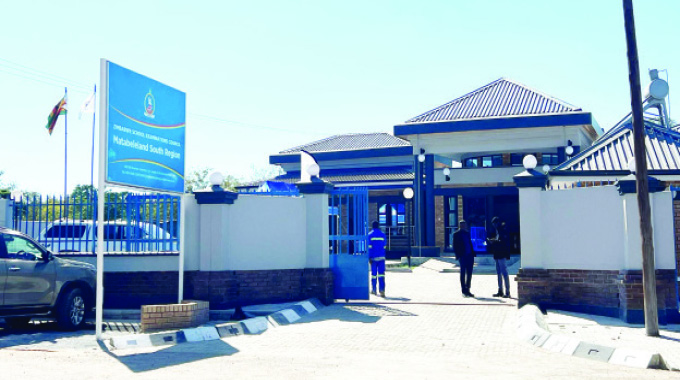
Sukulwenkosi Dube-Matutu
THE Government has opened a cutting edge Zimbabwe Schools Examinations Council (Zimsec) regional office in Gwanda, Matabeleland South, aiming to curb examination fraud and enhance efficiency. The flagship facility will serve as a blueprint for similar installations across all 10 provinces as part of a national strategy.
The modern facility, soon to be commissioned, features advanced security systems including CCTV surveillance and secure storage rooms, significantly reducing the risk of examination paper leakages. It also includes strong rooms for the safe storage of scripts, spacious offices, and marking venues capable of accommodating up to 20 examiners per session.
For the first time, Zimsec officers in the province will be able to carry out all critical functions — including registration, marking, marks capturing, printing, and partial processing of examination materials — under one roof.
Previously, Zimsec had to outsource storage services, as the former regional office could not accommodate even one district’s examination scripts, raising concerns over the security of sensitive materials. The new centre will also serve as a training hub for examination personnel.
This week, the Parliamentary Portfolio Committee on Primary and Secondary Education embarked on a nationwide fact-finding mission to assess the state of Zimsec facilities, beginning on Monday in Matabeleland South.
The inquiry follows concerns raised last year regarding inadequate funding and structural challenges affecting Zimsec’s credibility and capacity.
Speaking during the committee’s visit, Zimsec Chief Executive Officer Dr Lazarus Nembaware said the Gwanda centre represents a bold step towards improving service delivery and safeguarding the integrity of the country’s examination system.
He noted that the infrastructure not only sets the standard for Matabeleland South but also reflects Zimsec’s vision for all regional offices nationwide.
“It provides dedicated space for key examination activities — from the setting and receiving of question papers to the storage and marking of scripts, as well as engagement with the public,” said Dr Nembaware.
However, he acknowledged that rolling out similar facilities across other regions remains a challenge due to funding constraints.
Dr Nembaware emphasised that all examination centres must meet Zimsec’s minimum standards, including secure and conducive environments for both storage and the sitting of exams, to ensure the system’s integrity is upheld.
In a speech read on his behalf by committee member Cde Obvious Murambiwa, Chairperson of the Portfolio Committee on Primary and Secondary Education Cde Supa Mandiwanzira said the committee’s inquiry is not merely a technical audit but a constitutional and moral obligation to learners.
“Today marks a pivotal step in our collective mission to uphold the integrity, efficiency, and effectiveness of Zimbabwe’s national examination system — a cornerstone of our educational landscape and the future of our students,” he said.
Cde Mandiwanzira said that the inquiry will assess the adequacy of Zimsec’s facilities, including printing centres and regional offices, and identify areas requiring urgent attention. It also aims to review the security of examination materials by scrutinising protocols for storage, distribution, and handling to prevent leaks and malpractice.
He said the findings will inform legislative reforms, particularly the refinement of the Zimsec Amendment Bill.
Speaking on behalf of the Ministry of Primary and Secondary Education’s Permanent Secretary Mr Moses Mhike, Chief Director Ms Olicah Kaira reaffirmed the ministry’s commitment to ensuring that every Zimsec facility upholds the highest standards of professionalism, security, and infrastructure.
“The ministry will continue to fulfil its responsibility as the custodian of our pupils’ future and as an advocate for a credible, efficient, and secure examination system that reflects the true merit of every Zimbabwean child.
“This model office incorporates the security features, infrastructure, and professionalism that every examination centre should embody.
“It is our aspiration that this standard becomes the template across all ten provinces,” she said.
Mr Mhike said the Gwanda model should become the national benchmark and called for attention to challenges still facing satellite centres, particularly in remote areas.
These include a lack of secure storage, poor infrastructure, inadequate accommodation for invigilators and teachers, weak ICT systems, and logistical issues with exam material delivery.
Representing the Minister of State for Provincial Affairs and Devolution for Matabeleland South, Albert Nguluvhe, Provincial Director for Infrastructure Development and Environment Mr Daniel Njowa said the new Zimsec regional office reflects the Government’s commitment to decentralisation and inclusive development under the Second Republic.
“This facility empowers our province by eliminating the need to rely on distant regional offices or Zimsec headquarters for urgent examination matters. It symbolises equitable service delivery and the localisation of education governance,” said Minister Nguluvhe.
He said that the development aligns with Vision 2030, which seeks to transform Zimbabwe into an upper-middle-income economy through investments in infrastructure and human capital. — @DubeMatutu