

 Online Reporter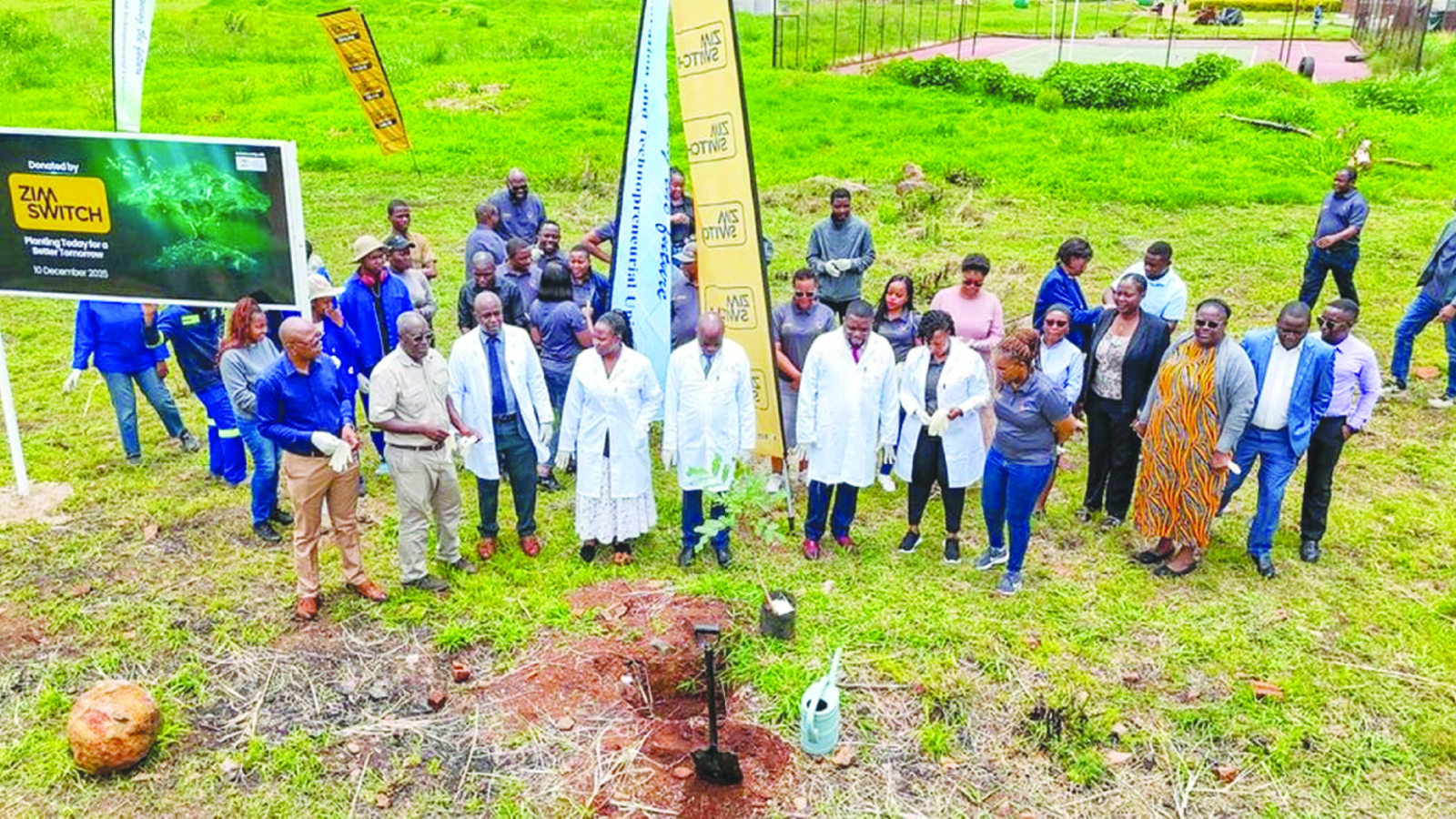
Business Reporter
Leading financial technology firm Zimswitch Technologies has partnered with the Harare Institute of Technology (HIT) to launch a strategic tree-planting initiative transforming the university’s campus into a “living laboratory” for student research.
The joint effort, which saw indigenous tree species planted across the campus on Wednesday, was highlighted as a practical example of Environmental, Social, and Governance (ESG) principles in action, linking corporate environmental stewardship directly with academic innovation.
In his address, Zimswitch Technologies chief executive, Zabron Chilakalaka, emphasised that the project moves far beyond a symbolic gesture.
“The aim of today’s initiative goes beyond environmental sustainability. It is a strategic investment in HIT’s student research programmes,” Mr Chilakalaka stated.
He explained that the carefully selected, drought-resistant, and fast-growing indigenous species will create an outdoor research facility, enabling students from various disciplines to conduct long-term, real-time studies that can continue across future academic cycles. This, he noted, strengthens HIT’s research infrastructure and enhances practical learning for students.
Mr Chilakalaka also praised the longstanding relationship between the two organisations, which has previously included successful financial literacy programmes aimed at empowering students for the digital economy.
Speaking on behalf of Vice Chancellor Professor Quinton Kanhukamwe, HIT Pro-Vice Chancellor Academic Affairs Willard Gwarimbo underscored the university’s commitment to integrating sustainability into its core mandate. He affirmed that this year’s initiative marks a significant shift from ceremonial planting to achieving measurable results.
“This programme is being developed to monitor survival rates, growth performance, and carbon sequestration over time. In essence, we are planting trees that will be counted, watched, and reported on, rather than forgotten,” Professor Kanhukamwe said.
He further revealed that the university, guided by its Environmental Management, Renewable Energy, and Climate Research Centre (EMRECC), is aligning the project with its annual sustainability reporting and future participation in voluntary carbon markets. This move positions tree planting not only as an environmental duty but as part of a broader “climate innovation and green finance ecosystem.”
The Vice Chancellor commended the partnership, stating it “exemplifies a strong model of ESG in practice, where private sector leadership, academia, and national priorities come together to create long-term environmental value.”
The formal part of the event concluded with a call to action from both leaders for participants to “plant with purpose and nurture with intention,” marking the official commencement of HIT National Tree Planting Day.
Following the formal part of the event, Mr Chilakalaka and Mr Gwarimbo, supported by Zimswitch staff, proceeded to plant trees with the assistance of Mr Duncan Chiwala, Forest Extension Officer, Harare Metro Province.
Meanwhile, speaking ahead of the tree planting, Mr Chiwala delivered a stark warning regarding the state of Zimbabwe’s forests, stating that the nation is currently losing an alarming 260 000 hectares of forest cover per annum.
He proceeded to detail the primary drivers fuelling this rapid environmental degradation, beginning with the unchecked pressures of population growth.
Mr Chiwala explained that the first major contributor is urban expansion, noting that as urban populations increase across almost all cities, people are buying bigger plots of land on which to build their homes, which necessitates the clearance of natural forests.
The crisis is compounded by issues related to resettlement and the subsequent demand for new cultivation land. Furthermore, deforestation is accelerated by those involved in brick making and brick moulding, who rely heavily on wood fuel; these individuals collect wood from the environment to supply the energy necessary for firing their brick ovens.
However, Mr Chiwala singled out the tobacco farming sector as the most significant industrial consumer of wood energy. He quantified the impact, revealing that to cure just one tonne of tobacco, a farmer requires a massive amount of wood energy, equivalent to a volume that would be spread through a 16-metre length of stretch to cover 1,2 metres by 1,2 metres – a volume he described as “a lot of wood energy” consumed solely by curing tobacco.
In light of this unsustainable demand, Mr Chiwala presented a clear, economic rationale for the immediate adoption of alternatives.
He highlighted the significant energetic potential of different fuels, noting that coal contains 30 000 kilojoules of energy per kilogram, followed by indigenous wood at 16 500 kilojoules per kilogram.
To combat the severe depletion of indigenous forests, he championed the use of Eucalyptus (gum tree) as an alternative substitute for tobacco curing wood energy.
This choice is predicated on the vast disparity in growth rates: he pointed out that it takes a staggering 52 years for indigenous wood, such as a msasa tree, to accrue the same amount of wood that a gum tree would have accrued in just eight years.
Mr Chiwala emphasised that this variation makes it financially sensible to establish gum tree plantations out of eucalyptus to quickly address the nation’s wood energy needs for tobacco curing, thereby prompting the creation of a dedicated tobacco wood energy programme to address this crucial disparity.



