Online Reporter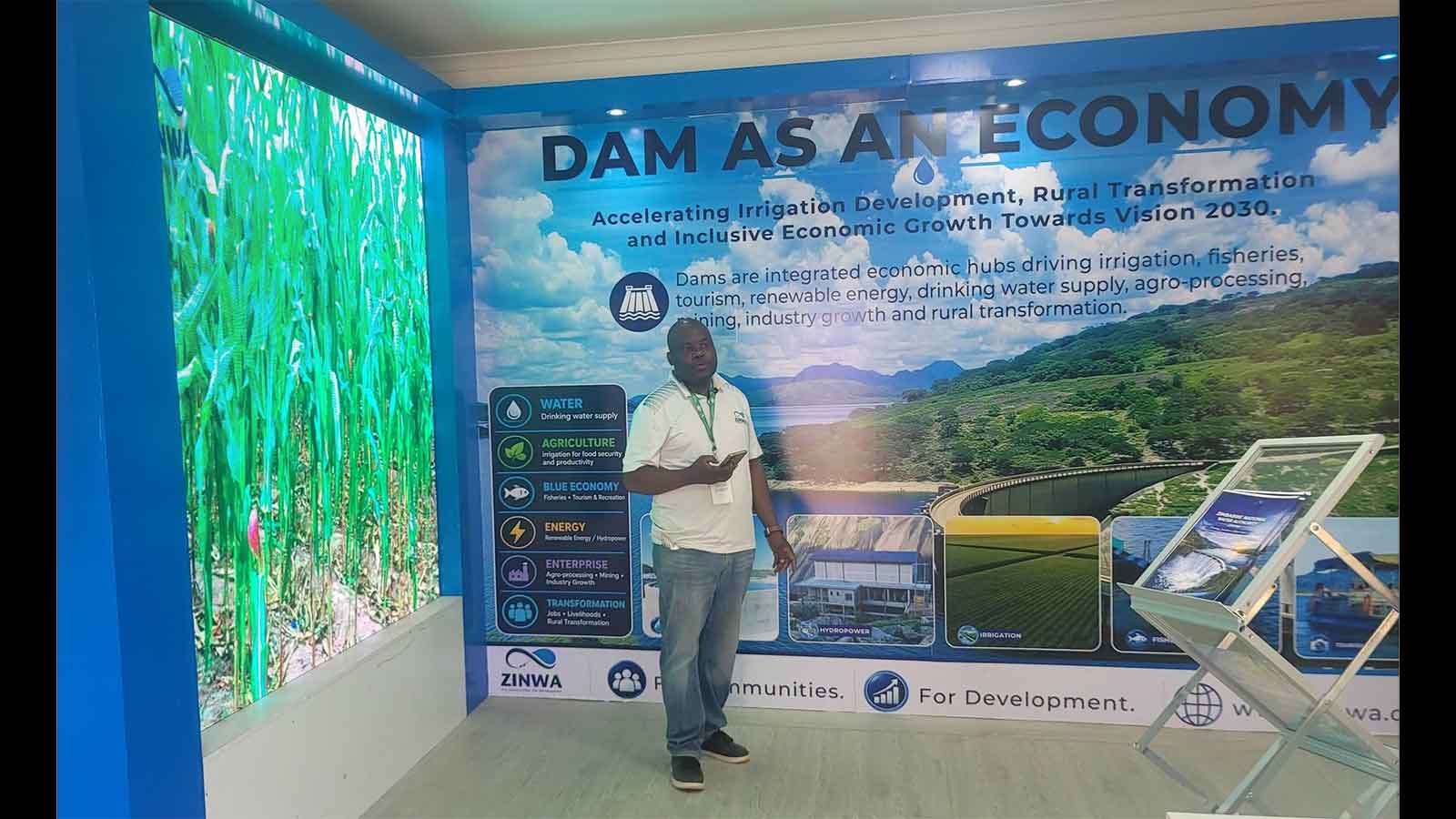
Zvamaida Murwira-Senior Reporter
THE Zimbabwe National Water Authority has unveiled an N-Space, a modern monitoring equipment with capacity to manage multiple projects such as dams and provide feedback in real time.
The equipment was shown to President Mnangagwa last Friday when he toured exhibition stands at the 116th edition of the Zimbabwe Agriculture Show that ended last Saturday.
The state-of-the-art machine can give details on the status of a project and challenges that might be present in real time.
Zinwa has since installed the machine at Kunzvi Dam, Government’s prime and flagship water project meant to end perennial water challenges in Harare and surrounding areas.
At Mazowe dam, the machine was applied to determine rehabilitation assessment and requirements to ensure it’s restoration to its full efficiency and efficacy.
The machine dovetails with the Second Republic’s quest to modernise and industrialise through innovation, thus giving impetus to the use of science and technology as an economic driver to attain an upper middle class income economy by 2030.
The machine was installed by Zinwa contractor, Makomo Engineering, currently the firm spearheading construction works at Kunzvi Dam.
Zinwa acting chief executive, Engineer Waddilove Mandiziba, took President Mnangagwa through the paces of how to use the machine and it’s significance.
Explaining how it works, Eng Mandiziba said the N-Space allowed decision-makers and specialists to enter a live remote site from a room, understand the situation at human scale, and intervene without delay — without wearing a headset.
He said the facility will be replicated at all their projects countrywide.
“We have a private network that we set up at Kunzvi Dam. So Kunzvi Dam is the one that is linked in real-time now. But we are linking it out to all the other dams that are under construction,” said Eng Mandiziba.
He said there was a deliberate mechanism for technological transfer so that the Chinese engineers impart knowledge to local engineers.
“We have the Chinese engineers that are at Kunzvi right now to train our engineers. And we are going to have this set up at the Zinwa head office. That’s where it will be operating from. So this will be equipment owned by Zinwa and operated by Zinwa engineers,” said Eng Mandiziba.
He said the machine could also inspect the floor of a deep dam.
“Our divers can only dive up to about 30 to 40 metres here. Beyond that, we are not able to inspect. So traditionally, we would wait for the dam levels to go down. But now, with this technology, we are able to see what is happening underwater,” said Eng Mandiziba.
He linked up with Zinwa engineers at Kunzvi Dam to demonstrate to President Mnangagwa how the machine works.
According to a presentation made by Zinwa and Makomo Engineering, the equipment operates under the auspices of RAAM—Room as a Medium—a paradigm in which the room itself becomes the medium for human presence and communication anchored on room-scale spatial communication terminal.
“It transforms an ordinary room into a human-scale window to another place, allowing people to experience and understand a remote environment as though they had stepped into it.
The system integrates a 22-channel full-HD optical projection and imaging array, 8K at 60 frames-per second real-time image processing, and Artificial Intelligence -based spatial computation,” reads the presentation.
“It detects the viewer’s eye position—not personal identity—and continuously adjusts the perspective so the view remains spatially correct as the person moves freely around the room. No headset, glasses or hand-held controller is required.
It’s core capability is to place panoramic view of a site like a dam project, for example, at a real site, allowing the live environment to be brought into an N’Space room.
This will allow experts, executives or public officials to view it in real time, look around the site naturally, communicate with the on-site team and make decisions with a much stronger sense of space and context than conventional video can provide.
“This is especially important when the right person cannot be physically pinned to one location because they must oversee many sites, when travel would delay a mission-critical decision, or when entering the site would expose senior personnel or specialists to unnecessary safety risk,” reads the report.
The functions can also be applied to other projects like mines, factories, ports, vessels and major construction sites. It can also be applied in hazardous, restricted, underwater or otherwise difficult-to-accesenvironments.
The report notes that each deployment of the facility is accompanied by training of receiving engineers.
“Each deployment includes installation, commissioning and training for local operators. We can also provide structured technical enablement for approved local partners and institutions, covering routine operation, first-line support, application workflows and ongoing maintenance. The scope of any broader localization or technology-transfer program would be defined separately according to the partnership and deployment plan,” it said.