admin
admin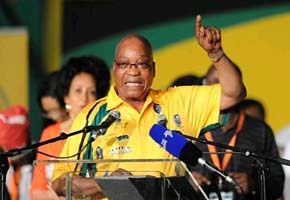
Inside the conference there were also plots and intrigue.
Zuma had faced an embarrassing, if lacklustre, leadership challenge from his Deputy President Kgalema Motlanthe, who won 991 of the votes.
Party secretary general Gwede Mantashe and chairwoman Baleka Mbete were re-elected to their positions, with newcomers deputy-secretary general Jesse Duarte and treasurer general Zweli Mkhize, who is also the premier of Zuma’s home province KwaZulu-Natal.
The scale of Zuma’s victory, dubbed a “Zumanami,” will take some of the heat off the embattled president.
But after three crisis-marked years in power, Zuma faces a tough slog ahead.
He will have to work hard to win back South African voters, who increasingly see the ANC as out of touch, incompetent and corrupt.
Zuma’s poll numbers have steadily eroded amid a series of scandals.
Criticism of his administration reached a crescendo earlier this year when police killed 34 striking miners in one day and it emerged that around $27 million of taxpayers’ money had been used to refurbish his private home.
A TNS South Africa poll released on Monday showed Motlanthe’s approval ratings at 70 percent, while Zuma polled 52 percent — less than the ANC’s total at the last elections.
Despite public anger at the state of the country, the ANC is likely to romp home in 2014.
The ANC has consistently received around two thirds of the vote in previous elections since the end of apartheid.
But a poor showing could exacerbate divisions within Africa’s oldest liberation movement.
With the opposition Democratic Alliance gaining traction in their personalised attacks on Zuma, the ANC could face a tough scrap to retain control of provinces like Gauteng — which includes Johannesburg and Pretoria.
Zuma will also face an uphill struggle to correct the course of the ailing South African economy.
Unemployment remains stuck around 25 percent and the economy is growing at its slowest rate in three years.
Meanwhile, crucial sectors like mining have been hobbled by strikes over low wages and are struggling to modernise and reduce reliance on masses of cheap labour.
Credit ratings agencies have warned that further rating downgrades will come if the conference does not see the ANC change course.
Opening the five-day meeting Zuma tried to reassure investors that he does not back calls for mass nationalisations and that the country is not “falling apart.”
The election of Ramaphosa as deputy head of the party — putting him firmly in line to become deputy president — may also assuage industry’s fears.
“We are somewhat sceptical of the impact Ramaphosa can make though the market may interpret him, plus Zuma backing the National Development Plan as being a real positive,” said Peter Attard Montalto, an analyst with Japanese bank Nomura.
“What we may have here then is a positive PR boost plus another investor friendly voice in cabinet but little real change on the ground and in action.”
For Motlanthe the outlook seems bleak.
He ran a largely silent campaign that has sometimes appeared more like a protest than a real run at the top office in the country. Defeat leaves him in the political wilderness, with uncertainty even he will remain as the country’s deputy president.
Meanwhile, Zanu-PF yesterday congratulated South Africa’s ruling ANC for successfully holding its 53rd elective conference, in which President Zuma was re-elected president of the party with an overwhelming majority.
In a solidarity message at Mangaung, Bloemfontein in South Africa yesterday, Zanu-PF National Chairman, Ambassador Simon Khaya Moyo said the 53rd conference was the expounding of the journey the ANC had travelled to realise majority rule in South Africa.
“On behalf of the President and First Secretary of Zanu-PF, Cde RG Mugabe, the Politburo, the Central Committee, the entire party membership and indeed on behalf of my delegation, we bring you revolutionary greetings from your brothers and sisters in Zimbabwe — the land of Cde Robert Mugabe and the late Dr Joshua Nkomo. I convey fraternal and revolutionary congratulations to the just elected new leadership of the ANC,” said Ambassador Khaya Moyo.
He commended the ANC for inculcating the desire to be independent in Africans, since its formation in 1912 and working hard to find a solution to Zimbabwe’s political stalemate.
“In this regard, I would like to thank the ANC on behalf of Zanu-PF on their remarkable support in finding a peaceful and lasting solution to Zimbabwe’s political impasse.
“Indeed the African National Congress planted in all of us the passion and zeal of striving to be a free people. The efforts of the founding fathers of the ANC did not go in vain for we are a living testimony of their visionary leadership,” he said.
l To Page 2


 derick.khumalo