

 admin
admin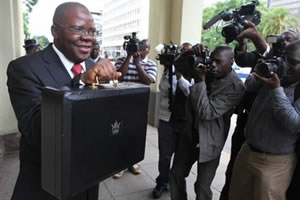
Finance ministry sought to tie a few “loose ends”.
The absence of President Mugabe, who had travelled to Asia on official business, had also been overlooked.
The President returned home on Sunday.
Minister Biti will on Thursday present his Budget statement amid wide expectations and limited fiscal space.
He is expected to present a US$3,4 billion budget which balances the interests of various economic stakeholders.
The minister has the unenviable task of balancing ballooning recurrent expenditure bill and the Government’s capital projects.
However, Minister Biti might derive respite from the sale of diamonds after the Kimberly Process Certification Scheme approved the exportation of Marange gems.
Anjin, one of the diamond firms operating in Marange, is yet to export its stockpile.
In the face of the tight fiscal space, the finance minister might expand his purse by taxing a proportion of revenue for mining firms with the funds going to the Sovereign Fund.
“Minister Biti needs to come up with some mechanism to create additional funds for the national coffers and it would be ideal for him to establish a Sovereign Fund,” said Mr Gift Mugano, an economics lecturer at Bindura University of Science Education.
“Its not healthy to run a cash budget.”
Nonetheless, Minister Biti has to perform a special balancing act on resource allocation in the face of limited revenue after walking a similar path last year for his US$2,7 billion budget.
The health and education sectors remain top priority.
Observers say the minister cannot continue ignoring funding agriculture which contributed 33 percent of the GDP last year alone.
Critical social service requirements compete fiercely for funding with other such important obligations as better remuneration for civil servants.
Inevitably, recurrent expenditure has shown no signs of receding with employment costs for Government staff expected to gobble 60 percent of budget.
The possibility of elections next year presents another challenge for the minister who has to set resources aside for the plebiscite and the constitutional referendum.
Economist Dr Eric Bloch said: “We expect he would present a budget that does not tax the poor and that he would introduce measure to cut on (recurrent Government) spending.”
Dr Bloch said amid the stark reality of tight fiscal space, Minister Biti would have to announce measures to stimulate the economy.
Growing the economy presents an opportunity for fiscal revenue growth.
In his 2012 national budget strategy paper, the finance minister projected the economy would next year expand by an average of 7,8 percent.
Some economists expect the minister to announce measures to stimulate exports, grow constrained industrial capacity and increase its competitiveness.
Buy Zimbabwe, an initiative advocating increased consumption of local products said key issues should be centred on job creation, revamping the manufacturing sector, and promotion of a sustainable and competitive industry.
“The major priority of the 2012 budget should be to save jobs in the country. With only 850 000 Zimbabweans in formal employment it is critical that we do not continue to export jobs but create an environment that protects current jobs and creates more jobs. This means that we have to create a vibrant local economy that has local companies that employ locals,” said Buy Zimbabwe.
This means Minister Biti would have to find a workable formula to enable importation, at a reduced cost, of raw material key for the growth of industry and a raft of measures to curtail imports that hurt recovery of local firms.
Limited funding not withstanding, key enablers of economic growth such as Zesa Holdings, Zimbabwe National Water Authority and the National Railways of Zimbabwe need financial support to enhance their operations.
According to the budget strategy paper Minister is expected to set aside about US$80 million for the rehabilitation of power stations to increase power generation to about 1 900MW.
Resources would also be directed towards water and sanitation. Harare and Bulawayo are facing acute water problems.
But it also goes without saying the national treasurer would have to spare a thought for vulnerable groups by introducing social safety nets.



 Online Reporter