Chronicle Editor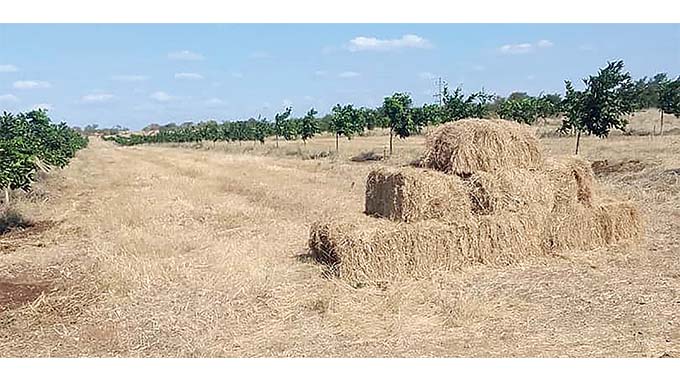
Sukulwenkosi Dube-Matutu – [email protected]
GOVERNMENT, through the Agricultural and Rural Development Advisory Services (ARDAS) in Matabeleland South Province, working with various partners, has started hay baling with a target of 250 000 bales in order to curb poverty deaths.
Hay baling helps to supply livestock farmers with affordable feed for their animals as commercial feed remains beyond the reach of many farmers.
In addition to baling hay, farmers are also bailing fodder which is highly nutritive.
Some parts of the country received low rains during the 2022/23 farming season which means farmers in some areas will run out of grazing land for their animals before the next rainy season, a situation that will affect the condition of livestock resulting in deaths.
Matabeleland South acting provincial agricultural director rural development services, Mr Mkhunjulelwa Ndlovu said the province has about 20 000 bales so far. He said the hay baling programme mainly targets smallholder farmers in order to afford them access to nutritive supplementary fees at subsidised prices.
“In a bid to sustain and maintain our flock, we have started biomass harvesting which we term hay baling. Our target as a province is 250 000 hay bales of standard weight, which is 18kg per bale. Our aim is to meet this target. We have engaged a number of players within the beef industry and Government is taking the lead.
“We have Matobo Research Centre who are also baling hay on their farm and at Matopos National Park.
As Agritex, we are targeting the Beitbridge and Shangani areas. We also have farmers in Esigodini, Shangani, Mangwe and Bulilima who are also baling. At the moment we have partnered with Toppick Investment Farm in Beitbridge where we are baling grass. We started last week and we have exceeded 1 000 bales. Our target is to harvest quickly before the grass loses its nutritive value. Already Matobo Research Centre has close to 10 000 bales so far,” he said.
Mr Ndlovu said the bales will be moved to farmers beginning of next week while the baling process continues. He said this intervention will ensure that the provincial herd survives. Mr Ndlovu said commercial feed is expensive making it difficult for farmers to access supplementary feed.
He said the targeted areas were Beitbridge West, Gwanda South, Matobo South, Mangwe, Bulilima West and some parts of Insiza.
Mr Ndlovu said baling of legume fodder crops was also underway in the province with close to 5 000 bales having been mobilised.
“Farmers have grown a lot of legume fodder crops on the arable lands. They have baled a lot of these legumes following last year’s experience where farmers who had baled legumes were able to save their animals. The farmers who used legume fodder bales recorded close to zero kid, calf mortalities and poverty deaths. The uptake of legume bales has improved and we are looking at close to 7 000 bales,” he said.
This year’s hay baling exercise is being held under the theme: “Bale it, don’t burn it.”
Mr Ndlovu said farmers were being encouraged to bale grass instead of burning it. He said this year his department would work closely with the Environmental Management Agency in rolling out anti-fire programmes.
Mr Ndlovu said hay baling can be a source of livelihood for farmers without livestock as they can bale and sell to their fellow farmers.
He said hay baling can also prevent cases of stocktheft and spread of cross boundary diseases which are caused by animals straying into Botswana in search of pastures.
Mr Ndlovu said farmers who are into irrigation farming should put a portion of land under high yielding fodder grass or fodder crops to supplement small stock like goats and lactating animals in order to save them as well as feed the animals with crop residue.
He said there was also a need to establish bigger irrigations to grow high yielding grasses which could be sold to farmers.
“Farmers with bigger arable lands should fence them and have a certain area where they can plant fodder. Our thrust is to push fodder production at big irrigations across the province. Our target is to have at least 20 percent of arable land at all irrigations under fodder production so that farmers can support their animals during the dry season instead of relying on crop residue which is low in nutrients,” he said.–@DubeMatutu



 Online Reporter