Vusumuzi Dube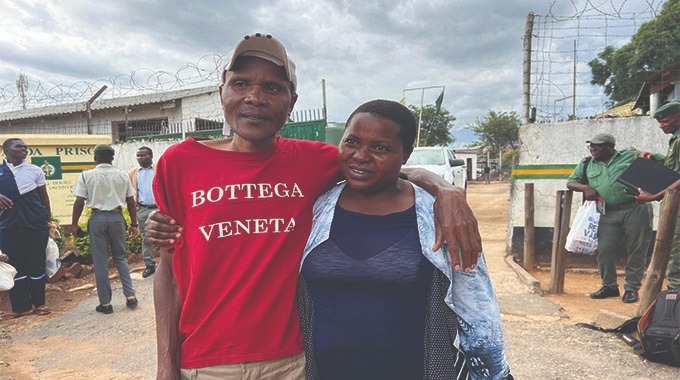
Sukulwenkosi Dube-Matutu, [email protected]
THE Presidential Amnesty could not have come at a better time for 43-year-old Charles Shoko from Mberengwa District, who now has another opportunity to be reunited with his wife and four children.
Shoko had served four years and was left with two years in prison after being sentenced to nine years in jail in 2021 for illegal possession of a pangolin, with three years suspended on condition of good behaviour.
Upon his release from Gwanda Prison on Monday, he was greeted by his sister, Ms Sithulisiwe Ziwawe.
He expressed huge gratitude to President Mnangagwa for giving him a second chance in life through the amnesty.
“I have been in prison for four years and when the Presidential Amnesty came, I was left with two years. I was imprisoned in 2021 after I had been found in possession of a pangolin in Beitbridge. I can now go to my wife and children. I have four children and the youngest is four-years-old,” he said.
“When I was imprisoned, my youngest child was a few months old. It always pained me that my children had to go through these years without their father.
“My wife had to perform piece jobs to make ends meet. I thank President Mnangagwa for his programme of pardoning inmates.”
Shoko said he will fully utilise this opportunity to lead a law-abiding life and expressed gratitude for his stay in prison for the rehabilitation process.
His sister, Ms Ziwawe, said it was a huge relief to reunite with her brother.
“I’m glad that my brother is finally out. It’s been a long time since he was incarcerated. Now, he can finally be united with his children and wife and entire family,” she said.
“We are grateful for the Presidential Amnesty programme, which has helped us to reunite with our families.”
Another amnesty beneficiary, Thulani Mlilo (26), said he was grateful for the pardon and that he has learnt a lot in prison, including life skills. Mr Mlilo said he has learnt that as a young person, there is a lot that he can constructively do with his life.
A total of 260 prisoners have been released from prisons in Matabeleland South Province under the Presidential Amnesty.
Speaking on Monday during the release of prisoners from Gwanda Prison, Zimbabwe Prisons and Correctional Services (ZPCS) Matabeleland South Commissioner Cleopas Mzila Moyo said of the pardoned prisoners, 256 are men and four are women.
“As Matabeleland South Province, we have a total of 260 inmates who are benefitting from the Presidential pardon. Out of the 260, four are females and 256 are males. Beitbridge Prison has 84 pardoned inmates, Gwanda Prison, including its satellites, which are Filabusi, Esigodini, Kezi and Gwanda Farm Prison, has 132, while Plumtree Prison has 44 inmates,” he said.
“The amnesty will help us in decongesting our prisons as we have been facing a serious challenge of overcrowding across the whole province.”
Comm Moyo said that having gone through various rehabilitation programmes during their stay in prison, the inmates are expected to live a law-abiding and productive life.
He said during their stay in prison, inmates are given a chance to choose skills training programmes of their choice so that after being released, they can pursue these skills.
Comm Moyo urged communities and families to give the pardoned inmates a second chance and revealed that, before being released, the inmates are counselled to prepare them for integration into the community.
“The inmates have been given a second chance through the amnesty and it’s our hope that they don’t waste this opportunity. We don’t want to see the inmates that have been released coming back,” he said.
President Mnangagwa has granted 4 305 prisoners amnesty as part of efforts to promote restorative justice and decongest the country’s correctional facilities.
He proclaimed Clemency Order No.1 of 2026 after exercising his Executive Prerogative of Mercy in terms of Section 112 (1)(a) and (d) of the Constitution of Zimbabwe.
The amnesty is targeted and merit-based, focusing on vulnerable groups and inmates who have shown significant progress in rehabilitation. Most beneficiaries are required to have served at least one-third of their sentences by the date of gazetting.
Those qualifying for full remission include convicted female inmates,
excluding those convicted of specified offences.
The clemency also covers visually impaired and physically challenged inmates whose conditions cannot be adequately managed within correctional facilities, inmates at open prisons, and those who have served a minimum of 20 years, including prisoners whose death sentences were commuted to life imprisonment.
However, offenders convicted of serious crimes such as murder, treason, rape, robbery, armed robbery, carjacking, public violence and trafficking in persons are excluded.—@DubeMatutu



 Online Reporter