

 Online Reporter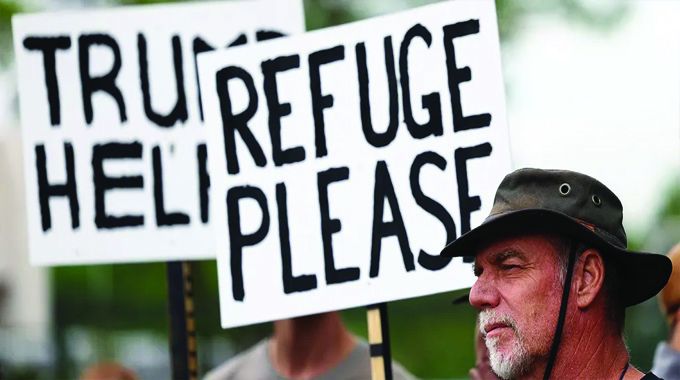
Marshall Ndlela, [email protected]
THE decision by 50 South African Boers to accept refugee status in the United States — dubbed “Trumpland”— has sparked a wave of controversy, laying bare South Africa’s unresolved legacies of colonial land dispossession, racial injustice and economic inequality.
Though these 50 individuals represent a mere 0.001 percent of the estimated 4,7 million Afrikaners (Boers) in South Africa, their departure has resonated globally, highlighting the nation’s ongoing struggle to reconcile its past with the pursuit of a more equitable future. Amid the uproar, calls have emerged for the South African government to take legal action against these “disloyal” Boers—seizing their assets and redistributing them to unified South Africans as a firm stance against perceived unpatriotic conduct. Paradoxically, while the government and other groups have dismissed claims of Afrikaner persecution as misinformation, it has nonetheless facilitated the logistics of the Boers’ repatriation — without assessing their claims, wealth, or landholdings and without applying expatriation taxes, conducting only basic security vetting.
Demographics of South African Boers
Boers, or Afrikaners, are primarily descendants of Dutch settlers, who arrived at the Cape of Good Hope in 1652, later joined by French Huguenots, Germans, and other Europeans. Numbering approximately 4.7 million, they constitute the majority of South Africa’s white population — 8.4 percent of the total 60 million population, according to 2023 estimates.
Afrikaners are predominantly Afrikaans-speaking, with a cultural identity rooted in Calvinist Christianity, rural traditions, and a historical narrative of resilience against British colonialism.
They are concentrated in Gauteng (economic hubs of Pretoria and Johannesburg), the Western Cape (noted for agriculture and tourism), the Free State (a farming stronghold), and the Northern Cape (sparsely populated but agriculturally significant). Afrikaners control over 72 percent of South Africa’s farmland — a legacy of colonial and apartheid-era policies.
Formation of the Afrikaner Republic and Van Rensburg’s influence
By the early 19th century, Dutch settlers had evolved into Boers — a distinct group with their own language (Afrikaans), Calvinist faith, and agrarian lifestyle. Resisting British annexation of the Cape in 1806, thousands embarked on the Great Trek (1835–1840), migrating inland to establish independent republics such as the South African Republic (Transvaal) and the Orange Free State.
These republics were underpinned by a belief in divine entitlement to the land, reinforced by Nicolaas van Rensburg, a Boer prophet born in 1864. His visions, recorded by followers, predicted Afrikaner prosperity and resilience, fuelling nationalist fervour.
Van Rensburg’s prophecies — blending spirituality with cultural pride — remain influential, among some Afrikaners and are invoked by groups like AfriForum, to defend their heritage against perceived threats such as land reform. This narrative of divine mission continues to complicate efforts to foster a unified South African identity.
Dispossession of Khoi, San and black populations
European settlement profoundly disrupted indigenous societies. The Khoi and San — the Cape’s earliest inhabitants — were displaced as Dutch and Boer settlers claimed land for farming and grazing.
By the 1700s, many Khoi had become labourers on settler farms, while the San were pushed to marginal areas or absorbed into colonial economies as part of the “coloured” population.
Bantu-speaking groups — Xhosa, Zulu, Sotho, Tswana and others — lost fertile territories through wars, treaties and land allocations to white settlers. The Xhosa Wars (1779–1879) and other conflicts saw African communities forcibly relocated to reserves — a pattern later formalised by Boer republics and British authorities.
This systematic dispossession stripped indigenous groups of their economic and cultural foundations, laying the groundwork for apartheid’s “homelands” and today’s unresolved land disputes.
Cecil John Rhodes and the scramble for Southern Africa
British imperialist, Cecil John Rhodes envisioned a “Cape to Cairo” empire. Through the British South Africa Company, he facilitated white settlement and resource extraction in Zimbabwe, Zambia, Botswana and Malawi, linking these territories to British colonies in East Africa. His policies supported white settlers — including Boers involved in mining and agriculture — while imposing taxes and labour systems that integrated Africans into colonial economies.
Rhodes’ De Beers Company dominated diamond mining, and his influence in the gold-rich Transvaal heightened tensions with Boer republics. His legacy, including institutions like Rhodes University, remains contentious. Movements such as #RhodesMustFall (2015) have demanded decolonisation, reflecting broader calls for historical redress.
Anglo-Boer wars and exploitation of black labour
The Anglo-Boer Wars (1880–1881 and 1899–1902) were pivotal in shaping South Africa’s racial and political landscape. Driven by British ambitions to control Transvaal’s gold mines, the wars pitted British forces against Boer republics. Both sides relied heavily on black labour: Africans served as porters, scouts, miners and support staff, often under brutal conditions.
The British interned over 115 000 Boers and 25 000 Africans in concentration camps, where disease and malnutrition were rampant. An estimated 28 000 Boers and 14 000 Africans died. Black communities lost land and livestock, emerging as the wars’ primary victims. The 1902 Treaty of Vereeniging consolidated white control, paving the way for the Union of South Africa and further marginalising black South Africans.
Partition of South Africa and fraudulent land sales
The 1910 Union of South Africa united British and Boer interests, creating a white-dominated state that excluded black Africans from political power. The 1913 Natives Land Act restricted black land ownership to just seven percent of the country — mostly barren reserves —while reserving 93 percent for whites.
Simultaneously, emigration schemes in Britain, the Netherlands, Germany, and other European countries marketed African land as “available,” ignoring the presence of indigenous peoples.
These fraudulent land sales, promoted by colonial governments and private companies, attracted thousands of settlers. Many of their descendants —including Boers — hold title to disputed land today. These transactions are now widely regarded as illegitimate, fuelling demands for land restitution and reparative justice.
Boer abuse of native South Africans
As landowners and employers, Boers played a central role in exploiting black labour. On farms, African workers endured long hours, low wages, and strict control, often living as tenants under exploitative systems such as the “dop system” (payment in alcohol), which entrenched dependency.
In urban areas, Boers enforced pre-apartheid segregation, barring black South Africans from skilled trades, public facilities and residential areas.
This systemic exploitation, rooted in Afrikaner nationalism and a belief in racial superiority, marginalised black communities and continues to fuel resentment in contemporary land reform debates.
Apartheid: A crime against humanity
In 1948, the Afrikaner-led National Party formally institutionalised racial oppression through apartheid, a system later declared a crime against humanity by the United Nations in 1973.
Apartheid enforced racial segregation, stripped black South Africans of citizenship, and confined them to just 13 percent of the land in economically unviable “homelands” such as Transkei and Bophuthatswana.
Pass laws restricted black mobility, while forced removals displaced millions from communities like Sophia town and District Six to barren townships. Boers, as principal beneficiaries, dominated politics — through figures like Hendrik Verwoerd — agriculture, and industry, amassing wealth while black communities were systematically impoverished.
The brutality of apartheid, exemplified by the Sharpeville Massacre (1960, 69 killed) and the Soweto Uprising (1976, over 600 killed), drew global condemnation, leading to sanctions and international isolation.
Substandard services and State-sponsored violence
Apartheid deliberately underfunded black education, healthcare, and housing to entrench white supremacy. The 1953 Bantu Education Act prepared black South Africans for menial labour, with per-pupil spending on white students ten times higher. Black hospitals were overcrowded and understaffed, contributing to high mortality rates. Housing in townships such as Alexandra lacked basic amenities, perpetuating cycles of poverty and marginalisation.
Codesa and the land compromise
The Convention for a Democratic South Africa (Codesa, 1991–1993) negotiated the transition to democracy but failed to resolve the land question. To secure white co-operation, the ANC agreed to protect existing property rights, thereby preserving Boer and white land ownership. This compromise left millions of black South Africans landless, confined to townships or informal settlements like Khayelitsha. The post-1994 “willing buyer, willing seller” model proved ineffective, as white landowners demanded exorbitant prices, stalling redistribution and fuelling accusations of betrayal.
1994: ANC victory and the Freedom Charter
In 1994, the ANC, led by Nelson Mandela, won South Africa’s first democratic election, ending decades of white rule. The Freedom Charter (1955) had promised that “the land shall be shared among those who work it,” alongside free education and economic justice. However, global economic pressures —including influence from the World Bank and IMF — and internal divisions within the ANC led to a prioritisation of stability over radical reform. Land restitution and redistribution programmes launched in 1995 aimed to return land to dispossessed communities, but bureaucratic delays, corruption, and white resistance hindered progress. By 2023, only nine percent of land had been transferred to black ownership.
Zimbabwe’s Land Reform and South Africa’s radical turn
Zimbabwe’s land reform programme sought to address historical land injustices by redistributing white-owned farms to landless black Zimbabweans. The initiative aimed to empower indigenous farmers, restore ancestral lands, and promote economic equity—aligning with the ethos of the liberation struggle. It successfully transferred significant land to black citizens, enabling many to engage in agriculture, build sustainable livelihoods, and contribute to national development.
This bold move inspired South African activists, who saw parallels in their own landlessness and drew motivation from Zimbabwe’s commitment to corrective justice. Left-wing parties emerged, including the Economic Freedom Fighters (EFF, founded 2013), African Transformation Movement (ATM, 2018), and Black First Land First (BFLF, 2015), all advocating for land expropriation without compensation. The EFF, led by Julius Malema, secured 12 percent of the vote in 2024, reflecting growing youth frustration. These parties, amplified by social media campaigns such as #LandOrDeath, have pressured the ANC to amend Section 25 of the Constitution to allow uncompensated expropriation—though implementation remains contested.
AfriForum and anti-black sentiments
AfriForum, founded in 2006, is a prominent Afrikaner advocacy group with over 260 000 members (2025 estimate). It defends white land ownership, promotes Afrikaans culture, and portrays Boers as victims of “reverse racism.” Its international campaigns highlight farm attacks (1 500 incidents from 2010–2020, affecting all races) to support claims of a “white genocide.” AfriForum’s rhetoric often fuels anti-black sentiment, framing land reform as a threat to Afrikaner identity. Its lobbying efforts in the United States, Australia, and Europe have amplified fears among Boers, contributing to the “Trumpland” narrative. Critics argue that AfriForum exploits legitimate concerns about crime to preserve white privilege, obstruct reconciliation and deepen racial divisions.
The Trumpland refugee initiative
The administration of former US President Donald Trump granted refugee status to 50 Boers — a negligible 0.001 percent of South Africa’s 4.7 million Afrikaners. Trump’s ties to Elon Musk, the South African-born billionaire who has commented on the safety of white South Africans, reportedly influenced the decision. Musk’s posts on X (formerly Twitter), reaching millions, have echoed AfriForum’s claims, amplifying the narrative of Boer persecution.
The United States prioritised these Boers over refugees from conflict zones such as Libya, Syria, Yemen, and Sudan, prompting accusations of selective humanitarianism driven by racial and political motives. Right-wing media outlets, including Fox News and Breitbart, framed the initiative as a rescue from “persecution,” despite the fact that Afrikaner emigration rates remain low (less than one percent annually). The move has been widely criticised as an attempt to exploit South Africa’s land reform debates for political gain, undermining efforts to address historical injustices.
South Africa’s diplomatic failure and contradictory actions
The South African government has struggled to counter the “Trumpland” narrative, revealing significant diplomatic shortcomings. The Department of International Relations and Co-operation (Dirco) issued statements dismissing allegations of Afrikaner persecution as “misinformation,” emphasising that South Africa remains a stable, multicultural democracy with strong protections for all citizens. Civil society organisations and progressive Afrikaner communities have echoed this stance, rejecting claims of systemic discrimination against Boers and highlighting their continued economic dominance — such as their control of 72 percent of farmland. These rebuttals are supported by data showing that farm attacks, while tragic, are not racially motivated, with both black and white farmers affected in proportion to their land ownership.
Paradoxically, despite this firm public position, the government facilitated the departure of the 50 Boers to the United States by providing administrative support, including processing travel documents and liaising with US authorities. This assistance was granted without evaluating the legitimacy of their refugee claims, assessing their land or financial assets, or applying expatriation or emigration taxes — standard procedures for South Africans emigrating with significant wealth. The vetting process focused solely on security clearance, neglecting to scrutinise motives or economic status. This contradiction — publicly denying persecution while enabling the exodus — has provoked public outrage, with many South Africans viewing it as a failure to challenge the “Trumpland” narrative and a missed opportunity to assert national sovereignty. Critics argue that this inconsistency undermines the ANC’s credibility, emboldens AfriForum’s distortions, and weakens South Africa’s global standing amid ongoing land reform debates.
Legal measures against the disloyal 50 Boers
The decision by the 50 Boers to accept refugee status in “Trumpland” has been widely condemned as an act of disloyalty and a betrayal of South Africa’s post-apartheid vision of unity. Political analysts and community leaders argue that by aligning with a foreign narrative falsely portraying South Africa as unsafe for whites, these individuals have undermined national sovereignty and reconciliation efforts. The government’s facilitation of their departure, without due scrutiny, has intensified calls for legal action.
Under the South African Citizenship Act of 1995, the state may revoke citizenship from individuals who act against national interests, particularly if they acquire foreign citizenship with the intent to sever ties with South Africa. The acceptance of refugee status could be interpreted as a deliberate act of disloyalty, potentially triggering citizenship reviews. Additionally, the Prevention of Organised Crime Act (1998) allows for asset forfeiture when actions are deemed harmful to the state. Seizing the Boers’ assets — land, properties, and financial holdings — could be justified on the grounds that their departure, coupled with false persecution claims, damages the country’s reputation and social cohesion.
Such measures would send a strong message to other unpatriotic citizens, particularly those who perpetuate divisive narratives or seek to exploit historical privilege while abandoning the nation. The recovered assets could be redistributed to committed South Africans — black, white, and others — through land reform, affordable housing, or community development initiatives. For example, farmland could be allocated to landless black farmers, while urban properties could support housing projects in townships like Soweto. Expatriation taxes, typically applied to emigrants with assets exceeding R1 million, should also be enforced retroactively to ensure the state recovers revenue for equitable development. These steps would demonstrate the government’s commitment to justice, deter future acts of disloyalty, and advance the Freedom Charter’s vision of shared prosperity.
Economic inequality and land ownership
South Africa’s Gini coefficient of 0.63 reflects one of the highest levels of inequality globally. Boers and other white South Africans own 72 percent of farmland and 60 percent of urban property, despite comprising only 8.4 percent of the population. Since 1994, ANC-led land reform has transferred just nine percent of land to black owners, with 24 million hectares still in white hands. Corruption scandals — such as the 2020 Vrede Dairy Project — and bureaucratic inefficiencies have eroded public trust. Black farmers, often allocated marginal land, face limited access to capital, training, and markets, perpetuating structural disparities and fuelling social tensions.
International media misrepresentation
Western media outlets — particularly in the United States, Australia, and the United Kingdom — have amplified AfriForum’s claims of a “white genocide,” citing farm attacks (2 000 murders from 1994 to 2020) while ignoring the broader context of South Africa’s 20 000 annual murders. Channels like Sky News Australia frame land reform as anti-white, often omitting the historical context of colonial land dispossession. The “Trumpland” initiative is portrayed as a humanitarian necessity, sidelining the lived experiences of black South Africans and distorting global perceptions, thereby complicating South Africa’s efforts to attract foreign investment.
++The “born-free” generation is at the forefront of land activism, using platforms like X (formerly Twitter) to amplify their demands. Hashtags such as #LandOrDeath trend weekly, reaching millions. EFF-led protests, including the 2023 Cape Town march, have drawn thousands demanding land redistribution and employment. This digital movement resonates with African diaspora communities but also attracts right-wing backlash, with AfriForum branding activists as “radicals.” With youth unemployment at 45 percent for those aged 15–34, land reform is increasingly tied to economic justice, intensifying calls for structural change.
Environmental and agricultural challenges
Boer-owned farms currently produce 80 percent of South Africa’s food and employ around 700 000 workers. Land reform must therefore balance restitution with food security. Black farmers face significant barriers, including limited access to water rights — 85 percent of which are controlled by white farmers — and poor soil quality. Climate change has further exacerbated challenges, with droughts (2018–2020) and floods (2022) reducing yields by up to 20 percent in some regions. Sustainable reform requires investment in irrigation, training, and infrastructure to ensure both equity and agricultural stability.
Psychological Legacy of Apartheid
Apartheid’s dehumanisation of black South Africans has left a lasting psychological impact, fostering internalised racism and mistrust. Simultaneously, some Boers retain a siege mentality, fearing the erosion of their historical dominance. Studies show that 30 percent of Afrikaners express anxiety over land reform, while 70 percent of black South Africans report landlessness as a source of trauma. These emotional legacies complicate dialogue and reconciliation, as evidenced by polarised reactions to the “Trumpland” episode.
Global right-wing solidarity
The “Trumpland” initiative reflects a broader network of right-wing solidarity, with figures like Donald Trump, Elon Musk, and Australia’s Pauline Hanson aligning with AfriForum’s narrative. Amplified on platforms like X, this alliance portrays South Africa as a cautionary tale of “white decline,” influencing policies such as Australia’s 2018 Boer visa offer. These interventions undermine international support for South Africa’s reform agenda and embolden resistance to transformative justice.
The path forward
The ANC must expedite land redistribution, aiming for a 30 percent transfer by 2030, while committing R400 billion annually to education, and investing in healthcare and employment to address the roots of xenophobia. Legal action against the 50 Boers —revoking citizenship, seizing assets, and imposing retroactive expatriation taxes — would serve as a deterrent to disloyalty and help finance equitable development. Redistributing confiscated assets to united South Africans would further the vision of the Freedom Charter. On the diplomatic front, South Africa must challenge AfriForum’s misrepresentations by collaborating with the African Union and the United Nations to frame land reform within a global context. The government’s contradictory role in facilitating the 50 Boers’ repatriation must be scrutinised through transparent policy reviews, ensuring future decisions are consistent with its rejection of persecution claims. International partners, including the United States, should support reform efforts rather than divisive narratives such as “Trumpland.”
The granting of refugee status to 50 South African Boers in “Trumpland” highlights the lingering scars of colonisation, apartheid, and land dispossession, while offering a chance to reaffirm justice and national unity. From the displacement of the Khoi, San, and Bantu-speaking peoples to the atrocities of apartheid and the compromises of Codesa, land remains South Africa’s central fault line. AfriForum’s divisive rhetoric, Zimbabwe’s bold land reform, and radical voices like the EFF all reflect a nation still wrestling with its history. The government’s mixed signals — denouncing persecution claims while aiding the Boers’ return — undermine its credibility. However, legal measures against these disloyal individuals could send a resolute message. By seizing and redistributing their assets, South Africa can promote land justice, gender equality, and sustainable agriculture — transforming stolen land into a shared foundation for unity. The world is watching as South Africa stands at a critical crossroads, where bold, principled action is both a moral and practical necessity.


