Online Reporter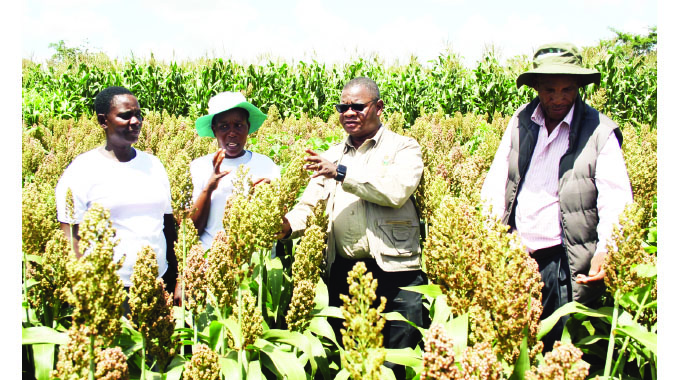
Theseus Shambare-Herald Correspondent
TRADITIONAL grains have emerged as key anchors of Zimbabwe’s food security strategy after farmers planted over 563 000 hectares of drought-resistant crops nationwide during the 2025-2026 summer cropping season.
This follows a Government policy shift that formally elevated small grains to strategic staples alongside maize.
Under the agro-ecological tailoring of crops policy, sorghum, pearl millet and finger millet are being prioritised in drought-prone regions that receive erratic rainfall as part of a broader effort to build resilient and sustainable food systems.
Latest figures from the Agricultural and Rural Development Advisory Services (ARDAS) as of January 12, 2026 show that farmers have planted a cumulative 558 333 hectares of sorghum and 5 008 hectares of pearl millet, reflecting growing uptake of climate-smart agriculture practices.
The expansion has been supported by a strengthened logistics and input supply system.
While seed supplies for maize and sunflower were in surplus this season, Government intervened to address deficits in small grains through imports to ensure nationwide availability.
In addition, 3 749 tonnes of various seeds were delivered to Grain Marketing Board (GMB) depots, with 2 436 tonnes already distributed to farmers.
Lands, Agriculture, Fisheries, Water and Rural Development Permanent Secretary, Professor Obert Jiri, said climate change had made it necessary for the country to reduce its reliance on maize, which remains highly vulnerable to water stress.
“Climate change has compelled us to deliberately rethink our dependence on maize and to promote drought-resistant crops as a central pillar of our national food security strategy,” said Prof Jiri.
Prof Jiri said the agro-ecological tailoring framework ensures that crops are matched to specific climatic zones, enabling farmers to maximise yields even in marginal areas.
Agricultural Business Advisory Officer, Ms Blessing Mudaniso, said traditional grains provide a more reliable production pathway under changing climatic conditions.
“Traditional grains such as sorghum, pearl millet, and finger millet are naturally adapted to low rainfall environments,” said Ms Mudaniso.
She said these crops also improve nutrition and reduce dependence on food aid.
The policy shift is further anchored under the Agriculture Food Systems and Rural Transformation Strategy 2 (AFSRTS2) 2026-2030, which operationalises climate-smart agriculture as a driver of rural transformation.
To support the current season, Government has deployed 16 425 functional tractors, while national dam levels have risen to 85 percent, significantly improving water security for summer cropping.
Despite the gains, challenges persist.
Ms Mudaniso noted that some farmers still view small grains as “poor man’s crops”, while marketing systems remain underdeveloped.
To encourage wider adoption, Government has set pre-planting prices for traditional grains at US$380 per tonne, matching the price of maize.
In addition, 29 272 master farmer trainees have been registered and trained to equip farmers with the technical skills required for successful production.
“As climate shocks become more frequent, the elevation of traditional grains marks a decisive shift in Zimbabwe’s agricultural policy – one that seeks to transform vulnerability into resilience and secure food systems on the path to Vision 2030,” she said.