

 admin
admin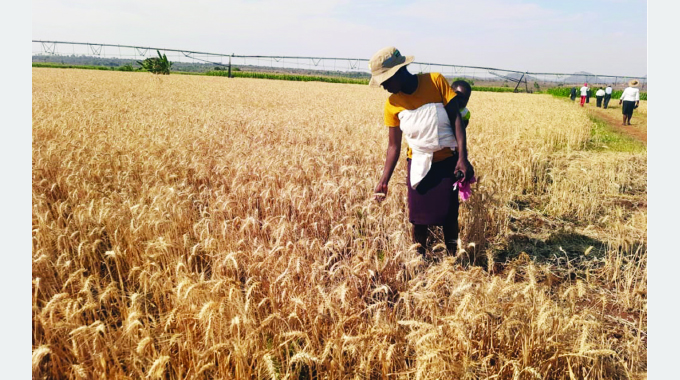
Precious Manomano-Herald Reporter
More than 20 percent of the wheat grown during the last winter has already been harvested, translating to over 84 000 tonnes.
This comes as wheat farmers are working hard to have harvesting completed by the middle of next month so farmers can shift to the summer season, while at the same time avoiding the complications arising from early rains.
Latest statistics from Agricultural and Rural Development Advisory Services indicate that the total harvested across the provinces stands at 16 446,5ha, which is 20 percent of the planted area, with a cumulative harvest of 83 856 tonnes.
The bulk of the remaining crop is at physiological maturity across the provinces and the crop is in good condition.
Zimbabwe is expecting a bumper harvest of 380 000 tonnes this year, the first time since commercial wheat production started in 1966 that the country has reached self-sufficiency.
Zimbabwe National Farmers Union vice president Mr Edward Dune confirmed that all systems are in place and farmers are busy with harvesting.
“I urge wheat farmers to stick to the calendar to avoid compromising the quality of their crop. We should stick to dates when dealing with wheat. Time is crucial in wheat farming because failure to bring it in on time could compromise the crop. The affected crop may not be accepted for human consumption and that is the biggest loss,” he said.
Disruptions in the global value chain caused by the Russia-Ukraine conflict prompted the Ministry to increase productivity by expanding the National Enhanced Agriculture Productivity scheme to press private companies, mainly millers, to join Government in contracting farmers and so assure themselves of raw materials for their flour.
There was a Pfumvudza component in inputs for smaller-scale farmers with irrigation long with the normal and expanded production from the farmers with larger holdings.
Recently, Lands, Agriculture, Fisheries, Water and Rural Development Permanent Secretary Dr John Basera said participation by the private sector in contract growing and mainstreaming was crucial in economic development and transformation of the industry.
All private businesses must contribute to local production, and this year the private sector managed to chip in with 29 000 hectares of wheat through joint ventures. The CBZ Agro-Yield supported over 18 000 hectares of winter wheat whilst the Agriculture Finance Corporation supported 10 500 hectares.
Wheat farmers around the country said they have secured enough combine harvesters and they are aiming to finish harvesting before the rains.
They also hailed the Presidential Winter Wheat Scheme, saying it supports them with inputs which is crucial in farming.
Mr Blasius Mandiriza of Craigengower Farm said he was expecting five tonnes a hectare. “We are grateful for the inputs we got from the Presidential Scheme and next year, we hope to do better than this next year. We got enough inputs and all was done on time. We thank the President for this initiative,” he said.
Another farmer in the same area, Mr Benet Mudimu, said he expected to get a good harvest. “This year is different from other years. I promise I can get 8 tonnes per hectare. I have 6ha and the crop is in good condition,” he said.
Mrs Edwich Zaranyika of Hadura Farm in Ward 32 said wheat production was good in her area adding that a bumper harvest is likely to be achieved “The Pfumvudza wheat programme has helped us to get a better harvest. We are grateful for this initiative,” she said.
The Second Republic has been working hard to push agricultural output and farm incomes by going for self-sufficiency of most food products, since this gives the farmers guaranteed markets and ensures Zimbabwe can cope with any geo-political or global supply challenges. In Zimbabwe, wheat is the second most important cereal crop after maize.
Last season, farmers produced wheat that is enough to cover nine months’ supply to meet domestic demand with GMB receiving 156 144 tonnes from the farmers it had under contract.



 Online Reporter