Online Reporter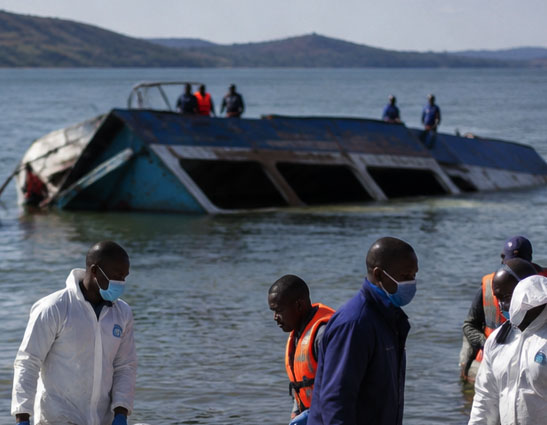
Lloyd Makonya
Correspondent
THERE are journeys that begin as ordinary journeys and end up becoming part of a nation’s history.
The journey of the Mbuya Nehanda Ferry from Kariba town towards Chalala Fishing Camp on August 11, 2026, should have been just another ordinary journey across Lake Kariba.
For the people who depended on that route, it was a familiar passage between Kariba town and the remote communities around the lake, a journey connected to work, fishing, trade, family and home.
Nobody who boarded that ferry that day could have imagined that it would become the last journey of their lives.
Nobody leaving Kariba town that day could have known that, instead of arriving safely at Chalala, they would become part of one of the darkest chapters in Zimbabwe’s history.
Ninety-five people confirmed dead at the time of writing and possibly that number set to rise. It is a number so large that the human mind struggles to comprehend it. But 95 is not simply a number.
It is 95 mothers and fathers, 95 sons and daughters, 95 brothers and sisters, 95 friends and neighbours whose absence will now be felt in homes and communities across the country.
It is 95 families whose lives have been divided into a time before August 11 and a time after it. It is 95 stories suddenly interrupted in the middle of ordinary lives.
That is what makes the tragedy so devastating. The people on the Mbuya Nehanda Ferry were not embarking on some extraordinary adventure. They were travelling because life required them to travel.
They were going to fishing camps, returning to their communities, carrying goods, going to work, visiting families and simply trying to get from one place to another.
The ferry was part of the rhythm of life around Lake Kariba.
For many communities, the lake is not merely a beautiful expanse of water admired from a distance. It is a source of livelihood, food, transport and survival. The journey from Kariba town to Chalala was therefore not simply a journey across water; it was a lifeline between communities.
And now that same lake holds the memories of 95 people who will never make the return journey home.
For us in Manicaland, the grief carries an especially painful echo. It is August again.
Thirty-five years ago, in August 1991, our province experienced a tragedy whose memory has never completely faded.
On August 3 that year, the Nyanga disaster claimed 89 lives, including 82 schoolchildren. The country woke to the kind of news that leaves a permanent scar on the national conscience. For Manicaland, Nyanga became more than a disaster. It became a wound passed from one generation to another, a reminder of how suddenly an ordinary journey can turn into unbearable loss.
And now, 35 years later, we find ourselves mourning again.
The calendar itself seems cruel.
The Nyanga tragedy occurred on August 3, 1991. The Mbuya Nehanda Ferry went down on August 11, 2026. The two tragedies are separated by exactly 35 years and eight days.
Even the numbers carry a haunting coincidence: 89 lives were lost at Nyanga; 95 have now been confirmed dead at Kariba.
Six more lives than the tragedy that for generations defined one of the darkest moments in Zimbabwe’s transport history.
But numbers, however shocking, cannot tell the whole story. Eighty-nine was never merely 89 at Nyanga. It was 89 funerals. It was 89 families whose lives changed forever. It was empty desks, empty bedrooms, empty places at family tables and parents forced to confront the unimaginable reality of burying children.
And now we have another number, 95, behind which are another 95 families facing the same terrible silence.
This is why, from Manicaland, our hearts go out to Mashonaland West and to the communities around Kariba and Chalala. We know something about this kind of grief.
We know what it means when a community waits for people to come home and instead receives news of death.
We know what it means to look at photographs and realise that the people smiling back at you will never walk through your door again. We know the sound of mourning. We know the emptiness that follows a tragedy of this magnitude.
So today, Manicaland does not mourn Kariba from a distance. We mourn with Kariba. We mourn with every mother and father who lost a child. We mourn with every child who has lost a parent. We mourn with husbands and wives who have suddenly been left alone.
We mourn with brothers and sisters who will never again hear the familiar voice of a loved one. We mourn with the fishing communities whose lives have been shaken to their foundations.
And we mourn with the people of Mashonaland West who must now carry the burden of a tragedy that no community should ever have to bear. Lake Kariba has always carried a strange duality for the people who live around it. It gives life, yet it can also take life. It provides fish and livelihoods. It connects communities.
It generates electricity. It has become one of Zimbabwe’s great symbols of human achievement and the power of nature. Yet on August 11, it became the final resting place of 95 Zimbabweans.
The country must now ask difficult questions about how this happened.
The Government has confirmed that the ferry was carrying about 180 people, despite a stated capacity of 90, and investigations are under way into the circumstances surrounding the disaster. Those investigations must be thorough, independent and honest.
They must establish what happened, why it happened and whether anything could have been done to prevent it.
Perhaps the greatest tribute we can give the dead is not simply to mourn them, but to ensure that their deaths change us. Let the 89 of Nyanga rest in the knowledge that Zimbabwe remembers them. Let the 95 of Kariba rest in the knowledge that their deaths will not be allowed to become another statistic in an old newspaper archive.
Let their names and their stories remind us that an ordinary journey should end with a person arriving safely at home.
Thirty-five years ago, Manicaland learnt this lesson through the pain of Nyanga. Today, we share that painful lesson with Mashonaland West and the people of Kariba.
Different places. Different generations. Different modes of transport. But the same grief.
As Manicaland extends its deepest condolences to Mashonaland West and to every family affected by the Kariba tragedy, let us mourn together, let us demand answers together and most importantly, let us resolve together that this must not happen again.
May the souls of the 95 who perished on Lake Kariba rest in eternal peace. May the 89 souls of Nyanga continue to rest in peace. From Nyanga to Kariba, may we finally have the courage to say, never again.