Chronicle Editor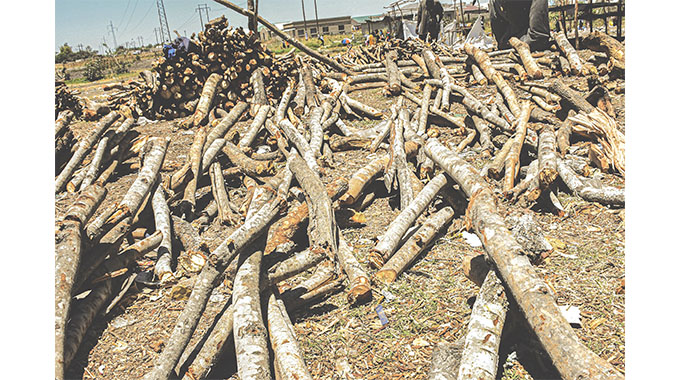
Patrick Chitumba, Midlands Bureau Chief
Clad in a sunburn grey T-Shirt, a blue work suit pair of trousers and black gumboots, Chrispen Sibanda is busy selling firewood to a resident in Mkoba Village Four suburb.
Sibanda lackadaisically picks and throws down a log onto the ground. He waits patiently for his client to choose four logs for US$2. Sibanda is in no mood for chitty chatty.
“I cannot afford to be at a place for a long time because I risk being arrested by Forestry Commission rangers,” said Sibanda (30).
He says he wakes up at around 2AM to cut down trees for firewood from nearby forests, farms or plots and by 7.30AM, he is in Mkoba selling the firewood.
Using a donkey drawn scotch cart, Sibanda’s first targets are butcheries, bottle stores or Tshisanyama places where his product is bought in bulk. On a good day he just supplies one bottle store or Tshisanyama and he sells a load for US$20. If luck is not on his side, he goes house to house selling a bundle of firewood for US$2. Sibanda says when he is arrested by the rangers, he is fined Z$5 000.
He said he is charged for selling firewood without a firewood traders licence and also selling firewood without a transportation permit. A traders’ licence costs US$50 per annum for individuals and US$100 for companies for the same period.
A permit to transport firewood costs US$10 per single trip. Sibanda is one of the more than 70 donkey-drawn scotch cart owners who deal in firewood illegally in Gweru. He says there is high demand for firewood because of Zesa’s load shedding.
The Chronicle caught up with Sibanda in one of the streets in Mkoba Village Four as he was busy selling firewood.
“Selling firewood has been my life, it’s been my source of livelihood and my clients are bottle store operators, butchers and Tshisanyama operators. I have to fend for my family through selling firewood.
I have tried applying for a licence but I don’t have a vending site,” said Sibanda, a father of two girls.
He said he usually wakes up around 2AM to cut trees on the outskirts of the city.
“Sometimes we steal and sometimes we negotiate with property owners who charge us US$5 for a load. People want firewood from Mopani trees which they say doesn’t burn out fast and so it is very hard to look for Mopani trees but I have no choice,” said Sibanda.
The recent power cuts announced by the power utility Zesa, has resulted in a rise in demand for alternative sources of energy which include firewood.
Forestry Commission Gweru district officer Mr Polite Foto bemoaned the increase in firewood poaching in and around Gweru.He said every day, 50 to 80 donkey-drawn carts and 10 to 15 trucks loaded with firewood make their way into Gweru to deliver the commodity.
“We are facing unprecedented levels of firewood poaching in and around Gweru as the demand for firewood has increased. Some blame it on load shedding, some on the surge in housing development and some on butchery, Tshisanyama and bottle store operators who sell meat and provide places for roasting meat,” said Mr Foto.
He said in Gweru, the recommended firewood sites were in Mkoba Village Six, Mkoba Village One, Senga, Mkoba Village 16, Mtapa and Mambo shopping centres.
“There are bays where legal vending of firewood is allowed but only a few firewood vendors are licensed,” said Mr Foto.
He said in the last three weeks more than 80 illegal firewood traders were arrested in the city and paid a combined Z$420 000 in fines.
“Firewood poaching and charcoal production have significantly contributed to deforestation,” said Mr Foto
He said it was a cat and mouse game between the Forestry Commission rangers and the firewood poachers who have devised ways of evading the law.
“These firewood vendors operate at night to avoid raids and as the Forestry Commission we are urging these people to come and register for licences so that we work together to reduce deforestation. If they are registered, we work together in identifying proper places to cut down trees as opposed to this wanton destruction of forests that is happening,” he said.
Mr Foto said protecting trees should be everyone’s business because trees are life. Lack of deterrent measures in dealing with perpetrators has also been identified as another factor.



 Online Reporter