Gay Mufambi
Correspondent
This article traces the constitutional history of Africa from precolonial governance structures through the traumatic ruptures of the Transatlantic slave trade and European colonisation, to the inherited frameworks of post-independence African states and ultimately to Zimbabwe’s own journey from 1980 to the present.
It argues that Africa’s constitutions cannot be fairly evaluated against the yardstick of Western liberal democracy, a system built over centuries of industrial accumulation and constitutional evolution, because Africa’s constitutional starting point was qualitatively different, shaped by four hundred years of forced underdevelopment.
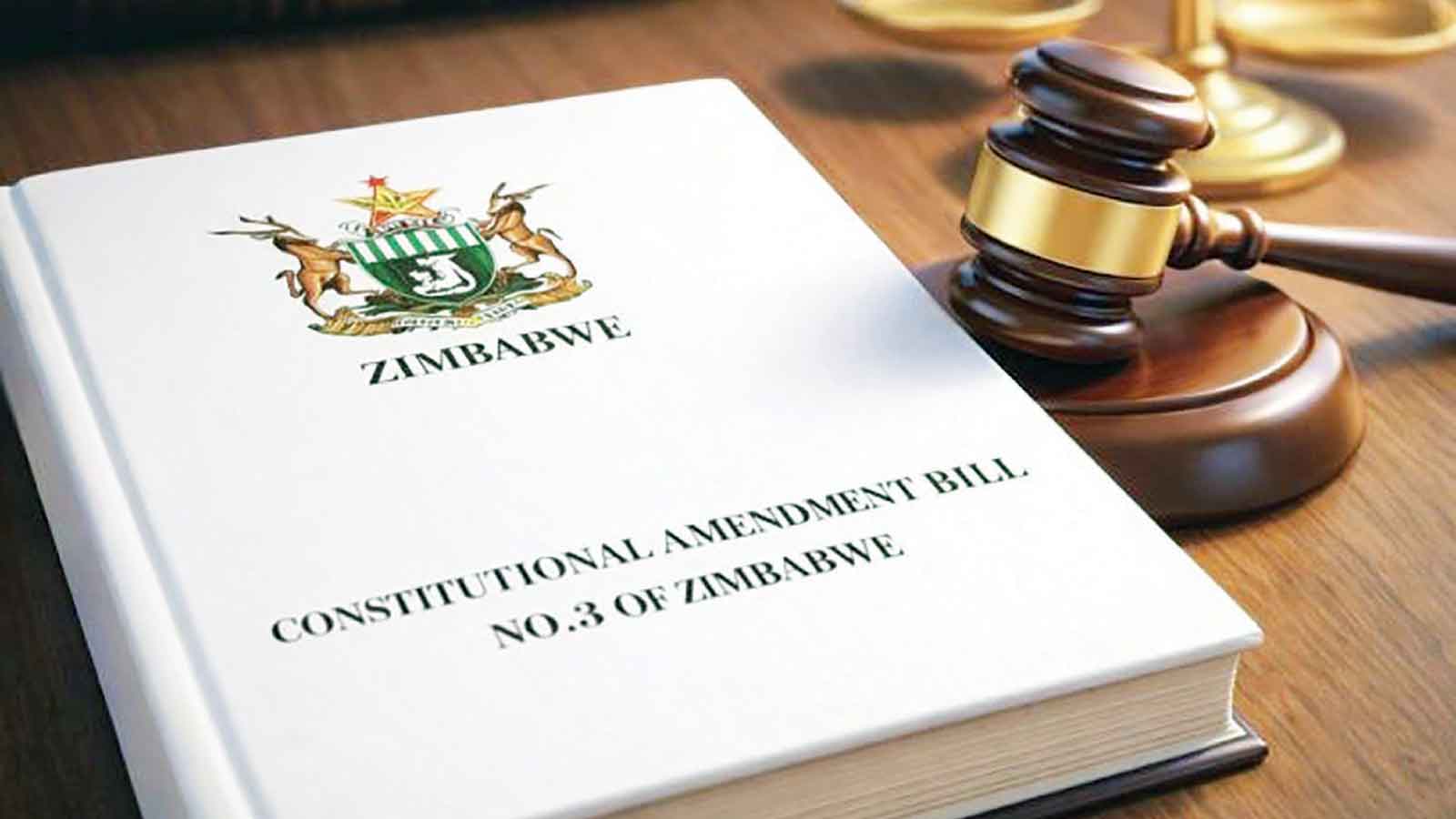
Against this historical background, the article demonstrates that Constitutional Amendment No. 3 Bill is not an aberration, but a constitutionally and historically justified act of sovereign self-determination: a young nation of 46 years correcting an inherited constitutional architecture to suit its own development trajectory.
When Western commentators assess Zimbabwe’s constitutional choices, they frequently deploy a comparative framework drawn from the liberal democratic tradition of Western Europe and North America, a tradition that has had more than two centuries to mature, consolidate, and embed itself into the institutional fabric of those societies.
The implicit standard of comparison is the United States constitution, ratified in 1788, or the Westminster parliamentary model, exported across the British Empire over three centuries of colonial administration.
Africa was not a governance vacuum before the arrival of European colonisers. The continent had developed, over millennia, sophisticated systems of governance, law, dispute resolution, and political authority that constituted, in effect, its own constitutional tradition.
The Great Zimbabwe civilisation, from which modern Zimbabwe takes its name, flourished between the 11th and 15th centuries CE and produced a highly organised state system with centralised political authority, a redistributive economy, and a social code governing relations between rulers and the governed that bears every characteristic of a constitutional compact.
Historical Perspective
Across the continent, comparable constitutional traditions operated with sophistication and durability. The Mali Empire (1235-1670) was governed partly by the Kouroukan Fouga a constitutional charter proclaimed in 1222, regarded by many scholars as one of the world’s earliest written constitutional instruments, establishing rights, social covenants, and limitations on the exercise of power.
The Ashanti Confederation in present-day Ghana operated under the Odwira constitutional framework, which provided for a functional separation of powers between the Asantehene, the council of chiefs, and the broader assembly of subjects.
The critical difference is that Africa’s precolonial constitutional traditions were not allowed to evolve organically into modern state structures. They were violently interrupted first by the slave trade and then by colonisation.
The transatlantic slave trade, which operated at scale from approximately 1450 to 1850, represents the first and most catastrophic rupture of Africa’s constitutional and developmental trajectory.
Over this period, an estimated 12,5 million Africans were forcibly transported to the Americas and the Caribbean, with perhaps double that number dying during the process of capture, transportation, and the infamous Middle Passage. The regions most devastated by the slave trade lost not merely population, but the most productive, politically active, and economically vital segments of their societies, precisely the people who, in any functioning polity, build and sustain constitutional institutions.
The constitutional consequences were profound and lasting. States that had developed sophisticated governance structures were destabilised as European slave traders allied with local power factions to capture rivals, eroding the trust-based constitutional relationships between rulers and communities that precolonial governance depended upon.
The Kongo Kingdom, one of the most organised precolonial African states, was effectively dismembered by the slave trade over the 16th and 17th centuries, its constitutional architecture destroyed from within by the corrosive economics of human trafficking.
America’s constitutional democracy evolved in a context of extraordinary economic accumulation that was extracted from Africa. To compare Zimbabwe’s 46-year-old constitutional democracy with this 239-year-old model without acknowledging this foundational historical injustice is not comparative analysis; it is historical amnesia. If the slave trade was the first rupture of Africa’s constitutional evolution, European colonisation was the second and in many ways the more structurally enduring.
Colonial Implications
The Berlin Conference of 1884-1885, at which European powers partitioned Africa among themselves without the participation of a single African representative, imposed an entirely new political geography on a continent whose constitutional traditions had evolved around very different territorial, ethnic, and ecological boundaries.
In Zimbabwe, the colonial period began formally with the British South Africa Company’s occupation of Mashonaland in 1890 and lasted, in its various forms, until independence in 1980, ninety years of continuous colonial administration.
During this period, the indigenous Shona and Ndebele peoples were subjected to a racial colonial legal order that denied them political rights, property rights, and civic participation.
The Land Apportionment Act of 1930 and its successor legislation consigned the majority of Zimbabwe’s population to overcrowded communal lands, systematically impoverishing the institutional and material foundations on which a post-colonial state would eventually have to build.
The Lancaster House Constitution was itself a product of colonial negotiation, entrenching protections for white minority property and political representation that constrained the new Zimbabwean Government’s capacity to implement redistributive development policies.
Zimbabwe did not govern itself under a truly self-determined constitutional order until 2013, meaning the country has had fewer than 13 years of genuinely indigenous constitutional governance. To demand constitutional perfection from Zimbabwe at this stage is to apply a standard that no Western democracy has met at a comparable point in its development.
The United States took more than 130 years after its 1789 Constitution to extend voting rights to women (Nineteenth Amendment, 1920). Britain did not achieve universal adult suffrage until 1928. These democracies did not achieve constitutional maturity overnight and they achieved it without the handicap of 400 years of the slave trade and 100 years of colonial extraction.
A consistent pattern across post-independence Africa has been the adoption of constitutional models transplanted from former colonial powers, Westminster parliamentary models from Britain, Napoleonic administrative frameworks from France, with little or no adaptation to African governance realities.
The rights framework in Chapter 4 of Zimbabwe’s 2013 Constitution, socio-economic rights to education, health, and shelter, reflects the aspirational constitutionalism of post-apartheid South Africa and the Kenyan constitutional moment of 2010. These are admirable aspirations. But aspirational rights without the developmental infrastructure to realise them are constitutional promises that the State cannot keep.
The developmental philosophy embedded in Amendment No. 3 Bill reflects a more honest constitutional approach: that development must precede the full realisation of rights, not because rights are unimportant, but because rights are hollow without the institutions, resources, and infrastructure needed to give them content.
This is not a novel constitutional philosophy; it is, in fact, the model that all currently developed nations actually followed, regardless of what they now reach.
During the Industrial Revolution, the period of greatest constitutional and economic transformation in Western Europe, there were no enforceable rights to education when there were no schools; no rights to health when there were no hospitals; no rights to safe working conditions when there were no labour inspectorates.
Rights followed development. Britain’s National Health Service, the institutional realisation of the right to health, came in 1948, more than 150 years after the Industrial Revolution began. You build the school first; the right to education follows.
You build the hospital first; the right to health follows. You achieve development first; the full catalogue of rights becomes realisable thereafter. Zimbabwe is simply being honest about this sequencing.
Against this historical background, the Constitution of Zimbabwe (Amendment No. 3) Bill, 2026 must be understood not as a retreat from constitutional governance, but as an assertion of constitutional sovereignty.
A nation that has survived 400 years of slave trade, 90 years of colonial occupation, 33 years under an imposed constitutional order, and fewer than 13 years of genuine constitutional self-determination has earned the right, indeed, has the obligation to amend its constitution to reflect its own development trajectory rather than the borrowed philosophies of constitutional systems forged in radically different historical circumstances.
The Bill’s most significant provisions each reflect this developmental constitutionalism. The parliamentary election of the President under Clause 3 creates continuous executive accountability without the destabilising five-year electoral cycle that disrupts long-term development planning.
The seven-year term extensions under Clauses 4, 9, and 10 provide the governance horizon that major infrastructure projects, such as roads, dams, hospitals, and universities, require to move from planning to completion.
These are developmentally rational ones, drawn from the experiences of parliamentary democracies around the world. The restoration of traditional leaders’ political rights under Clause 21 acknowledges that in a country where the majority of citizens live in rural areas governed through traditional authority structures, excluding those leaders from the political process is itself a form of constitutional disenfranchisement.
Constitutional amendment is not a constitutional failure; it is constitutional maturity. The United States amended its Constitution within two years of ratification (the Bill of Rights, 1791).
India has amended its Constitution more than 100 times since 1950. South Africa has amended its constitution 17 times since 1996. Zimbabwe, at 46 years of independence, is not amending prematurely; it is amending on schedule, as every constitutional democracy does when it discovers the gap between its inherited framework and its lived developmental reality. Africa did not choose to begin its constitutional journey from where it stands today. The slave trade chose that starting point. Colonialism confirmed it.
The least that historical justice demands is that Africa be permitted to build its constitutional future from where it actually is, not from where Western theory imagines it should be.
The historical record compels a clear conclusion: Africa’s constitutions cannot be judged by the standards of societies that built their democratic institutions on African slave labour and African colonial extraction.
Post-Independence Narrative
Zimbabwe’s constitutional journey 46 years of independence, 13 years of indigenous constitutional governance is a journey that Western democracies took 200 or more years to complete, and completed under conditions of material prosperity that Africa was systematically denied.
The Constitution of Zimbabwe (Amendment No. 3) Bill, 2026 is, in this light, an act of constitutional sovereignty. It is Parliament saying, as every mature constitutional democracy has said at some stage in its development, that the constitution must serve the people, not the other way around. Development must be achieved before rights can be fully realised.
The Constitution must be amended until it reflects Zimbabwe’s own development trajectory, not the borrowed philosophies of systems forged in centuries of accumulation that Africa was never permitted to share. Zimbabwe has every historical, legal, and moral justification to amend its constitution.
The question is not whether to amend, but how to amend wisely, deliberately, and in faithful service of the 16 million Zimbabweans whose future this constitution must ultimately fulfil.
Gay Mufambi, is a development commentator, trainer and resource person at the Chitepo School of Ideology. For feedback, he can be contacted on +263775662662 or [email protected]
A historical justification for Amendment No. 3 Bill