admin
admin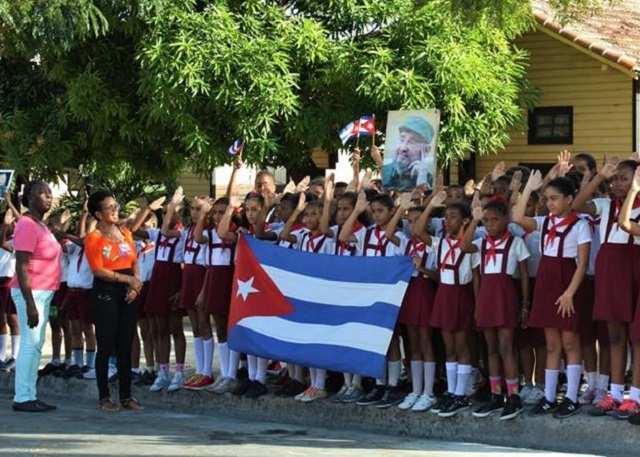

Ibraham Jimenez Enoa
Santiago (Cuba) — Images of Fidel Castro’s face flash on the giant screen as patriotic music plays in the background. The incessant stream of people walking along the boulevard comes to a standstill, as though time itself has stopped. Everyone looks at Fidel. An old man in a night guard’s uniform stands to attention, lifts his chin and salutes.
Along the length of the boulevard, there are five other screens. Fidel appears from them all; up close, full-length, dressed in military fatigues. Cubans and foreigners take selfies with his image.
But Fidel is no longer here. For the first time since 1959 he has left Cuba to walk alone.
Some hours remain before the caravan, which is carrying the ashes of Fidel Castro across the island, arrives in Santiago de Cuba for its posthumous farewell. After a week of solemn vigil, the tension here is palpable.
The Santa Ifigenia cemetery, where the late Cuban leader’s ashes will be interred, is patrolled by police.
Inside, workers toil under the sun – sweeping, painting, preparing. Like ants, they move constantly, side-to-side.
Fidel Castro’s ashes will be entombed just a few metres away from the mausoleum of the 19th-century independence icon Jose Martí. But not even the workers know what Castro’s tomb will be like.
“They have lowered a huge stone from the Sierra Maestra on a crane, but nobody knows what it looks like because it is covered with a tarp,” explains one of the custodians, who is guarding the back entrance to the cemetery.
Julia Gonzalez lives nearby. “These works did not begin with Fidel’s death,” she explains. “This started some time ago when they began to evict the people who lived here. They took a lot of people out of their houses, so that the front of the cemetery would look good.”
A year and a half ago, Julia says the city government began to depopulate the area in front of the cemetery – run-down homes on the edge of the city’s sewage drain — to beautify the area where Fidel would be laid to rest. The drain was covered — although the smell remains — and the residents were moved to apartments elsewhere.
The only things that separate the cemetery from the poor neighbourhood of Aguero behind it are a wall and a dusty embankment. White marble angels peek over the wall. Sometimes, the cries of the bereaved drift across it.
Ninety-five-year-old Jose Perez sits in the doorway of his home, leaning on a metal cane, his gaze drifting off into his neighbourhood.
“I’m waiting for death,” he says. “I want to go to the hole already.”
After the triumph of the Cuban revolution in 1959, and the subsequent nationalisation of private enterprises, Jose lost his dry cleaning business.
“I lost my business but I’m with him [Fidel Castro] 100 percent, because that man got us out of capitalism,” says Jose, who subsequently became a carpenter and opened his own workshop. “He is the greatest thing nature has ever given.”
In street C, a pig has just been killed. Its ribs lie exposed on a sheet of iron. Two men are squeezing the animal’s intestines. A broth cooks over a low heat.
‘I feel goosebumps when I say that Fidel is dead’
Noelvis, a 52-year-old bricklayer, lives a few metres away. He built his house himself, without any help from the state. “I have done nothing else because the government wants to extend the cemetery and has put the neighbourhood on a demolition plan,” he explains after making some coffee.
All of the other houses in Aguero are made from wood and old, rusting zinc. But not Noelvis’ house. Inside it has a wall he designed that features a scene from Havana and a fish tank embedded in the masonry.
From the roof of his house you can see the whole cemetery. Climbing up there, he says: “I feel goosebumps when I say that Fidel is dead.”
Two medical students knock on the door to ask whether there are any children living in the house and if a resident has recently had a fever. There have been cases of dengue in the neighbourhood, they explain. Outside, a woman walks by, carrying a small pig wrapped in a blanket.
This week, Santiago de Cuba is a different place during the night and the day. When it is light, everything is hustle and bustle. There are policemen everywhere and cars with loudspeakers that inform people about how they are to dress and behave when the caravan reaches the city. At the Moncada barracks, students from elementary and junior high schools practise the greetings they will give in a few hours.
But at night, it is as though the city is under curfew. The silence is total. There is nobody on the streets.
Gold statues for the Virgin
Twenty-one kilometres away from the centre of Santiago de Cuba, the Church of the Virgin of Charity, in the village of El Cobre, is quiet, aside from the birds that sing and the wind that rustles the leaves outside.
Candles burn, lips whisper prayers and Umberto Amaral sweeps the church floor. “The day after his death, Fidel was given a mass here,” he says.
Wilbert Moreno, who works at the church, explains: “The village has felt it. We are all very sad.”
“We agreed to do the Catholic novena, which consists of praying and massing for nine days, so that God will welcome him, reward him for all the good he has done and forgive him all the mistakes he may have made,” says Eugenio Castellano, the priest at the church.
Castellano says that Fidel never visited the church, but when he launched the revolution, his mother offered the Virgin gold statues in exchange for the safety of her three children. When Fidel was later released from prison, his mother returned to the church, leaving another gold statue, this one bearing the name of Fidel Castro Ruz.
‘Fidel is like Jesus’
On the outskirts of Santiago de Cuba, a small island appears in the middle of the bay. It is called Cayo Granma and is home to some 2 000 people, a shop, a restaurant, a church, a café, a dining room for the elderly and two doctors’ offices. If someone dies here, they must be taken by boat to the mainland.
In the port, Alberto Rodriguez, a Jehovah’s Witness, is waiting for a boat to take him across the Caribbean Sea to Santiago de Cuba. “Fidel is like Jesus Christ. He helped the children, the poor, the dispossessed, so I appreciate what he did for this country,” he says.
Two old men — one is 70 and blind, the other is 69 — are talking under the shade of a tree. They have lived here their whole lives, they say; it never occurred to them to leave.
“I am sure that the tranquillity here will not be found anywhere,” says the 69-year-old.
“Not because we are isolated but because we have stopped feeling it. My wife is disconsolate,” adds the 70-year-old.
‘I want to be buried here’
Eighty-three-year-old Maria Caridad lives on the southern part of the island. “My 11 children studied thanks to the revolution,” she says. “When my son called me to tell me the news [of Fidel’s death] I could not eat during that day. I had a tremor all over my body and had to lie in bed.” She is holding her lunch – a plastic dish with rice, sweet potatoes and corn.
Her home is a dilapidated colonial mansion. The floors tremble as she walks across them, carefully avoiding the deep holes in the wooden floorboards.
“I’m not leaving here because all my ancestors are there in the cemetery. I want to be buried here,” she says.
A few metres from her house is a sign, erected a few months ago, that declares: “Happy 90th birthday Fidel!” It’s a message replicated on cartons, buildings and the walls of abandoned homes all over Cuba. — AL Jazeera
Quotes from Fidel Castro:
“Condemn me. It does not matter. History will absolve me.” — October 16, 1953, at his trial for rebel attack that launched Cuban Revolution.
“I am not interested in power nor do I envisage assuming it at any time. All that I will do is to make sure that the sacrifices of so many compatriots should not be in vain, whatever the future may hold in store for me.” — January 1, 1959, upon triumph of the revolution.
“Workers and farmers, this is the socialist and democratic revolution of the humble, with the humble and for the humble.” — April 16, 1961, declaring his government socialist.
“Millions of Cubans shed their tears today together with the loved ones of the victims of the abominable crime. And when an energetic and forceful people cry, injustice trembles.” — October 15, 1976, addressing more than 1 million mourners in Havana the week after the terrorist bombing of Cuban airliner killed 73 people.
“Today it hurts us if a Cuban is hungry, if a Cuban has no doctor, if a Cuban child suffers or is uneducated, or if a family has no housing. It hurts us even though it’s not our brother, our son or our father. Why shouldn’t we feel hurt if we see an Angolan child go hungry, suffer, be killed or massacred?” — March 30, 1977, to Cuban civilian and military personnel in Luanda, Angola.
“Cuba is not opposed to finding a solution to its historical differences with the United States, but no one should expect Cuba to change its position or yield in its principles. Cuba is and will continue to be socialist. Cuba is and will continue to be a friend of the Soviet Union and of all the socialist states.” — December 20, 1980, to Congress of Communist Party of Cuba.
“We will take the steps we have to take to keep our factories running, to keep our workers employed, to keep going forward in these difficult conditions, and … find the formulas to save the country, save the revolution and save socialism.” — October 14, 1991, to Communist Party congress as Cuba felt first effects of waning Soviet trade.
“We will win this battle for life, and not only for your lives, but also for the lives of all children in the world.” — December 23, 1999, calling on schoolchildren to participate in fight to repatriate Cuban boy Elian Gonzalez.
“I promise that I will be with you, if you so wish, for as long as I feel that I can be useful — and if it is not decided by nature before — not a minute less and not a second more … Now I understand that it was not my destiny to rest at the end of my life.” — March 6, 2003, upon being re-elected by Cuba’s National Assembly to sixth term as Council of State president.
“I do not have the slightest doubt that our people and our revolution will fight to the last drop of blood to defend these and other ideas and measures that are necessary to safeguard this historic process.” — July 31, 2006, announcing he had undergone intestinal surgery and temporarily ceded his powers to younger brother Raul, Cuba’s defense minister.
“I am saying that I will neither aspire to nor accept — I repeat, I will neither aspire to, nor accept — the positions of president of the State Council and commander in chief.” — February 19, 2008, announcing his resignation as president.
“I was at death’s door, but I came back,” speaking of his 2006 illness in an August 30, 2010, interview with Mexican daily La Jornada.
“I’ll be 90 years old soon,” Castro said at an April 2016 communist party congress where he made his most extensive public appearance in years. “Soon I’ll be like all the others. The time will come for all of us, but the ideas of the Cuban Communists will remain as proof that on this planet, if one works with fervour and dignity, they can produce the material and cultural goods that human beings need and that need to be fought for without ever giving up.” — AFP


 Online Reporter