Online Reporter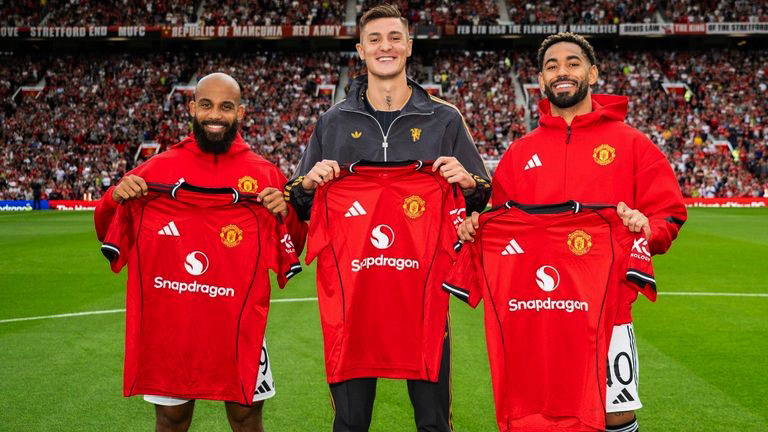
MANCHESTER United came into the summer transfer window tasked with beginning to remedy the reasons for the clubs worst-ever Premier League season.
A 15th-place finish last term represented an all-time low for United, who failed to inspire on the pitch. The season ended in further disappointment in the form of a Europa League final defeat to Tottenham, denying them Champions League football, which further raised the importance of this summer window.
Having arrived in November of last season, the last few months have represented Ruben Amorim’s first summer window in charge at Old Trafford. United were busy from the off, getting Matheus Cunha done early before completing moves for Bryan Mbeumo, Benjamin Sesko and securing Senne Lammens' services on Deadline day.
There were also departures for Antony and Alejandro Garnacho, in permanent deals to Chelsea and Real Betis respectively, as well as Marcus Rashford, Jadon Sancho and Rasmus Hojlund leaving on loan.
A new data-driven approach at Old Trafford Manchester United will reflect on their summer transfer business and ask four specific questions:
1) Is the squad better now, than the one that ended last season?
2) Did they get all of their primary marquee targets?
3) Did each of the signings fit the club's new parameters in terms of age, profile and cost?
4) Did they manage to move on those high-earning players that are not part of Amorim’s plans?
Even the most critical supporter would have to admit that the answer to all of those questions is yes.
That is not to say that the issues at United are fixed. Far from it.
It is a huge juggernaut of a club that has lurched in the wrong direction for far too long, crashing into plenty of obstacles en route.
And they are still a long way from being Premier League title contenders and are long shots for the Champions League. But the club's hierarchy knows that it will take a lot of time and effort to make them regular challengers to Liverpool, Arsenal and Manchester City.
They won't shy away from that, and they feel confident that they are now starting to put the fundamentals right and make inroads into the gap between them and the Premier Leagues
best. This transfer window was the start of that.
The juggernaut is at least now being steered in the right direction.
Uniteds transfer strategy this summer has been simple, strategic and is being based increasingly on data. The hierarchy at Old Trafford knows it will take several windows to get the squad where they want it to be, and there will be some imbalance and some pain in the meantime. Amorim is fully on board with that plan.
Financial restrictions mean that they have had to prioritise -and its very clear that the priority has been to make United an attacking force again, even if that means putting other positions of need on the backburner.
Why the focus was attack over defence So why have Manchester United focused on forward areas,with £207.2m spent on three players, at the expense of other positions? Director of football Jason Wilcox and his team forensically analysed the recent past. The focus was how the team performed last season, and this is the one statistic that leaps out: apart from the three relegated teams, only Everton scored fewer goals than Manchester United last season.
For a club famed above all else for its attacking football and entertaining style of play, that was damning. It became an overriding priority, which is why they targeted Cunha (£62.5m), Mbeumo (£71m) and Sesko (£73.7m).
Before trying to sign those three, the club analysts produced their reports, and the scouts produced theirs. Only when the two were put together – hearts and minds, if you like – did they produce a pecking order of targets.
In Uniteds eyes, those three players were the best in class for the specific roles the team needed, and they got each of them at fair market value, and on affordable salaries that are in line with the new structure.
Very simply, the stats showed that in order for United to climb the table it was essential they scored more goals – and that is
more important than keeping them out at the other end. If they scored the same number of goals again this season, the
calculations went, it would be impossible for Manchester United to make the top six.
By contrast, only Everton and Crystal Palace had better defensive records than United outside the top nine clubs in the Premier League last season. That might seem a strange statistic to most fans when you consider United conceded 54 goals in 38 matches, and had a goal difference of -10 over the season.
In fact, Uniteds defensive record last season was their third worst in the modern era – and the two that topped it, also occurred in the last five years.
It would be wrong to suggest that United s recruitment team isnt aware of the defensive frailties and the need to strengthen in midfield. Rather, they identified the lack of goals as a more pressing concern, and know there is no quick fix to improving the squad as a whole.
Look at Uniteds goalkeeping targets as a case in point…
Martinez vs Lemmens explained Plenty of people in football will ask why, if you have one of the worlds best goalkeepers available and keen to move to Old Trafford, would you turn him down and choose an unproven young stopper instead?
That is the reality of United choosing Senne Lammens over Emi Martinez. The Argentina World Cup winner is without doubt one of the best in world football. But he is 33 years old.
He was likely to cost over £30m. He would, quite rightly, demand a huge salary. And there would be very little value in any future fee United could demand for him, if they sold him.
Exactly the same reasoning explains why United didnt choose to rival Manchester City for Gianluigi Donnarumma, one of the best goalkeepers of his generation.
Instead, they went for Lammens. Not the finished article, not in the same league right now when compared to Donnarumma and Martinez. But a player who fits into the new wage structure, and who the metrics and scouts say has all the potential, with good coaching and development, to be a future Manchester United number one.
Last season, he had one of the highest goals prevented statistics in Europe, made more saves than any other keeper in Europes top 10 leagues, and proved he was good with his feet, too – making the most progressive passes for any goalkeeper under the age of 23.
Just £17.3m? Half the price of Martinez? A good deal, as far as United were concerned.
Man Utds bomb squad
The club are determined to avoid the mistakes of the past,
where some big-name players with big reputations ended up
as expensive bench-warmers. Or worse, VIP viewers from
the posh seats in the Sir Alex Ferguson stand, such has been
the bloated nature of United's squad.
And they are delighted that this summer has seen many of their extraneous players leave Old Trafford. Chelsea think they got a great deal for Garnacho, with a fee of £40m, but United are happy too, earning the largest sale ever for an academy player.
Rashford has his entire wages covered by Barcelona for the coming season. Antony, Hojlund and Jadon Sancho are all out of the building too, which limits the external noise around the squad and the manager.
There is no shying away from the fact that United have wasted big money on some big-name players who simply havent cut it at Old Trafford in recent years.
The bomb squad has cost them almost £100m in lost revenue. United paid Ajax £86m for Antony in 2022 and they have now sold him to Real Betis for £21.7m. Hojlund cost £72m from Atalanta two years ago – he is now on loan at Napoli, with an obligation for them to pay £43m for him next summer (if Napoli make the Champions League).
Man Utd summer transfer window – Outs
Alejandro Garnacho – Chelsea, £40m
Christian Eriksen – released
Jonny Evans – released
Victor Lindelof – released
Elyh Harrison – Shrewsbury, loan
Marcus Rashford – Barcelona, loan
Radek Vitek – Bristol City, loan
Ethan Wheatley – Northampton Town, loan
Jack Moorhouse – Leyton Orient, loan
Toby Collyer – West Brom, loan
Ethan Williams – Falkirk, loan
Rasmus Hojlund – Napoli, loan
Antony – Real Betis, £21.7m
Harry Amass – Sheff Wed, loan
Jadon Sancho – Aston Villa, loan
Sanchos move to Aston Villa isnt a permanent switch, but United will recoup 80 per cent of his wages and earn a chunky loan fee. Only Tyrell Malacia remains at Carrington after the clubs best efforts to move him on to Elche failed on Deadline Day.
Mainoo and the midfield United wont shy away from the mistakes they’ve made in the past, and they accept that it will cost money to correct them.
But this window has seen evidence of a new financial discipline, so that they hope there will be fewer expensive mistakes in the future.
The fact that they werent tempted to over-pay for Carlos Baleba – with Brighton reportedly wanting £100m for the 21-year-old – is a case in point. United like him; he fits their profile, the metrics are good… but the finances dont stack up. Hence, there was no approach.
Many United fans will be questioning why the midfield wasnt deemed a priority position.
Gary Neville said after the 1-1 draw with Fulham .In central midfield, I think United have to do a piece of business now. I would have liked to have thought that (Kobbie) Mainoo could step up and be that person, but its quite clear that at this moment in time Amorim is not having him.
Manchester United head coach Ruben Amorim responded to the Kobbie Mainoo transfer rumours, saying he wants the midfielder to stay and fight for his place Sky Sports News has been told that, while midfield is an area Wilcox would like to strengthen in the right circumstances, it has not been the top priority. And if you look carefully at Uniteds midfield, you can see they already have four full internationals there.
Amorim has been key in tweaking the role of Casemiro, who he thinks is much fitter and more influential already than last season. And United see the captain Bruno Fernandes happily occupying the central midfield role alongside him for much of this season, with Cunha taking on the more advanced number 10 position.
United would also point to the fact that Mainoo is yet to start a Premier League game this season, and is waiting in the wings.
A young midfielder who started for England in last seasons European Championship final is currently struggling to get into Amorims starting 11.
Why would you try to buy more midfielders if a player of his quality cant get in? And United are adamant they will not sell him. It was only in the final week of the window when Mainoo went to the club and asked them to explore a possible exit, frustrated as he was by the lack of game time. Mainoo was met with a categorical no and told that Amorim and United want to keep him. He is on a long contract. He is not for sale.
The United project is much more evolution than revolution. It is a work in progress.
This summer s transfer window wasnt perfect, but Uniteds bosses stuck to their principles and their strategy. They are pleased with the ins and the outs.
They feel they have caught up some of the ground on the clubs ahead of them. But they know there is still a long road ahead.The hope inside Old Trafford is now that, with the juggernaut plotting a more steady and sensible course, there are fewer potholes to navigate. — Sky Sports.