malvernmugadzikwa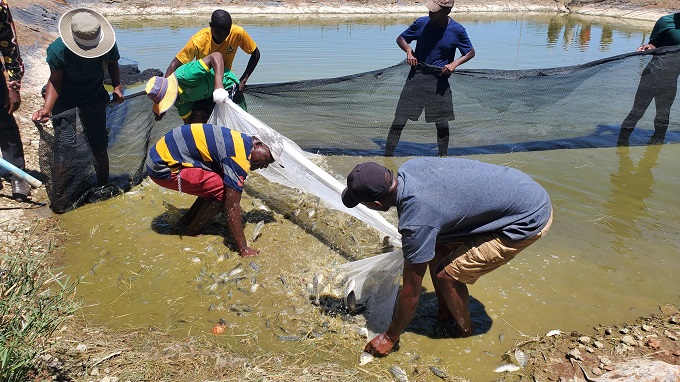
Theseus Shambare in MASVINGO
FROM a casual TikTok scroll during the Covid-19 lockdown, a spark was ignited, leading to Ms Rudo Maponga, a corporate woman in her early 40s, being hooked.
The video showcased the simple beauty of farming, a stark contrast to her bustling city life in South Africa.
“I was just scrolling down my phone during the lockdown when I visited my father who was not feeling well.
“I saw a video showing how some ladies were succeeding in agriculture, highlighting the opportunities it offered,” said Ms Maponga.

Inspired, Ms Maponga, a holder of a Master’s degree in Business Science, traded her sleek suits for overalls and her office for the serene fields of Masvingo.
“Although I had a company which was paying handsomely, I discovered that I would not be able to do it at my advanced age. I had to think of what I could start doing while I still had energy,” she said.
“Farming is a huge and high-paying business.”
She abandoned her white-collar job in the “proverbial green pastures” of South Africa and retraced her way back home.

Ms Maponga is now carving a niche for herself in the male-dominated field of agriculture. She inherited her father’s farm in the semi-arid area under Chief Bere, about 30 kilometres west of the Masvingo Central Business District.
She drilled boreholes and installed reservoirs using savings from her South African job. As a woman farmer, she faced scepticism and doubt, but she persisted.
Her journey was not without its challenges.
“When I started, I purchased bogus fingerlings. The suppliers lied that the fingerlings were sex-reversed, yet they were not,” she said.
Sex-reversed fingerlings are those whose sex characteristics have been altered using a sex hormone called 17 alpha methyl testosterone.
This treatment only gives an advantage to the male sex characteristics to gain an upper hand in determining the sex of a fry or small fish in order for a farmer to get maximum yield with no need of multiplication.
“They even sold me about 800 fingerlings, yet I had paid for 4 000 fingerlings,” she said.
This turned out to be a blessing in disguise. Since the fish were multiplying uncontrollably, instead of harvesting after seven or eight months, Ms Maponga is now harvesting in a three-month cycle.
“I am now migrating to good quality sex-reversed fingerlings supplied by the Government, but these fishponds have been giving me good returns every three months. I can harvest at least 500 kilogrammes and sell at an average price of US$3 per kg.”
She has established four 10m×15m fishponds, where sex-reversed fingerlings are being planted for food production.
Each fishpond is expected to give her a gross amount of US$7 000 per seven months after spending a maximum of US$200 per month for feed.
“It is quite profitable if we do it using these good quality sex-reversed fingerlings,” said Ms Maponga.
From initial setbacks in fish farming to mastering the art of the whole agribusiness, Ms Maponga has transformed her father’s farm into an agricultural hub.
She has diversified her ventures, adding poultry, tomato farming and munyemba (cowpea leaves) production to her agricultural portfolio.
“Currently, I am doing poultry. We sell 300 birds per week, but my customer is requesting me to supply at least 1 000 birds per week.
“I am also doing tomatoes. My client at times collects one tonne, sometimes 1,5 tonnes per week,” she said.
On cowpea leaves, she dries the high-quality leaves under controlled temperatures using a solar dryer before packaging.
“I am failing to meet the demand and I am planning on creating an outgrower scheme,” said Ms Maponga.
She employs six full-time workers and on average, 10 casuals, especially for weeding and harvesting of tomatoes.
Maize production at Ms Maponga’s farm is exclusively for these employees.
After having grasped most major concepts in the agriculture sector, Ms Maponga is utilising the infrastructure built by her father. She is now hosting a commercial farmer field school.
Two Government extension officers from livestock and crop sub-sectors offer lessons at the school.
“People now register with the Ministry of Lands to come and take part in lessons in fields of their choice,” she said.
It is against this background that Ms Maponga’s farm became one of the only two centres countrywide to be picked when the Government, through an advert, sought a place that could house a fish distribution hub.
Last week, the Government, under the Fish for Africa, the Caribbean and the Pacific (FISH4ACP) programme, funded by the European Union and the German Federal Ministry for Economic Cooperation and Development, launched a groundbreaking fingerling hub at Ms Maponga’s farm.
The hub is designed to hold up to 488 000 fingerlings at a time. It will serve as a crucial distribution centre for farmers in Masvingo province and parts of Matabeleland South, ensuring they have timely access to quality fingerlings so that they will not fall into the same trap that Ms Maponga once found herself in.
Lands, Agriculture, Fisheries, Water and Rural Development Permanent Secretary Professor Obert Jiri said it is the Government’s policy that whenever a water source is established, five components under rural development should be implemented.
“One component is the construction of the water source itself. The second is hydropower that it should generate.
“The third are the fish that should be put in the dam or reservoir.
“The fourth is the irrigation that should be supported by the water source and the fifth is the water reticulation that would come out of the water source,” said Prof Jiri.
The setup should be replicated from the household level to the national level.
Masvingo Minister of State for Provincial Affairs and Devolution Ezra Chadzamira encouraged more youths and smallholder farmers to take a leaf from Ms Maponga.
“To this end, I call upon smallholder farmers and youths to ensure that rural projects for community development, women and economic empowerment remain priority enterprises and are commercialised. The true meaning of independence and self-determination should be realised through our own hard work, production and productivity. We cannot flee from our country but it is upon us to make it great,” he said.
Ms Maponga has become a force to be reckoned with, inspiring other women to embrace agriculture.
Her story is a testament to the power of passion, perseverance and a willingness to challenge the status quo.



 Online Reporter