Bongani Ndlovu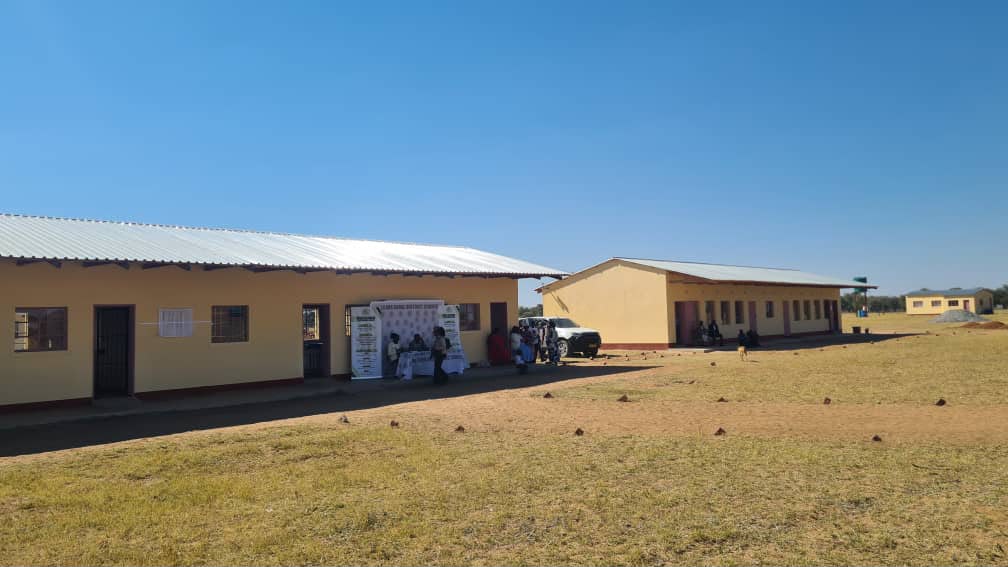
Mthabisi Tshuma recently in Bulilima
TUCKED away in the sandy bushes of Tjemahale village, 85 kilometres from Plumtree town, the idea of having a secondary school was once dismissed as a far-fetched dream.
For decades, children from Tjemahale and surrounding villages had to walk 13 kilometres to Siyephambili Secondary School in Ndolwane or 12 kilometres to Phakama Secondary School at Manguba just to access secondary education. That was if they managed to complete Grade 7 at all.
Long distances, safety concerns, and transport costs forced many to drop out, particularly girls who were vulnerable to early marriages and other social challenges.
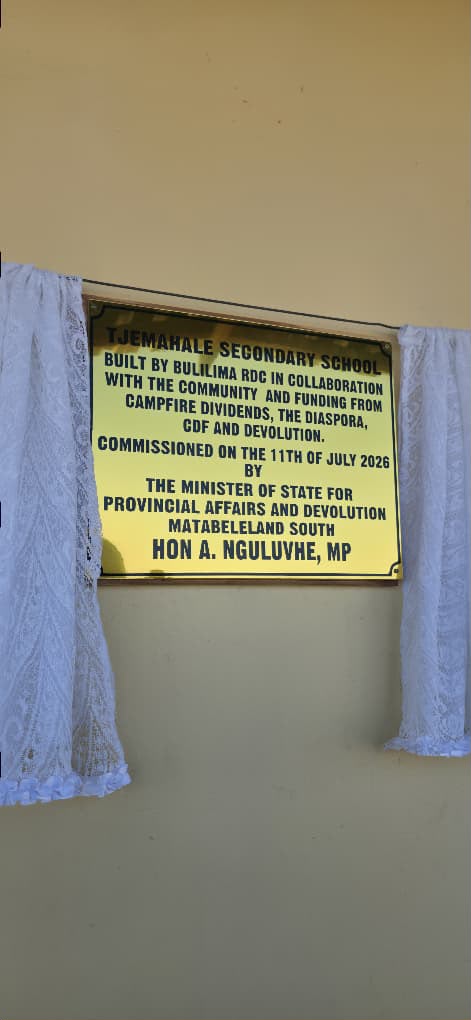
That story changed last Saturday when Tjemahale Secondary School was officially commissioned, bringing quality secondary education within walking distance and marking a major milestone in the government’s push to accelerate educational development in rural areas.
The new learning institution is equipped with two modern classroom blocks, two F14 staff houses, a science laboratory, a solar-powered borehole, ablution facilities and other supporting infrastructure designed to create a conducive environment for teaching and learning.
Since commencing operations in 2023, the school has already transformed access in Ward 22. The furthest learner now walks less than four kilometres to class.
That reduction in distance has translated directly into improved safety, better attendance, higher retention rates and a sharp drop in school dropouts.
The school currently has an enrolment of 102 learners, a figure that reflects growing community confidence, and school authorities expect that number to rise steadily as infrastructure and learning facilities expand.
One of the most significant milestones for 2026 is that Tjemahale Secondary School will host its very own ZIMSEC O-Level public examinations for the first time.
It is understood that the inaugural Form 4 class will sit for their exams at home, ending years of having to travel to other centres.
There is also a major boost for Science, Technology, Engineering and Mathematics. A new science laboratory is under construction as part of the government’s legacy projects.
For years, many rural schools in Matabeleland South have lacked practical science facilities, forcing learners to share resources or skip experiments altogether. At Tjemahale, learners will now conduct practicals in Biology, Chemistry and Physics on site.
The school was selected as one of the beneficiaries of 40 science laboratories being constructed across Matabeleland South Province under the legacy projects of the 46th National Independence Celebrations held in Maphisa, Matobo district early this year.
Speaking during the commissioning of the school, Tjemahale SDC chairperson Mr Godfrey Sgabade Moyo said the school was proof that communities can achieve the unimaginable when they work together.
“Through collaboration from the community, diaspora, Ministry of Education, RDC, CAMPFIRE and the office of the MP Cde Dingumuzi Phuti, people who worked very hard to make this ceremony a reality and a wonderful one.
As villagers in Tjemahale, we want to thank everyone who walked with us throughout this journey to ensure that our children have a brighter future,” said Mr Moyo.
Bulilima Constituency legislator Cde Dingumuzi Phuti said the opening brings pride to the entire district.
“The moment we are experiencing today gives happiness to the Bulilima community and most especially the people of Khame Ward 22.
Education is one of the key areas that, as the area legislator, I have set out since I got into office, and I will continue to make sure that children do not have to walk long distances to acquire their right. They should be at par with any children from across the country,” said Cde Phuti.
In his keynote address, Matabeleland South Provincial Affairs and Devolution Minister Albert Nguluvhe said the occasion was more than the opening of a new school.
He said it was the fulfilment of a shared vision.
“Education remains one of the key pillars of Zimbabwe’s socio-economic transformation. Under the visionary leadership of His Excellency, the President of the Republic of Zimbabwe, Cde Dr Emmerson Dambudzo Mnangagwa, Government continues to prioritise investment in education as a catalyst for sustainable development, in line with Vision 2030, which seeks to transform Zimbabwe into a prosperous and empowered upper-middle-income economy,” said Minister Nguluvhe.
He noted that the establishment of Tjemahale Secondary is fully aligned with National Development Strategy 2, particularly the pillar on Human Capital Development and Innovation.
“This project also gives practical expression to Sustainable Development Goal Number 4, which calls for inclusive and equitable quality education and the promotion of lifelong learning opportunities for all,” he said.
“This strategic investment demonstrates Government’s unwavering commitment to strengthening science, technology and innovation as key drivers of industrialisation in line with the Heritage-based Education 5.0 model. I am confident that, once these laboratories are fully equipped and operational, we shall witness an increase in the uptake of Science, Technology, Engineering and Mathematics disciplines in Bulilima District and Matabeleland South Province as a whole.
“For many years, learners from this area were walking long distances up to 8 kilometres to attend schools such as Siyaphambili and Phakama Secondary Schools. This led to absenteeism, increased the risk of school dropouts and exposed vulnerable learners, particularly girls, to early marriages and other social challenges. Recognising these challenges, the community chose to become part of the solution.”
Minister Nguluvhe said the school was constructed at a total cost of US$156,742.00, financed through a combination of multiple currencies from residents, diaspora contributions, Constituency Development Fund, CAMPFIRE and devolution funding.
“This achievement is a practical demonstration of the whole-of-government and whole-of-society approach,” he said.
Minister Nguluvhe urged learners to honour the sacrifices made by the community.
He said learners should see the school as a representation of an investment in their future and that many people have sacrificed their time, resources and energy to provide them with this opportunity.
“Honour their investment by committing yourselves to discipline, hard work and academic excellence,” emphasized the Minister.
“To parents and guardians, your responsibility does not end with the construction of this school. I encourage you to ensure that every school-going child is enrolled and receives the support necessary to succeed.
“As the school motto aptly states, ‘Zwidiyo Lukata’ – Education is Inheritance. Indeed, education is the greatest inheritance we can bequeath to our children.”
He also called on the community to safeguard the infrastructure and urged the community to protect the valuable investment and continue supporting the school’s growth.
Minister Nguluvhe said infrastructure alone does not produce quality education; it must be complemented by effective teaching, committed learners, responsible parenting and active community participation.
He said the long-term impact of the school will extend well beyond these buildings.
“It will nurture future teachers, engineers, doctors, entrepreneurs, farmers, public servants and community leaders who will contribute to the socio-economic development of Bulilima District, Matabeleland South Province and Zimbabwe as a whole,” said Minister Nguluvhe.
He also hailed the opening of Tjemahale Secondary School as a model for how targeted investment, community ownership and government policy can rapidly close education gaps in rural Zimbabwe.
Minister Nguluvhe added that with reduced walking distances, new STEM facilities, and the first O-Level centre in the area, the school represents what can be described as accelerated development in the education sector — taking services closer to the people and giving every child, regardless of location, a fair chance to learn.
As the first Form 4 class prepares to sit for exams later this year, Tjemahale’s story has shifted from one of distance and disadvantage to one of opportunity, infrastructure and hope.


 Online Reporter