Chronicle Editor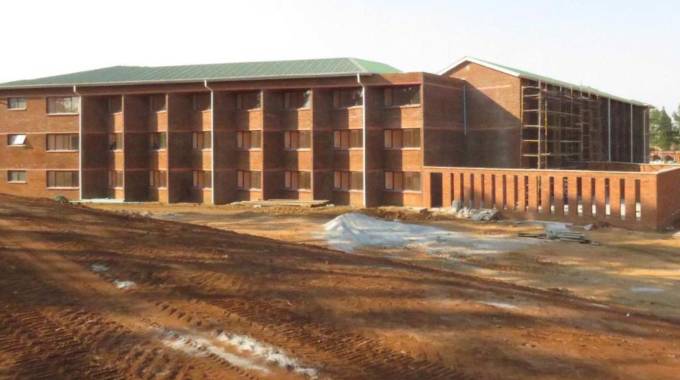
Garikayi Chipfunde, Analysis SECURING a place to study at a university is one of the most exciting milestones in the academic lives of many as it signifies a new dispensation of broadening their knowledge and better job opportunities on the market.
One begins to set their dreams high and would expect nothing but an exhilarating university experience.
Most would, however, have their dreams dampened by the torturous road that they would travel in order to reach their expected destination.
There is a coterie of challenges but what have become common to most universities is the unavailability of on-campus accommodation.
This has become a crisis for most students that is negatively impacting on their productive hours and the exciting university experience.
The experiences of Nombulelo and Kudzai are eye-opening. The two were excited after being offered places at one of the universities in Zimbabwe.
They thought they were going to be accommodated at a very conducive and peaceful learning environment. Having been at boarding school for the greater part of their academic journey and from a family that knows not how to live frugally, it never occurred to them that they were going to face such problems at the tertiary institution.
They packed their bags leaving their leafy and comfy homes for a new one – the university campus, only to be told that campus accommodation was in short supply.
Nombulelo and Kudzai got stranded and phoned their parents whose connections could not assist. Having grown up at boarding schools, the two were not streetwise.
It was after consultations that they were directed to places closer to their university where there were places to lodge.
Their expectations that they could get single rooms each went up in smoke when they realised, they had entered an area of no-nonsense landlords whose house letting businesses had taken over the pride and lucre of soft gold business.
Their need for something called privacy saw them resisting several temptations from ‘well-wishers’ trying to snare them at each point.
Having exhausted all attempts, they finally settled for a single room at a certain house where they were required to share with eight other students to make them ten, each one of them required to pay US$120 per month.
They had no choice but to use the money they had budgeted for their upkeep including food and other requirements that would see them until the end of the month.
“It is not easy to get accommodation at the university campus. It is first come first served. We paid our fees and registered last minute, so all accommodation was taken up.
Only the most senior intakes like part-fours and some others are accommodated inside campus. Worse still, we even struggled to find off-campus accommodation.
“Off-campus accommodation is expensive without corresponding facilities. The whole radius of five kilometres around most universities you cannot find cheap accommodation.
Landlords are taking advantage of our desperate situations as students who would have failed to secure university accommodation.
In our case, our landlord does not allow us to keep lights on beyond 12 midnight. We do not have Internet, we are beyond the campus Wi-fi radius and data is now expensive.
“There is better freedom on-campus, because you can study until whatever time, unlike where we are staying. We would have wanted to use the library which opens up to 9 PM,” complained Nombulelo.
Some landlords around university campuses in Zimbabwe are constructing more spacious accommodation for students which most universities are failing to do for their students.
The other challenge is that a great number of off-campus accommodation fails to meet even minimum standards to compete with on-campus accommodation.
With no competition from universities, these landlords have carved their own niche markets and would not want to make losses by letting small numbers of people into their rooms such as families. They charge rentals per head.
In order to cope with this kind of life, some stranded learners end up requesting their privileged colleagues on-campus to allow them to squat in their rooms.
But in most cases, this has resulted in some good-hearted students also losing their privilege and getting chased out of on-campus accommodation together with their colleagues whose plight they would have tried to alleviate.
This is a crisis which must not be ignored neither should it be solved by punishing students in that way. The problem is not the student but the shortage of accommodation which has made the students so vulnerable, that must be given full focus by authorities.
Students from various universities have the same accommodation challenges. They indicated that even if some of their parents or guardians could afford to pay for their off-campus accommodation, they all preferred on-campus accommodation.
“Off-campus accommodation has its own challenges. You cannot have enough time to interact and engage in academic discussions with colleagues from different backgrounds. You get to your lodgings; it is either there is no water or electricity.
“Sometimes there is noise at the house or neighbourhood and you cannot challenge anyone. They are having their parties or other functions, they don’t think there are students who want to study, they tell you this is not a college.
You may get accommodation where the landlords are always engaged in domestic violence and various other nasty behaviour.
These are just a few of the problems of off-campus accommodation but you cannot have the same bad experiences on-campus.
We implore authorities to consider the welfare of everyone not the few fortunate ones,” said an affected student.
“We would like to stay away from various abuses that most of us experience in our homes and in this rented accommodation and stay in a conducive learning environment provided by universities.
We would be able to enjoy learning facilities like libraries whether online or offline within best environments of universities.”
It is therefore a great idea for universities to plan ahead for their students than to leave them at the mercy of some of the landlords who are after making profit than protecting the welfare of students.
Even if the landlords were to have a heart to cater for the welfare of the students, the universities should not leave this obligation to someone else and consider everything good.
Private public partnerships (PPPs) should be entered into for the construction of sufficient accommodation for students at universities.
This also calls for policy consideration to make the lives and welfare of learners at these universities better.
If sixteen students who are occupying a single room pay US$120 per head, it amounts to US$1 920 and when multiplied by ten rooms per house it’s about US$19200.
This amount of money is coming from a single house which is a lot of money when multiplied by the number of students.
If universities could work closely with all stakeholders and engage in thorough consultation, better accommodation models for students could be found.
If the choice of accommodation decided upon by stakeholders were to take the route of private players, licensing must be introduced to players and other control mechanisms to ensure they provide affordable, accessible and suitable accommodation which is conducive to learning.
There is also a need to consider persons with disabilities in the provision of accommodation.



 Online Reporter