happiness Chikwanha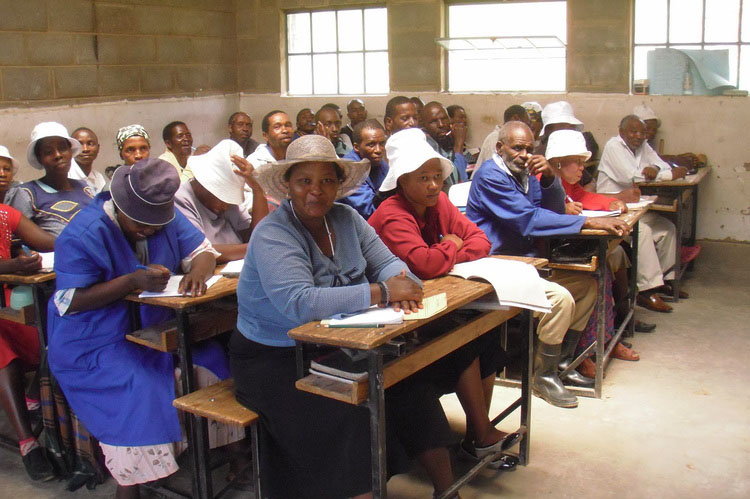
Leroy Dzenga Features Writer —
“We have started a comprehensive programme for non-formal education and we have authorised our schools to be able to work as centres for the lessons and examinations to be given to adult learners.”
Singer Sandra Ndebele hogged the headlines recently as she sat for her Ordinary Level Mathematics Paper One and is yet to sit for the second instalment coming in a few weeks. While the move drew ridicule from the ignorant and applause from the knowledgeable, it showed how our education system is structured in a way where possibilities of increasing one’s level of learning is not beyond reach.
At 34, most of the people she shared a room with were around half her age and she must have summoned a lot of bravery to sit for the examination. Her motivation was the end she was chasing, working to become a music teacher, a profession in which numerical acumen is a prerequisite, according to her.
Ndebele is not the only Zimbabwean to have decided to rekindle a relationship with academics at an unconventional but permitted age. The system may have started as a rectifying measure against the oppressive colonial system which sieved students at every level through the quota system.
Uninspiring ratios between black and white students which characterised the Rhodesian system, made it difficult for some black children to ascend academically.
After the attainment of Independence, the country had to rectify the academic disparity through the statues. The Education Amendment Act of 1996, allowed the establishment and continuation of correspondence school.
This minimised the space involved with learning as people would learn from their bases and without leaving their respective places of work. Section 25 of the Act on Adult Education says, “The Minister may provide facilities for (a) the teaching of; or (b) the training of persons for the purposes of teaching adult education”.
A number of people benefited, especially those who were disturbed in the height of the armed struggle for liberation. Swethen Dzvairo, an entrepreneur explained how he managed to salvage his academic career after Zimbabwe got Independent.
“We grew up around the Hwedza area, there was a time that the war escalated and we could not go to school safely as there were fears of interception by settler forces,” Dzvairo said.
Fearing for the children’s safety, his parents had to pull him out of school when he was 13 while in Standard Six, an equivalent to the modern day Form One-level.
Having stayed at home between 1975 and 1980, when the battles subsided, he got a job as a security officer at a factory in Harare. Fortunately, for him, his young age awarded him most daily shifts, permitting him to enrol at a night school at Chirodzo Primary School in Mbare from where he stayed.
“I would go to school after work and I managed to write my Ordinary Levels in 1983 at 21. I passed six subjects namely Geography, Mathematics, Science, English, Shona and Accounts,” he said.
He said this opening helped him regroup because there was no way he was going to be part of a normal classroom at 21 studying for Ordinary Level.
“I later enrolled for my Advanced Level on a correspondence basis with the Rapid Results College, I did Business Studies, Accounting and Economics.”
Unfortunately for him, his progression academically saw him getting promotions at work and he was left with little time to study. His results were not as glowing.
He continued with his studies and now holds an IMM Diploma in Marketing and is now studying for a Marketing Degree with University of South Africa (Unisa) through their correspondence learning plan. Correspondence learning is his preferred mode of academics as it allows him to balance between his car sale business and studying.
Cases like Dzvairo’s led to the establishment of multiple night school settings working on the informal enrolment model, where classes are held on school premises after normal working hours.
Perhaps the most detailed document on the Zimbabwean education system, the Nziramasanga Commission report of 1999 emphasised the importance of adult education to national development.
“Prior to Independence, successive colonial administrations promoted a racial system of education. That system allowed only a few Africans to go to university. The rest had no alternative type of education officially provided for them,” reads part of the report.
It says most Africans at the point survived through private study in distance learning as well as night-schools.
The Commission called for a policy on adult education which would formalise most of the study groups nucleated in the country. Up to now there is no stand-alone policy which galvanises the calls for the regularisation of most adult education.
The non-formal education system loosely known as adult education, had been popularised through night school at various centres in the country was disturbed by the economic dark space which the country went through around 2008.
Efforts are now being made to resuscitate the programme through the Ministry of Primary and Secondary Education. Deputy Minister, Professor Paul Mavhima said plans were now underway to give a new lease of life to non-formal and continued education in the country.
“We have started a comprehensive programme for non-formal education and we have authorised our schools to be able to work as centres for the lessons and examinations to be given to adult learners,” he said.
The rejuvenated programme comprises of three interrelated elements.
“There is the basic literacy and numeracy where people learn to read and write, life skills where the students stand to learn survival and technical skills such as Agriculture and Carpentry among others,” said Professor Mavhima.
The third element involved is the conventional Primary and Secondary education accreditation like Grade Seven and Form Four certificate, which entrants can study towards.
Calls were extended to all citizens regardless of race or creed who want to replenish their academic standing to join the programme.
“We are saying to those who may have not managed to go to school at the appropriate time visit the nearest centres and enrol as we have about 8 500 schools across the country.
“This also involves senior citizens who feel they need to go back to school,” he said.
The initiative is not limited in scope and they hope every Zimbabwean able should partake in it. The enrolment into night schools however, has seen a fall since the turn of the millennium.
Tertiary institutions have since introduced identical initiatives through their parallel enrolment structure which allows students to attend classes after working hours. Institutions like the Zimbabwe Open University have been at the forefront at encouraging distant education and allowing employed adults to learn as they earn.
The system has opened up room for tailor-made arrangements like the Block Release idea which is used to accommodate students who cannot afford to be at university campuses all semester. Former Reserve Bank Governor Gideon Gono, in his book “Zimbabwe’s Casino Economy” at some point in his career utilised the correspondence system to further his studies.
With tangible results of that calibre, what is left is to take the adult education drive to the rural areas with intent to bridge the information and knowledge asymmetry which exists between urbanites and rural dwellers.
Feedback : [email protected]


 Online Reporter