Moffat Mungazi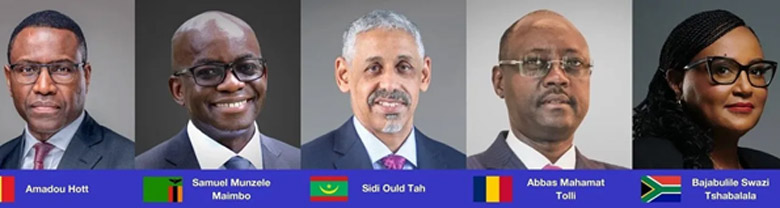
Lloyd Makonya
Correspondent
IT is all systems go for tomorrow (Thursday)’s African Development Bank (AfDB) presidential elections in Abidjan, Côte d’Ivoire.
The African Development Bank operates under the leadership of the president, who in accordance with Article 37 of the Agreement Establishing the bank, serves as the chairperson of the board of directors, the chief of the staff of the bank, as well as its legal representative.
The president conducts the current business of the bank, under the direction of the board of directors.
Under Article 36 of the Agreement Establishing the bank, the president is elected by the Board of Governors, and serves a five-year term, renewable once.
Article 1 of the Rules of Procedure governing the election of the president of the bank, as amended, requires that the bank holds the election of the president during the Annual Meeting closest to the end of the term of office of the serving president.
Accordingly, the Board of Governors will be electing Dr Akinwumi Adesina’s successor tomorrow, during the 2025 Annual Meeting of the Board of Governors of the Bank, which began on Monday in Abidjan, Côte d’Ivoire.
It is a decision that could significantly shape the trajectory of Africa’s development for years to come.
As incumbent president, Dr Adesina of Nigeria completes his second and final term, the race to succeed him has intensified, drawing five highly qualified candidates from across the continent.
This election arrives at a time of mounting fiscal uncertainty, with the United States under ongoing policy shifts threatening to reduce its contributions to the AfDB and its concessional arm, the African Development Fund.
Amid this shifting financial and geopolitical landscape, the next AfDB president will be called upon, not only to consolidate the bank’s achievements, but also to redefine its development agenda in a continent facing profound challenges and opportunities.
From climate change to debt sustainability, infrastructure financing to private sector growth, the issues at hand are as urgent as they are complex.
The five candidates, Ms Swazi Tshabalala (South Africa), Mr Amadou Hott (Senegal), Mr Samuel Munzele Maimbo (Zambia), Mr Sidi Ould Tah (Mauritania), and Mr Abbas Mahamat Tolli (Chad) all offer distinct visions, each with the potential to shape the bank’s future and, by extension, the development path of the African continent.
Each of the candidates brings a wealth of experience and a compelling strategy for the future of African development.
Ms Swazi Tshabalala of South Africa, the bank’s current Senior Vice President, argues for operational streamlining within the AfDB to enhance efficiency and impact.
Her focus is on building innovative financial instruments that harness domestic capital and public-private partnerships to scale up infrastructure investments.
Ms Tshabalala’s intimate knowledge of the bank’s inner workings positions her as a continuity candidate with reformist leanings.
From Senegal, Mr Amadou Hott, a former Minister of Economy and experienced banker, envisions a bank that promotes self-reliance by retaining African private capital within the continent.
He advocates for mobilising domestic revenues, improving the investment climate, and reducing dependence on external donors.
His emphasis on financial innovation and sovereign project design has drawn attention from both technocrats and development finance institutions.
Zambia’s Mr Samuel Munzele Maimbo, currently vice president at the World Bank, stands out as a technocrat with a deep understanding of global and African development finance.
With a career spanning three decades and endorsements from both the Southern African Development Community (SADC) and COMESA, Mr Maimbo has proposed the creation of an African version of the Paris Club to help the continent manage its external debt.
He also stresses the importance of intra-African trade, institutional capacity building, and unified regulatory frameworks.
Mauritania’s Mr Sidi Ould Tah, with a decade-long leadership at the Arab Bank for Economic Development in Africa, emphasises the urgency of formalising Africa’s informal economy and building climate-resilient infrastructure.
His vision includes leveraging partnerships with both the private sector and multilateral development agencies to diversify Africa’s economic base.
Chad’s Mr Abbas Mahamat Tolli brings experience from Central Africa, where he has held top positions including Finance Minister and head of the region’s development bank.
Mr Tolli’s strategy is rooted in digital transformation, improved governance, and the promotion of regional economic integration.
Though varied in approach, the candidates are unified in their ambition to elevate the AfDB as a driver of inclusive, sustainable, and autonomous African development.
As Dr Adesina’s tenure concludes, his legacy includes not only an expansion of the AfDB’s capital base and ambitious climate funding pledges but also a strong commitment to helping troubled economies regain footing. Nowhere is this more evident than in Zimbabwe.
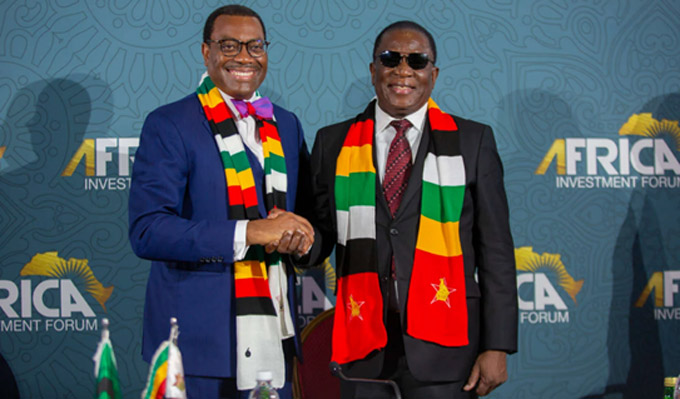
In 2022, Dr Adesina was appointed Champion of Zimbabwe’s debt clearance strategy.
Under his leadership, the AfDB facilitated high-level dialogues between the Zimbabwean government and international creditors to address over $21 billion in public debt.
His efforts were critical in kick-starting the compensation process for white commercial farmers and building confidence with international partners. President Emmerson Mnangagwa has hailed Dr Adesina’s “unwavering support,” noting that the AfDB’s credibility gave momentum to Zimbabwe’s re-engagement efforts.
Additionally, the bank under Dr Adesina extended $55 million in credit lines to Zimbabwean private sector actors and initiated a $25 million emergency food production project.
This programme benefited over 30,000 farmers and expanded food production across 65 000 hectares which is tangible proof of the AfDB’s potential to uplift economies in crisis when guided by strong leadership.
As the baton passes, many within the Southern African region are rallying behind Dr Samuel Maimbo, viewing his candidacy as an opportunity for SADC to play a greater leadership role within Africa’s development architecture.
Maimbo’s broad-based support and institutional pedigree offer a credible alternative to past patterns of dominance by larger West and North African economies.
Zimbabwe has strongly endorsed Mr Maimbo, with President Mnangagwa calling him “Africa’s best foot forward.”
Given Mr Maimbo’s leading role in the World Bank’s $93 billion IDA20 replenishment, the largest in history and many believe he possesses both the diplomatic finesse and technical knowledge needed to steer the AfDB through a period of constrained donor support and rising developmental needs.
The incoming president will face formidable challenges, not least of which is the proposed $555 million cut in U.S. funding under a revised foreign policy framework.
This poses a serious threat to AfDB’s operational capacity, particularly through the African Development Fund, which provides concessional financing to the continent’s most vulnerable nations.
Beyond external funding volatility, the AfDB must respond to internal calls for reform. African economies are grappling with debt distress, climate vulnerability, and structural unemployment.
In this context, the AfDB’s next leader must enhance private sector development, expand climate finance, and promote regional integration while improving governance and transparency within the institution itself.
Thursday’s election is more than a leadership change, it is a choice about the direction of African development.
Whether the winner is a seasoned insider like Ms Tshabalala, a financial innovator like Mr Hott, a globally respected technocrat like Mr Maimbo, a pragmatic development banker like Mr Tah, or a regional economist like Mr Tolli, the responsibility will be immense.
The next president must build on the gains of the past decade while charting a new course that prioritizes African-led solutions, self-reliance, and multilateral cooperation.
With the right leadership, the AfDB can continue to serve not only as a bank but as a beacon of hope for a continent striving to take ownership of its future.


 Online Reporter