admin
admin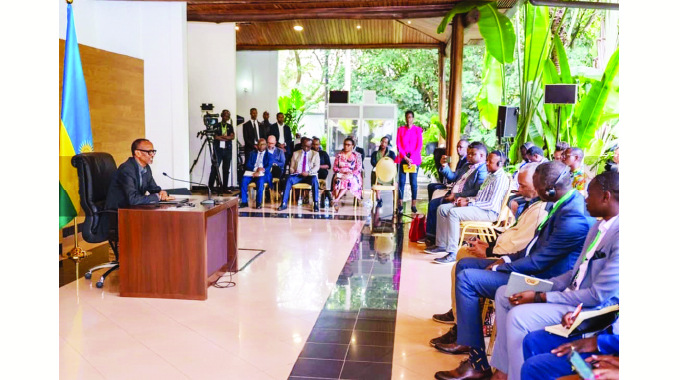
Ranga Mataire
Group Political Editor
On March 1, 2023, Rwandan President, Paul Kagame (PK), convened a press conference for African journalists who had just attended the Umushyikirano (a national dialogue platform for citizens). Journalists from Zimbabwe, Ghana, Tanzania, Mozambique, Zambia, Congo Brazzaville, Uganda, Cameroon and Kenya attended the media briefing. Among the journalists was the Zimpapers Group Political Editor, Ranga Mataire. The following is an abridged version of President Kagame’s interaction with the journalists.
Question: Thank you for inviting me to Umushyikirano. It was my first time attending such an event and I must say I was impressed with what I witnessed there. However, I am quite disturbed that although the African media took the event as an important initiative, the Western media kind of downplayed it. Can you comment on why the Western media continues to downplay home-grown initiatives meant to bring citizens together?
President Kagame: Well, thank you, but that has history and context. It is something that has not happened overnight that different countries including Rwanda get some narratives formed about us not so much to encourage us to do better, but to depict the situation as bad forever and even worse with time.
Sometimes it is deliberate; like I said it has context as to why the West is supposed to determine everything that happens in Africa. They (West) are supposed to decide for the people how they should be defined and what we should be doing.
There is this prejudice, I do not understand the rationale of it, maybe it is a tool of control to avoid people encroaching on your status. The West is up there, according to them nobody should really be approaching that position. We should stay where they want people to be so that they can easily control the people, the resources and determine their future.
You have heard so much about the global order. So global order is really about that, it is defined by the people and among other things it is one of those things that determine the global order.
But with time and certain realities, people challenge that notion that some parts of the world must control the whole world without question. Other big powers challenge that in a big way and small ones have their way of challenging that, especially trying to depart from being defined by others.
So with the Umushyikirano, we do it not to impress anyone. We think it will improve us, whether politically, economically and socially. It is something that improves society.
People having these political innovations and allowing ideas to flow or to be challenged but ultimately coming up with something that works for people. That should not be a bad thing in any way in my view.
It helps make you who you want to be instead of following the dictates of other people, you would rather follow where your heart and mind is taking you. This is something we have lived with, we know and we have faced a lot of challenges but we stay the course and do what we think is important and is good for us.
You then keep fighting these battles. So that Umushyikirano you were talking about and as you saw the people there, the young, the old from different backgrounds really constitute a very significant sample of the representation of our society. Why not sit together and talk about what we need to do that can improve our lives irrespective of who likes it or does not like it.
Question: Your Excellency, we have toured the Norrsken Tech-Hub, which is referred to as the Silicon Valley of Africa where young people are making amazing inventions. However, it appears a lot of what they are creating end up getting repatriated to European countries. What can be done to gate keep their innovations?
Pres. Kagame: Innovations must be free to be appropriated anywhere in the world. What makes it strange is that it goes to only one destination and that speaks to the private sector and the development of that and the whole ecosystem that should be observing that.
The task for us as leaders is to allow development here to accommodate all such inputs. Simple things like coffee, maybe it has value to some extent and then more value is added back and comes back and we drink that coffee.
We consume the coffee, but we do not need to stop anybody who needs it elsewhere.
We keep talking so much about what we can do, but we end up doing halfway and it benefits other people. We need to break this cycle, just like you have talked about, more importantly the leaders know what needs to be done.
Since Norrsken is here, that means that we are part of that mess. At least Rwanda must play its part. I am not going to stop anything going somewhere, but why should it go to one place? It is a structural problem we need to address.
Question: Are you considering retirement from politics? Are you standing as a presidential candidate in next year’s elections?
Pres. Kagame: It is not a big challenge for me, with time I will be preparing to go home and have some rest. As for what happens next year for elections, I am not so worried. It is not really one of the things that takes my time.
Right now I take my time, about what is happening in the Congo. Even though I am thinking of Ukraine, my mind is more on Congo, the neighbourhood.
Question: The impact of the conflict in Ukraine and the response of the AU and what it could have done differently? A lot of resources are being consumed and even the finances are being channelled to Ukraine. What is your response to the AU’s capacity to respond as a result of this conflict including tackling issues of food security and debt?
Pres. Kagame: The Ukraine situation has turned things more or less upside-down. There are so many things going wrong. What is happening has a lot of dimensions, it has changed things, Ukraine problem following the Covid-19 pandemic, it has changed people’s lives as we know it. To be honest, Africa and the African Union need to think about this seriously. We need to deal with many things relating to that situation.
Two things: One is that Africa is marginalised. It has no say at all in what happens to that part of the world. It is the big players – Russia, China, Ukraine and the US. Africa is just there. I do not know how we can reform that.
We are probably going to be hit hardest. It is already hard enough. Directly, with partners that we have been dealing with in a certain way and now that their minds are no longer with you – their minds are now focusing on that situation that you are talking about.
Question: One thing that has come out in your meetings is the fact that we have mercenaries in Rwanda. Everybody knows the limitations of Rwanda, but then you go to the Central Republic and then Mozambique. What is the interest there?
Pres. Kagame: I could have been in the Congo if the Congolese wanted me to be there. We even tried, but the Congolese did not want us. It is as if they see Rwanda as a source of a problem to the DRC. We have sought to work with the Congo for a long time so that we eliminate these problems. But they have refused.
But for Mozambique and the Central African Republic, by African standards, Rwanda has built a decent capacity and understanding to solve with others some of these challenges. We faced them as Rwanda and other countries face similar problems on the continent. There is a link to the problems in another part of Africa.
We faced so much of these challenges that inevitably we had to invest in our capacities. We do not have too much of anything, we just have decent capacity to address our problems, but working with others to increase capacity to address these problems.
Under the bilateral arrangement with a bilateral partner, we decide what to do and that is what we do. There are things we cannot do under the UN in the Central African Republic.
In the Central African Republic, they realised that the government was not being effective and that is why they asked for our help. It is on Rwanda’s costs.
In Mozambique, we still were asked by the Government – the rebels had taken over Cabo Delgado, that province is three times the size of Rwanda. Sometimes even if you were to use these systems like the UN and AU – it (the help) may come after two years. You can imagine someone in intensive care and you need urgent care.
What we did was (we reasoned) that if the house is on fire, it is on fire and then with time maybe some people will realise that it costs us so much and this is the way we approached it. As you may have seen already with the European Union, they are in the final stages of helping Mozambique. They are helping Mozambique, not Rwanda.
Some people are now trying to bring issues in Eastern Africa by saying do not give them money because they are causing problems in Congo. But by doing that you are punishing Mozambique. What wrong has Mozambique done?
If you are giving up on Mozambique, we have used entirely our resources, from the treasury. It is painful, it is costly, it means there are certain things we can do for ourselves. One way or the other, we were going to spend these resources or we are going to recover them at some stage.
Question: Your country suffers a contradiction of being praised and acknowledged highly in terms of economic development, but ranks low on human rights.
Pres. Kagame: How do you separate the two? On one hand you are able to provide food, security, shelter, to the people. There are already humans we are dealing with. When you are holding resources for the people, if you steal it and you do nothing for them, the courts will take care of them. Because of that we have produced so many people who are disgruntled.
So in other words, there is a narrative that says things are moving so well for people but then there is something lacking in them about their human rights. I just do not understand. Even when things do not add up. What is clear is that people who have gone after committing crimes here, including those who have killed people here, play a political card, saying they are being persecuted. This person is waiting for prosecution.
We have a case of five people who left the country after committing genocide, the victims are here. These guys are protected in the UK and started talking about ‘this is a Tutsi’ government that is telling people to shut up. They first said they could not send the people because they are not sure about our courts and judiciary. We then said let us give you the files and you trial them in your courts.
Surely, you cannot say there is a whole list of things we are doing right but . . . how do you add this up? Are there things going wrong here, of course yes. This is where the problem is. Sometimes, you are supposed to believe what they are saying about me, you are not even supposed to protest. You are talking about freedom, but you do not allow me to respond and say what you are saying is not true. You do not want me to explain my case, but you turn around to say Rwanda does not like criticism.
I am glad you actually raised this question, it has been there for many years because when you hear some people talk about Rwanda, you would think it is the worst country to live in, but on the other hand you are telling a good story about Rwanda. How do you say, on this side so much is wrong but on the other side there are good things?
Question: Ghana is looking for assistance from Bretton Woods institutions, which is proving difficult. What can we do as Africans to ensure self-sufficiency?
Pres. Kagame: We have not succeeded in everything we have tried to do for ourselves. Sometimes I do not feel comfortable saying things as if it is a prescription of what others can do to solve their problems. Ghana is a great country and has huge resources – human and other resources. I am sure Ghana is capable of doing many things for themselves. As a continent, we have tried to create the African Continental Free Trade Area (AfCFTA) and its purpose was to aggregate our capacity, our potential so that it is proportional to the people benefiting. There are things that are more or less straightforward. We start with simple things- connection to each other. Freedom of movement, communication, trading with each other. Operationalising AfCFTA is huge and every country has a role to play and we need it to work for us.
So I think if more of that was done then we should not be seeing our countries begging and asking people to bail us. We need to do that and stop being dependent on others.
Question: What impact do you think Arsenal’s likely win of the English Premier League would have on Rwanda?
Pres. Kagame: We have had some very good partnerships; it gets better every time. We can easily tell how many people got to know Rwanda based on that or how many people visited or invested in Rwanda because of the Visit Rwanda initiative. They say Rwanda is wasting money – who told you? You want people to believe you better than us. The better we perform towards getting the ultimate prize (that will bring) more dividend, absolutely. If we become the champions, we could be rushing to the bank. We have the same arrangement with PSG – there are variations but the same. We have something coming up with another famous football team.


 Online Reporter